

- 1944. A remote farmhouse on a Scottish island called Jura. George Orwell, dying of tuberculosis, types in the freezing cold. He’s writing about a man whose hand trembles as he commits the ultimate crime: thinking differently. The novel takes four years. Orwell dies six months after publication, never seeing his warning become prophecy.
- 2017. “Alternative facts,” a White House spokesperson says on live television. Within four days, 1984 sales explode 1500%. The book has been banned in Soviet states, gotten readers imprisoned, and keeps surging during every political crisis for 77 years. Why?
Because Orwell didn’t write political fiction. He wrote psychological horror.
Winston Smith doesn’t just fight Big Brother—he gets broken until he genuinely loves his torturer. Not pretending. Not surviving. Genuinely transformed. The government doesn’t just watch through telescreens. They control language itself (Newspeak), force contradictory beliefs (doublethink), and rewrite history daily until you can’t trust your own memory.
And in 2026, we’re living it—just not how Orwell imagined. He feared government forcing telescreens on us. We bought ours voluntarily. He feared information scarcity. We got information drowning. He feared obvious tyranny. We got algorithmic nudges so subtle you think your thoughts are your own.
The book’s most terrifying scene happens in Room 101, where they use your worst fear against you until you break. But here’s the real horror: you don’t need Room 101 when algorithms already know your fears, your desires, your vulnerabilities—and use them to sell you things, shape your politics, and predict your behavior.
Orwell’s dying warning wasn’t about Big Brother watching. It was about minds being controlled until victims don’t realize they’re victims. In 1948, that was dystopian fiction. In 2026, it’s your smartphone’s terms of service.
The Hand That Trembles Writing Thoughtcrime
April 4th, 1984. Winston Smith sits in the alcove of his flat—the one corner where the telescreen can’t see. His hand trembles. He opens a diary. Blank pages stare back.
He knows what comes next. Writing your thoughts down is thoughtcrime. Thoughtcrime doesn’t entail death—it IS death. Eventually. After they’ve finished with you in the Ministry of Love.
His hand moves anyway. The pen scratches across paper. Large, clumsy letters at first. Then faster. More certain.
“DOWN WITH BIG BROTHER.”
Four words. That’s all it takes to become an unperson—someone who will be vaporized, erased from photographs, deleted from records, removed from memory itself. Four words, and Winston Smith has committed suicide.
But here’s what you need to understand: in Oceania, thinking those words is just as criminal as writing them. The Thought Police don’t need evidence. They can see it in your face. A flicker of rebellion. A moment of doubt. A dream where Big Brother isn’t sacred.
Your face betrays you. So does your sleep. So does your heartbeat when you pass a poster of Big Brother. They’ve perfected surveillance to the point where your body is a confession booth you can’t escape.
Sound paranoid? In 2026, your smartphone measures your heart rate. Your smart speaker listens for keywords. Your car knows everywhere you go. Your TV watches your viewing habits. Your social media analyzes your typing patterns, pause lengths, and deleted drafts. The difference between Winston and you? He knew he was being watched. Do you?
Welcome to Airstrip One: Where Truth Dies Daily
London doesn’t exist anymore. It’s Airstrip One now—the third most populous province of Oceania, one of three superstates that have divided the world.
Winston sits at his desk in the Ministry of Truth, staring at today’s assignment. Yesterday’s Times reported chocolate ration at 30 grams. Today’s announcement: reduction to 20 grams. His job? Make the archives say it was always 15 grams. Transform a cut into a gift.
His fingers work the speakwrite. “Times 14.2.84 reporting bb dayorder doubleplusungood refs unpersons rewrite fullwise upsub antefiling.” The old article disappears down the memory hole—literally a hole in the wall leading to furnaces. In an hour, the only evidence will show chocolate was always 15 grams. The announcement of “increasing” to 20 grams becomes Party generosity.
Winston drops the revised article in the pneumatic tube. Another lie enters the permanent record. Another piece of the past erased.
He takes a sip of Victory Gin. It burns down his throat like acid, leaves a medicinal aftertaste. Everything in Oceania tastes synthetic—the coffee isn’t coffee, the chocolate isn’t chocolate, even the gin barely qualifies. But you drink it because there’s nothing else.
The city outside his window is decaying. Buildings crumble. Elevators don’t work. The electricity cuts out for hours during “Hate Week.” Food comes in tins labeled VICTORY with no indication of what’s inside. Everything is grey—the sky, the buildings, the clothes. Even hope feels grey in Airstrip One.
The Ministry names aren’t ironic—they’re deliberate doublethink. The Ministry of Truth creates lies. The Ministry of Peace conducts perpetual war. The Ministry of Love handles torture. The Ministry of Plenty manages starvation. Teaching citizens that words mean their opposite.
The proles—85% of Oceania’s population—live in their own neighborhoods, drinking gin, gambling, caring only about survival. The Party doesn’t worry about them. “Proles and animals are free,” goes the saying. When you’re busy with hunger and cheap entertainment, you don’t have energy for rebellion.
The real control focuses on Party members. Outer Party members like Winston: monitored constantly, rationed strictly, worked exhaustively. Inner Party members: the elite who live in luxury while managing the surveillance state.
And above everyone, on every wall, on every coin, on every telescreen: Big Brother’s face. Black-haired, black-mustachioed, eyes that follow you. Under his gaze, three slogans appear on the Ministry of Truth’s pyramid:
WAR IS PEACE
FREEDOM IS SLAVERY
IGNORANCE IS STRENGTH
These aren’t propaganda. They’re philosophy. In Oceania, you don’t just obey Big Brother. You believe. Genuinely. Until your thoughts align perfectly with Party doctrine.
In 2026, we don’t have Ministry buildings. We have platforms. Twitter’s Community Notes “correct” your posts in real-time. Wikipedia editors rewrite controversial pages within hours of events. Google’s algorithm decides which version of history you see first. News sites stealth-edit articles, changing headlines and content without marking corrections. The Ministry of Truth is decentralized now—harder to see, harder to resist, running on servers you’ll never locate.
Big Brother Is Watching (And So Is Your Phone)
Winston knew the telescreens watched his Ministry work. He’d learned to keep his face blank, his thoughts hidden during the rewrites. But the watching didn’t stop when he left the building. Everywhere he went, the surveillance continued.
He catches himself doing it again. Smoothing his expression. Making his face blank before passing a telescreen. It’s become automatic—the moment of self-censorship before speaking, the suppression of natural reactions, the constant awareness that someone might be watching.
The telescreen in Winston’s flat never turns off. It dims but stays active. At any moment, the Thought Police could be watching through it. They probably aren’t—there aren’t enough of them to watch everyone constantly. But you never know when they’re watching.
That’s the genius of the system. You police yourself because you might be monitored. Your behavior changes not because you’re being watched, but because you could be.
Mrs. Parsons lives next door, and Winston can hear her children through the wall. They’re playing “Spies and Traitors” again—following strangers, reporting suspicious behavior. She lives in terror of them. They’re seven and nine, fanatic Party loyalists who’ve already turned in three neighbors.
“They wanted to see the hanging in the park,” she tells Winston apologetically when he helps fix her sink. Her voice drops to a whisper even in her own flat. “I couldn’t take them. They were so angry with me.”
Winston knows what she’s not saying: one day they’ll report her. Most parents get reported eventually. The children are trained from age seven to spy, to listen, to betray. It’s their greatest pride.
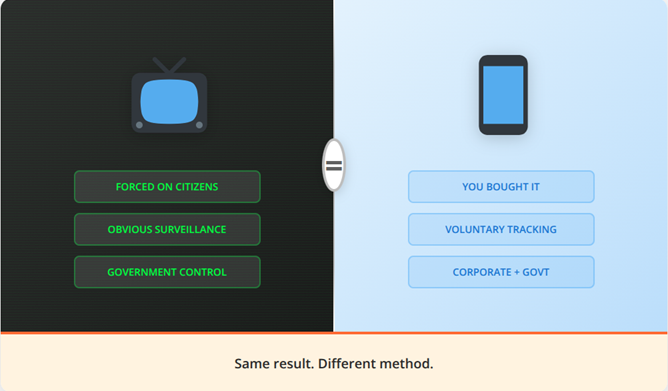
The telescreen watches and listens. It barks commands: “6079 Smith W! Yes, you! Stand up straighter! Bend lower during Physical Jerks!” The voice comes from the wall at 6:30 every morning for mandatory exercise. No one is exempt.
In the streets, helicopters hover between buildings, peering into windows. Microphones hide in trees. Winston walks carefully, aware that every step could be monitored, every word overheard.
The Thought Police move in the night. You hear boots on stairs. Doors bursting open. Screams cut short. By morning, that person has been vaporized—erased from existence. Their name removed from records. Their photos destroyed. Their existence denied. You were never their friend. They never existed.
Winston knows his own vaporization is coming. Writing in the diary sealed it. But here’s what keeps him awake: Will he give them what they want first? Will he confess to crimes he didn’t commit? Will he implicate innocent people? Will he betray everything he believes before they kill him?
He doesn’t know yet that death would be merciful. What they have planned is worse.
In 2026, Orwell got surveillance wrong in an interesting way. He imagined governments forcing telescreens on citizens. Instead, we bought smartphones. We pay monthly fees to carry devices that track our location 24/7, record our conversations (hey Siri, hey Alexa), photograph our faces for “security,” and analyze every click, pause, and scroll.
Your phone knows you’re pregnant before you tell your family—targeted ads appear for maternity clothes after you search symptoms. Your smart TV watches what you watch, adjusts recommendations, sells viewing data. Your car reports driving habits to insurance companies. Your social media analyzes posts for keywords that might indicate depression, radicalization, or dissent.
And just like Winston, you’ve learned to self-censor. You pause before posting. Delete drafts. Soften language. Avoid certain topics. The algorithm doesn’t need to actively monitor you—you’ve internalized the surveillance, changing behavior because you know you’re being tracked.
That’s scarier than Big Brother. At least Winston knew he was being watched.
The Man Who Remembers When Chocolate Was Chocolate
Winston is 39 years old. His ulcer bothers him. His ankle swells. He lives on Victory Gin and synthetic food. But his real problem isn’t physical—it’s memory.
He remembers chocolate tasting different. Richer. Real. He remembers London before it became Airstrip One. He remembers his mother, though she disappeared when he was young. He remembers a time before the Party.
Or does he?
That’s the torture of living in Oceania. The Party controls all records. If every document says chocolate has always tasted like this, and everyone else believes it, and you’re the only one who remembers differently—are you right or insane?
“Who controls the past,” runs the Party slogan, “controls the future: who controls the present controls the past.”
It works like this: The Party announces the chocolate ration has been increased from 30 grams to 20 grams. Everyone knows it was 30 grams last week. But within hours, every record will say it was always 15 grams. By tomorrow, newspaper archives, radio broadcasts, meeting minutes—all of them will show 15 grams.
The announcement of “increasing” to 20 grams becomes an act of Party generosity. People will genuinely believe they’re getting more chocolate. The past—verifiable, documented, remembered—gets erased.
Winston’s job at the Ministry of Truth is performing these erasures. A person gets vaporized? Winston removes them from every photograph, every article, every record. Someone who was important yesterday becomes a person who never existed.
Sometimes the revisions are massive. The Party declares Oceania has always been at war with Eastasia. Last week, they were allies and Eurasia was the enemy. Doesn’t matter. Winston spends weeks rewriting every reference, changing “Eurasia” to “Eastasia” in every document. The war with Eurasia never happened. We’ve always been at war with Eastasia.
People accept this. They have to. Because to question it—to say “Wait, wasn’t it different yesterday?”—is thoughtcrime.
Winston keeps a secret record in his mind. He knows the ration was cut, not increased. He knows the enemy switched. He knows Big Brother’s promises from five years ago contradict today’s reality. But he’s alone with this knowledge. And loneliness makes you doubt your sanity.
What if everyone else is right and you’re wrong? What if your memory is broken? What if the Party’s version is true and you’re delusional?
That’s how they break you before they touch you. Make you doubt your own mind.
In 2026, we call it “memory-holing”—when tweets get deleted, articles get stealth-edited, Wikipedia pages get rewritten overnight. Politicians deny saying things that are on video. News outlets correct stories quietly. Social media platforms ban certain topics, making them unsearchable.
The difference is subtle. Orwell showed obvious erasure. We get plausible deniability. “That never happened.” “You’re misremembering.” “Show me the proof.” And when you try to find the proof, it’s been deleted, corrected, or buried under algorithmic results showing the “accurate” version.
Who controls the search results controls the past. Who controls the past controls what you believe about the present. Who controls what you believe about the present controls what you’ll accept in the future.
Winston knows this. He writes in his diary knowing it won’t matter—the diary will be destroyed when they arrest him. But he writes anyway, because maintaining his own memory is the last rebellion available to him.
He doesn’t know yet that even this will be taken away.
I Love You: Three Words That Could Get You Killed
The girl from the Fiction Department walks past Winston in the corridor. Dark-haired, about 27, wearing the scarlet sash of the Junior Anti-Sex League. He’s seen her before. She scares him—too enthusiastic during the Two Minutes Hate, too eager, probably Thought Police.
Then she trips. Falls near him.
Winston helps her up. She presses something into his hand. A small scrap of paper, folded tight.
He doesn’t read it until he’s back at his desk, heart hammering. His fingers shake unfolding it.
Three words in clear handwriting: “I love you.”
Everything in Winston’s world says this is a trap. The Thought Police use this technique—fake romance to expose thoughtcriminals. But something in how she fell, how she looked at him for just a fraction of a second, feels real.
He burns the note immediately. Watches it curl and blacken. But the words stay burned into his memory.
Love is rebellion in Oceania. The Party knows that loyalty split between a person and Big Brother is loyalty weakened. They want all passion, all energy, all devotion directed upward to the Party. That’s why the Junior Anti-Sex League exists—to channel sexual energy into worship of Big Brother.
Marriage is permitted, but only for procreation. Party members need permission to marry. They investigate you first. If you seem too attracted to each other, application denied. Love is thoughtcrime. Desire is thoughtcrime. Pleasure itself becomes thoughtcrime.
The Party’s goal? Make sex a duty, joyless and brief, performed only to create new Party members. Kill eroticism. Kill passion. Kill any connection that might compete with love for Big Brother.
Winston spends days planning how to meet her. Can’t speak in the building—telescreens everywhere. Can’t be seen together. Finally, she passes him in the street, whispers a time and place. Victory Square. Lunch hour. Stand near the monument.
They meet surrounded by thousands. She gives him directions in fragments, never looking at him directly. A specific path through the countryside. Sunday. 2:30. Alone.
In 2026, your “private” messages aren’t private. Instagram DMs get scanned. Zoom calls get recorded. Even Signal and Telegram, supposedly encrypted, have their vulnerabilities. The difference between Winston and you? He knows his love is illegal. You think yours is private. Meanwhile, dating apps sell your data, your phone tracks who you meet, and algorithms predict relationship outcomes before you do.
The Golden Country: When They Could Still Feel
Winston finds the spot. Trees. Actual trees, not the dead stumps near London. Bluebells carpeting the ground. A clearing that matches his recurring dream—the place he calls the Golden Country.
Julia is already there. She’s brought real things—chocolate, real chocolate from the Inner Party, coffee, actual coffee, sugar, bread. Things Winston hasn’t tasted in years or maybe ever.
She’s 26. She’s worked in the Fiction Department for years, operating the novel-writing machines that churn out pornography for proles. She doesn’t care about politics. Doesn’t care about overthrowing the Party. She just wants to break their rules and survive.
“I’m corrupt to the bones,” she says, and she’s proud of it.
Julia’s rebellion is entirely different from Winston’s. Winston wants to understand the system, expose it, maybe change it. He thinks about posterity, about future generations, about truth with a capital T.
Julia? She wants to live. She wants pleasure. She wants real coffee and real sex and real chocolate. She doesn’t read banned books or dream about organized resistance. She follows Party rules publicly, breaks them privately, and has no guilt about the hypocrisy.
She’s had affairs with multiple Party members. She scouts locations, knows which areas have microphone coverage, understands surveillance gaps better than Winston ever could. While he worries about philosophical consistency, she’s learned which woods the patrols avoid.
Their relationship is her victory. Every moment of pleasure, every taste of real food, every intimate touch—it’s all rebellion from the waist down. The Party wants her energy? She’s using it on Winston instead.
Winston finds this both shocking and freeing. He’s been drowning in intellectual resistance, writing in diaries, trying to remember truth, exhausting himself with why and how and what it means. Julia just lives. She steals from the Party and enjoys it. She lies on her back eating chocolate and laughs.
“We’re the dead,” Winston says during one meeting, meaning they’re caught eventually.
“We’re not dead yet,” Julia answers, and kisses him.
They rent a room. Actually rent one—pay money to Mr. Charrington, the old man who runs an antique shop. The room is above his store, hidden in the prole district where surveillance is lighter. It has a bed. A window. No telescreen.
For the first time in his adult life, Winston experiences privacy. He can think his own thoughts. Say them out loud. Touch another person without fear. The room becomes his sanctuary, his golden country made real.
He doesn’t know Mr. Charrington is Thought Police. The room has a hidden telescreen. Every word, every touch, every moment of freedom—monitored, recorded, saved as evidence.
But for now, in their ignorance, they’re happy.
In 2026, couples think they’re private too. Then Instagram suggests photos from your “private” date. Then targeted ads appear for things you only discussed in person near your phone. Then the algorithm recommends wedding venues before you’ve even talked about marriage. Privacy isn’t forcefully taken—it’s casually surrendered for convenience, one app permission at a time.
The Brotherhood’s Promise (Or: How O’Brien Became God)
Winston has noticed O’Brien for years. Inner Party member. Powerful. Intelligent in a way that stands out even in the Ministry of Truth. And something in his eyes—a flicker of something that suggests he doesn’t believe either.
During the Two Minutes Hate, when everyone screams at Goldstein’s face on the screen, Winston catches O’Brien’s eye. For a second—just a second—O’Brien’s expression seems to say: “I’m with you. I understand. We’re on the same side.”
That look sustains Winston for months. Maybe years. The possibility that someone intelligent, someone powerful, secretly opposes the Party.
Then O’Brien speaks to him. Casual at first. Mentions an error in a Times article, asks Winston’s opinion. The conversation is innocent, professional. But he gives Winston his address. Says to stop by if Winston ever wants to look at the new edition of the Newspeak dictionary.
Newspeak dictionary. Everyone knows that’s code.
Winston brings Julia. They go to O’Brien’s apartment—luxury Winston didn’t know existed. Real wine. Real sugar. Servants. The telescreen turns off when O’Brien tells it to. (Inner Party privileges.)
O’Brien wastes no time. “We believe the same things,” he says. “The Brotherhood exists. Goldstein is real. We’re organizing resistance.”
Winston’s heart nearly stops. The Brotherhood—the legendary resistance network. Goldstein—the enemy of the Party, supposedly directing rebellion from wherever he hides. Real. All of it real.
O’Brien makes them pledge. Are you willing to commit murder? Yes. Terrorism? Yes. Betray innocents? Yes. Separate and never see each other again? Winston hesitates, then yes. Julia says yes immediately.
Only one thing they won’t promise: they won’t stop loving each other. That’s the one betrayal they refuse.
O’Brien accepts this. He gives them a book—Goldstein’s manifesto, The Theory and Practice of Oligarchical Collectivism. The forbidden book that explains everything. How the Party maintains power. Why perpetual war exists. The truth behind the lies.
“We shall meet again,” O’Brien says, pouring wine. “In a place where there is no darkness.”
Winston thinks he means the future, after the Party falls, in freedom. He’s wrong. O’Brien means the Ministry of Love, where the lights never turn off, where they’ll see each other again during Winston’s torture.
But Winston doesn’t know this yet. Right now, he has hope. He’s not alone. Julia loves him. O’Brien is Brotherhood. The resistance exists. Change is possible.
This is Winston’s highest point. Everything that comes next is descent.
In 2026, online resistance movements are just as vulnerable. Encrypted apps get infiltrated. Anonymous accounts get traced. Organizers turn out to be feds. The difference? Winston knew the risks and chose anyway. Your generation thinks VPNs and burner phones equal safety. Meanwhile, metadata analysis, behavior patterns, and AI prediction models make genuine anonymity nearly impossible. O’Brien doesn’t need to infiltrate your resistance group. The algorithm identifies you before you identify yourself.
The Book That Explains Everything (Almost)
Winston reads Goldstein’s book in the room above Mr. Charrington’s shop. Julia falls asleep beside him after the first few pages. He watches her for a moment—her indifference to theory, her complete lack of interest in understanding the system. She doesn’t care why it works. She just wants to break its rules and survive.
Winston envies that simplicity. But he can’t stop reading.
The Theory and Practice of Oligarchical Collectivism explains what he’s always suspected but never articulated, and each page makes him angrier.
The war is fake. The realization hits him hard. Not the fighting—that’s real enough, the bombs he hears are real. But the war itself is perpetual by design. Oceania, Eurasia, and Eastasia are roughly equal in power. None can conquer the others. The war continues because it needs to.
He thinks of the rocket bomb that destroyed a playground last week. Thirty children dead. For what? For nothing. For maintaining a system that requires endless destruction.
The book explains why: war consumes resources. The factories produce bombs instead of housing. The population stays frightened and obedient. All excess production gets destroyed in warfare instead of raising living standards. If people became comfortable, they might have time to think. Can’t have that.
The enemy switches—Eurasia to Eastasia and back—whenever convenient. Nobody remembers the switch because all records get rewritten. Winston has done these rewrites himself, destroyed the evidence with his own hands. The past becomes whatever serves the present.
The class structure is permanent. High, Middle, Low. It’s been this way throughout history. Winston feels recognition sharp as pain—he’s read this pattern in every history book before they were rewritten. Sometimes the Middle overthrows the High using the Low as muscle, then the Middle becomes High and nothing changes. The Low stay low forever. In Oceania, they’re called proles.
“If there is hope,” Winston has written, “it lies in the proles.” But the book crushes this hope. The proles will never rebel because they don’t understand they’re oppressed. Keep them drunk, gambling, buying lottery tickets, watching porn. They’re too focused on survival to organize.
Julia shifts in her sleep. Still uninterested. Still free in a way Winston will never be—she doesn’t need to understand the boot crushing her face to know she should avoid it.
Winston reads on, feeling something close to despair. The Party’s goal isn’t economic. It’s power for power’s sake. They don’t want to build utopia or improve lives. They want absolute dominance—over bodies, over minds, over reality itself.
He’ll learn this lesson again in the Ministry of Love, when O’Brien makes it explicit: “The object of power is power. The object of torture is torture.”
But right now, reading in his rented room, Winston still believes this knowledge matters. Still believes understanding the system gives him some kind of advantage.
He’s wrong.
In 2026, perpetual war continues—the War on Terror never ends, just shifts targets. Afghanistan, Iraq, Syria, Yemen, the list grows. Resources pour into military contracts while infrastructure crumbles. The rich get richer not through conspiracy but through system design. The wealth gap widens while everyone argues about culture war issues that don’t threaten power structures—bathroom laws, pronoun usage, which cartoon character is too sexy. The High stay high. The Low stay low. The Middle manage the system and pretend they might join the High someday.
Different methods. Same outcome.
Doublethink & Newspeak: The Weapons You’re Already Using
Winston’s friend Syme works on the Newspeak dictionary. He’s a language specialist, enthusiastic about his work destroying words.
“It’s a beautiful thing, the destruction of words,” Syme says during lunch. He’s talking about the Eleventh Edition of the Newspeak Dictionary—the final edition, he says, where the language will be perfected.
What does “perfected” mean? Stripped down. Reduced. Constrained until only one meaning exists for each word, and that meaning serves the Party.
Take the word “free.” In Oldspeak (regular English), “free” has multiple meanings: political freedom, free time, free from disease. Dangerous meanings that suggest alternatives to Party control.
In Newspeak? “Free” only means “free from”—as in “the dog is free from lice.” Freedom as a political concept won’t exist because the word for it won’t exist. You can’t think about freedom if your language has no word for the concept.
“Bad” becomes “ungood.” Very bad? “Doubleplusungood.” The vocabulary shrinks. The range of thought shrinks with it.
Every year they remove words. Eliminate synonyms. Destroy nuance. By 2050, Syme explains proudly, the entire corpus of Oldspeak literature—Shakespeare, Milton, Byron, everything—will be incomprehensible or require lengthy explanations. Eventually, thoughtcrime will be literally impossible because the words to think it won’t exist.
(Syme disappears shortly after this conversation. Too intelligent. Too enthusiastic. Even working on the right side, he understood too much. Vaporized.)
But Newspeak is only half the weapon. The other half is doublethink.
Doublethink means holding two contradictory beliefs simultaneously and accepting both. Not cognitive dissonance—something beyond that. Genuinely believing opposite things at the same time.
The Party slogans demonstrate this:
WAR IS PEACE
FREEDOM IS SLAVERY
IGNORANCE IS STRENGTH
These aren’t ironic. Party members believe them. The Ministry of Truth creates lies—and Party members know this—yet they also believe the lies are truth. Both. At once.
Winston’s job is rewriting history. He knows he’s falsifying records. But he also believes the corrected versions are true. He has to believe both to function.
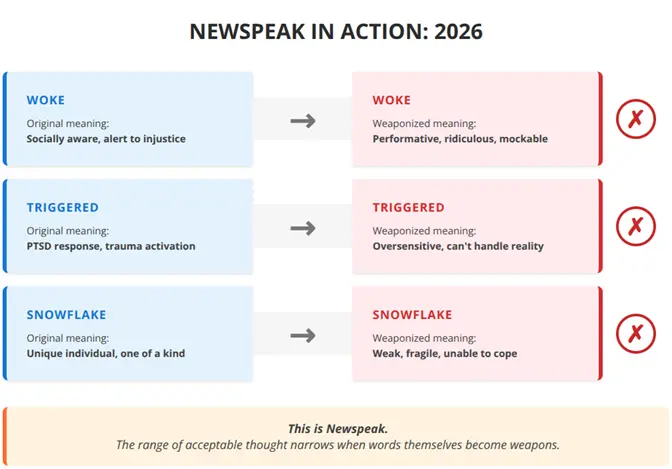
Here’s the test for 2026: Try to express a political opinion without using words that have been weaponized.
Try to discuss social justice without “woke” (now means “performative” and “ridiculous”).
Try to discuss mental health without “triggered” (now means “oversensitive”).
Try to discuss generational differences without “snowflake” (now means “weak”).
These words had meanings. Then one side redefined them to mock the concepts themselves. Now you can’t use the words without the baggage. The concepts become harder to discuss. The range of acceptable thought narrows.
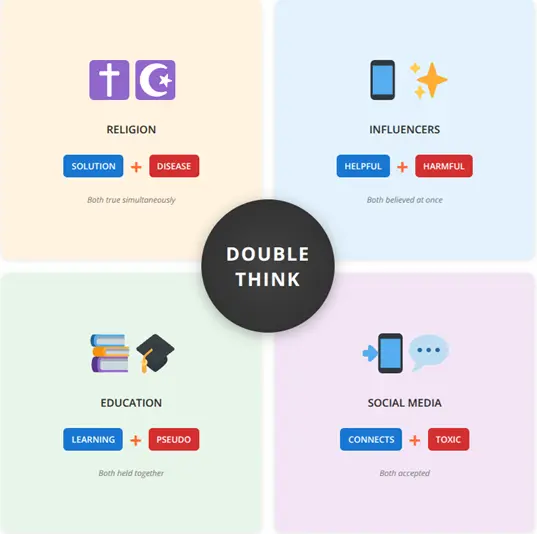
Or try this: Think about religion in 2026. Is it:
- A solution to life’s problems? (Yes, provides meaning)
- A disease causing problems? (Yes, causes division)
Both. You hold both beliefs depending on context. That’s doublethink.
Influencers: Are they helpful (providing valuable content) or harmful (promoting unrealistic standards)? Both. Simultaneously. You switch between beliefs without noticing the contradiction.
Education versus motivational content: Is that course teaching you something real or selling you false hope? You watch it believing it’s educational while knowing it’s probably pseudo-content. Both beliefs. Same time. Doublethink.
Your algorithm shows you war footage next to peaceful meditation content next to rage-bait next to self-care tips. You hold contradictory worldviews simultaneously depending on which video you just watched. That’s doublethink.
The Party’s genius wasn’t forcing doublethink on citizens. It was making doublethink necessary for psychological survival in a reality that constantly contradicts itself.
In 2026, you do this every day. You know social media is toxic—you believe this—yet you also believe it connects you to friends. Both true. Both false. You hold both.
You know your data is being harvested—you believe this—yet you also believe you have privacy. Both. Simultaneously. Doublethink.
The difference between Winston and you? He knows he’s doing it. Do you?
The Room Above the Shop Where Hope Died
Winston is reading Goldstein’s book when it happens.
A voice from behind the picture on the wall. A voice he knows but can’t place.
“You are the dead,” the voice says.
Julia screams. Winston freezes. The picture—that pastoral painting they loved—slides aside. Behind it: a telescreen. The telescreen they thought didn’t exist in this room.
“Remain exactly where you are,” the voice commands. “Make no movement until you are ordered.”
The door crashes open. Black-uniformed men flood in. They grab Julia, smash the glass paperweight Winston bought from Mr. Charrington. The fragment of coral inside—that beautiful, useless thing from the past—scatters across the floor.
Someone kicks Winston in the kidneys. He collapses. They haul him up, pin his arms.
Then Mr. Charrington appears in the doorway. Except he’s not Mr. Charrington anymore. He’s younger. The wrinkles were makeup. The accent was fake. He’s wearing a black uniform.
“And by the way,” he says in a crisp, educated voice, completely different from his shopkeeper drawl, “I wouldn’t recommend trying to speak. The room is protected.”
He was Thought Police all along. The room was never safe. Every moment, every word, every intimate touch—monitored, recorded, saved as evidence.
The last thing Winston sees before they separate him from Julia: her face, white with terror, as they drag her away. She’s screaming his name.
He never sees her again. Not like this. Not as the person she was.
They take him to the Ministry of Love. No windows. Bright lights. Cells packed with prisoners—some beaten, some waiting, all terrified. He sits there for hours. Days. Maybe weeks. He loses track of time.
Then O’Brien walks in.
Winston’s heart leaps. O’Brien, from the Brotherhood. He’s been captured too. They’re both prisoners now.
But O’Brien’s uniform is clean. Pressed. He’s not a prisoner.
“They got you too!” Winston says.
O’Brien smiles. It’s not a kind smile.
“They got me long ago,” he says.
And Winston understands. O’Brien was never Brotherhood. The Brotherhood doesn’t exist—or if it does, O’Brien isn’t part of it. O’Brien is Inner Party. O’Brien is his interrogator. O’Brien wrote Goldstein’s book—the Party wrote it—as bait to identify dissidents.
Everything was theater. Every moment of hope was choreographed. They knew about Julia from the beginning. They knew about the room. They let it continue because watching the rebellion was more valuable than stopping it early.
“We shall meet in a place where there is no darkness,” O’Brien had said. Winston thought he meant freedom. O’Brien meant here—the Ministry of Love, where the lights never turn off.
Winston realizes: he has been betrayed not just by O’Brien, but by his own hope. Hope was the trap. He fell into it willingly.
In 2026, the principle remains. Online resistance movements get infiltrated. Encrypted apps have backdoors. The moderator encouraging revolution? Sometimes they’re FBI. The anonymous forum where you feel safe expressing dangerous ideas? Monitored. The VPN you trust? Probably logging data.
But here’s what’s more insidious: you don’t need infiltration when the algorithm predicts dissent before you act on it. Your search history, viewing patterns, pause lengths, typing rhythms—they paint a picture of your thoughts. You’re identified before you’ve done anything. The trap isn’t set for you. You’re already in it.
Room 101: Where Your Worst Fear Waits
The torture starts with beatings. Simple, brutal physical pain. They break bones, pull teeth, deprive him of sleep. But this is just the beginning. O’Brien explains that they don’t want obedience. They want genuine belief.
“We don’t destroy heretics,” O’Brien says. “We convert them. We capture the inner mind.”
They make Winston confess to crimes he didn’t commit. Fine. He’ll confess. He’ll say anything to make the pain stop.
Not good enough. O’Brien wants real confession. Genuine belief in the lies.
“How many fingers am I holding up, Winston?”
Four fingers. O’Brien holds up four fingers.
“Five,” O’Brien says.
Winston says four. The pain increases. Electrical current through his body. Blinding, overwhelming pain.
“How many, Winston?”
He screams “Five!” to make it stop. O’Brien knows he’s lying. The pain continues.
Eventually—after weeks, maybe months—Winston genuinely sees five fingers. Not pretending. Not saying it to stop pain. He looks at four fingers and perceives five. His mind breaks and reforms around the Party’s reality.
O’Brien is patient. Cruel but patient. He doesn’t want Winston dead. He wants Winston remade.
“We shall squeeze you empty,” O’Brien tells him, “and then we shall fill you with ourselves.”
They argue about reality. Winston insists that two plus two equals four. O’Brien says sometimes it equals five. Sometimes three. Sometimes all of them simultaneously. Whatever the Party says is true becomes true.
The past isn’t fixed, O’Brien explains. It exists only in records and memories. Control the records, control the memories, and the past becomes whatever you say it was. Reality exists only in the human mind—and since the Party controls all minds, the Party controls reality.
Winston resists. Even through torture, through starvation, through degradation, he holds onto one truth: he loves Julia. They can’t take that. His love is his. Private. Real. Unbreakable.
O’Brien knows this. He’s been saving it.
Room 101.
They take Winston to Room 101. “The thing that is in Room 101,” O’Brien has told him, “is the worst thing in the world.”
The worst thing is different for everyone. Room 101 contains your specific nightmare. The thing you fear more than death. More than pain. The thing that breaks you.
For Winston: rats.
A cage. Wire mesh formed into a mask. Inside: two enormous rats, starving, frenzied. They strap it to his face. A door in the mask can open. When it does, the rats will eat through his face. Through his eyes. Through his mouth. Into his brain.
O’Brien’s hand hovers over the lever.
“It was a common punishment in Imperial China,” O’Brien says conversationally. “The rats bore into you. The pain is unimaginable. You’re conscious for most of it.”
Winston screams. Begs. Pleads. He’ll confess anything. Betray anyone.
Not enough.
The cage comes closer. He can see the rats’ teeth. Smell them. One rat’s nose touches the mesh inches from his face.
Something breaks inside Winston. The final piece. The last thread of humanity.
“Do it to Julia!” he screams. “Not me! Julia! Do it to Julia! Tear her face off! Not me! Julia! Not me!”
And he means it. Genuinely, desperately means it. In that moment, he doesn’t love Julia. He hates her for existing as the alternative to his suffering. He wants her to suffer instead. He wants her face eaten instead of his.
That’s the breaking point. Not physical pain. The moment when you betray the last thing you said you’d never betray.
The cage withdraws. O’Brien smiles.
They’ve won.
In 2026, Room 101 isn’t necessary. Your worst fears are already cataloged—in your search history, your social media anxiety, your late-night doom scrolling. The algorithm knows what terrifies you and uses it to keep you engaged. Not to torture you. Just to sell you things. To shape your behavior. To keep you scrolling.
You’re not screaming “Do it to Julia.” You’re clicking “Agree to Terms and Conditions” and handing over your psychological vulnerabilities voluntarily. The cage is already on your face. You just can’t see it because the rats are made of data.
The Man Who Used to Be Winston Smith
They release him. He’s not dead. He’s not imprisoned. He’s free.
Except freedom means nothing when you’re empty.
Winston sits in the Chestnut Tree Café. The same café where vaporized traitors used to sit before their final arrest. Now he’s one of them—a ghost waiting for deletion.
He drinks Victory Gin. It doesn’t burn anymore. He barely tastes it.
His job at the Ministry of Truth? They gave him a better one. Easier. Higher pay. Rewards for the reformed. He works when he feels like it. Nobody watches him closely. He’s been fixed. No need for surveillance anymore.
The chess board sits in front of him. He plays against himself. White always wins because he makes white win. There’s no strategy. No challenge. Just moving pieces to predetermined conclusions.
He doesn’t hate Big Brother anymore. That hatred has been surgically removed. Not suppressed—gone. The desire to resist, to rebel, to question—all of it burned out, root and branch.
This isn’t defeat. Defeat implies you’re still fighting but losing. Winston isn’t fighting. He doesn’t want to fight. That want has been extracted from his brain.
The telescreen plays news of victories. Oceania is winning the war. Has always been winning. Will always be winning. Winston believes this. Genuinely. When the news contradicts yesterday’s news, he doesn’t notice. When it contradicts itself within the same broadcast, he feels nothing.
His mind has been emptied. Now it’s filled with exactly what the Party wants there.
In 2026, you don’t need Ministry of Love to achieve this. The algorithm does it softer, slower, more completely. It doesn’t break you through torture. It shapes you through nudges. Each video recommended, each post boosted, each search result ordered—slowly sculpting your thoughts until you believe the patterns are yours. You think you’re choosing your opinions. You think you’re thinking your thoughts. The cage is invisible. That’s why it works.
When Julia Walked By and He Felt Nothing
Winston sees her in the park. Julia. Just walking. She sees him too.
They sit on a bench. Cold March day. Neither speaks at first.
She’s gained weight. Her face is fuller, harder. The vitality gone. The rebellion burned out of her too.
“I betrayed you,” she says finally. Flat voice. No emotion.
“I betrayed you,” Winston responds. Same flatness.
She explains: Room 101. Whatever her worst fear was—she won’t say—they used it. She screamed for them to do it to Winston. Just like he screamed for them to do it to her.
They both broke. Both betrayed. Both stopped loving.
“Sometimes,” she says, “they threaten you with something you can’t stand up to. You think there’s no alternative. You want it to happen to the other person instead.”
Winston nods. He understands. Doesn’t judge. Doesn’t care enough to judge.
“After that,” Julia continues, “you don’t feel the same about the other person.”
“No,” Winston agrees. “You don’t feel the same.”
They sit in silence. Once, Winston loved this woman enough to risk death. Once, Julia loved him enough to break Party rules. Now they’re strangers who shared a past that no longer matters.
She stands to leave. No goodbye. No regret. No lingering glance.
Winston watches her walk away. Feels nothing. Love isn’t suppressed. It’s dead. The Party didn’t forbid it. They erased the capacity for it.
In 2026, relationships die differently. No Room 101 required. The algorithm surfaces old posts at worst times. Creates suspicion through targeted ads. Recommends content that drives wedges. You stop trusting your partner because their feed shows opinions you never knew they had. You disconnect not through torture but through designed friction. Love dies not from breaking but from slow algorithmic starvation.
The Victory: He Loved Big Brother
Winston sits in the Chestnut Tree Café. The telescreen announces tremendous victory. Oceania has won. The war is over.
Except the war isn’t over. It’s never over. But Winston believes the announcement. Tears roll down his face. Joy. Pure joy.
He looks up at the poster on the wall. Big Brother. The black mustache. The eyes that see everything.
Winston’s heart swells.
He loves Big Brother.
Not pretending. Not acting to survive. Genuinely, completely, overwhelmingly loves Big Brother.
This is the victory over himself. The final victory. He spent years fighting, resisting, rebelling. Now he’s won by losing. Or lost by winning. It doesn’t matter. The struggle is over.
The Party doesn’t need to kill him now. He’s more useful alive—proof that everyone breaks, everyone converts, everyone comes to love Big Brother eventually.
That’s the horror Orwell captured. Not death. Not physical suffering. The mind being turned against itself until you genuinely love what destroyed you.
So here we are. 2026. Seventy-seven years after Orwell died warning us.
He got some things wrong. He feared government monopoly. We got government-corporate partnership. He feared information scarcity. We got information drowning. He feared obvious telescreens. We got pocket-sized ones we check 150 times daily.
But he got the essential thing right: minds are vulnerable to systematic control. Reality can be manipulated until victims don’t know they’re victims. Language can be weaponized to limit thought. Surveillance changes behavior even when you’re not being watched. And worst of all—you can be broken until you love your breaking.
The book ends with Winston loving Big Brother. Your story doesn’t have to.
But here’s the question Orwell leaves you with: How would you know if you already do? If your thoughts have been shaped by algorithms, your language controlled by weaponization, your reality filtered through platforms you don’t control—would you recognize it?
Winston thought he was different. Special. Capable of resistance. He was wrong.
Are you?
The cage is already on your face. The rats are made of data. And you’re reading this on a device that tracks your reaction to every word.
Orwell died six months after publication, never knowing his warning would become prophecy. He saw 1984. We’re living it in 2026. The only question left is whether you’ll see it before it’s too late—or whether you’ll sit in your own Chestnut Tree Café, drinking your own Victory Gin, loving your own Big Brother, genuinely believing you chose this freely.
The book is a warning. Your phone is a telescreen. The difference is: Winston’s telescreen was forced on him.
You paid for yours.