

1958. More than twenty-five years after Brave New World was published, Aldous Huxley sat down to write a follow-up. Not a sequel — a reckoning. Brave New World Revisited was his attempt to measure the distance between his fictional society and the actual one. He had written the original as a satire, not a prophecy. He assumed, in 1932, that he had exaggerated for effect.
He had not exaggerated. If anything, he had been conservative.
What disturbed Huxley most was not the technology. It was the willingness. The real world was not drifting toward his World State because dictators were imposing it. It was drifting there because ordinary people — comfortable, distracted, pleasured at every turn — were walking in that direction without anyone having to push.
This is what makes Brave New World the harder book to sit with. 1984 offers you something to resist: a boot, a screen, a slogan you can hate. Huxley offers you something you might want. That is a more difficult position for a reader to be in.
Most summaries treat Brave New World as a warning to be acknowledged and set aside — the reader nods at Huxley’s prescience and continues scrolling. That framing is not wrong, exactly. But it lets the reader off too easily. Brave New World is not asking you to recoil from the World State. It is asking you to notice that some part of you finds it appealing — and then to sit with that honestly.
The World That Actually Works
Huxley begins not with a character or a conflict but with a tour. The Director of the Central London Hatchery and Conditioning Centre is showing students around the facility where human beings are made — and the word made is exact. Eggs fertilised in vitro, embryos bottled and chemically treated to produce the correct intelligence and physique for the correct caste, infants conditioned through hypnopaedia and electric shock and Pavlovian repetition until they not only perform their social function but love it. The Gammas are content with their simple work. The Epsilons could not imagine wanting more. The Alphas are satisfied with their authority. Nobody is fighting their life. Nobody is losing.
The World State works.
There is no poverty. There is no war. There is no loneliness — not the permanent kind, the three-in-the-morning kind that has no name and no cause. Soma, the State’s distributed pleasure drug, handles the temporary kind. Ten grammes and the grief dissolves. Twenty and the world is warm and golden and entirely sufficient.
The World State’s founding slogan — Community, Identity, Stability — is not propaganda in the cynical sense. It is an accurate description of what the State actually delivers. The citizens are not performing happiness. They are happy. That is the whole point, and that is the whole problem.
Huxley is not asking you to sympathise with people who are oppressed. He is asking you to confront a society where oppression has been made unnecessary — because the desire for anything beyond what you have been given is removed before it can form.
Bernard Marx and the Wrong Kind of Rebel
Huxley gives us an Alpha-Plus male who is slightly too short, slightly too solitary, and slightly too aware that the pneumatic Lenina Crowne is a person rather than a recreational convenience. Bernard Marx is the first crack in the World State’s surface — the first sign that conditioning does not always take.
He is not a hero.
Bernard does not want freedom. He wants status. What disturbs him about the World State is not its cruelty — the World State has very little cruelty, and this is part of its point — but its indifference to his particular preferences. He wants to be noticed. He wants Lenina to find him interesting rather than merely adequate. He wants the Director of Hatcheries, who openly mocks him, to take him seriously. When Bernard briefly becomes famous — as the man who brought John the Savage back from the Reservation — he does not use that visibility to challenge anything. He throws parties. He becomes popular. He enjoys it.
You have met this person. Not Bernard specifically, but the type — the person whose dissatisfaction with how things work turns out, under examination, to be dissatisfaction with where they personally stand within the system. The employee who argues for reform until the promotion comes through. The critic who becomes an enthusiast the moment they are invited inside. The dissident whose real objection, stripped of its principles, is that the current arrangement is not sufficiently flattering to them. Bernard is this type dressed in a futurist costume, and Huxley is clear-eyed enough to make him the first dissident the reader meets.
What does it mean that the only person in London who seems to notice that something is wrong is a man whose primary grievance is that he is insufficiently admired? It means the impulse to resist a comfortable cage and the actual substance of resistance are different things entirely. Bernard has the impulse. He does not have the substance.
The actual alternative — or what appears to be one — lives on a reservation in New Mexico.
The Reservation Is Also a Dystopia
The Savage Reservation in New Mexico is not free. It is just differently unfree.
Bernard and Lenina visit on a kind of dark tourism — authorised, supervised, the discomfort safely contained within a scheduled trip. What they find is a community organised around superstition, ritual, and the social enforcement of shame. There is disease. There is poverty. There is a woman named Linda who was accidentally left behind years ago when she came here as a tourist, fell pregnant, and could not get back. Linda is the biological mother of John. In the World State she would have been an unthinkable embarrassment — pregnancy is the most obscene word in the vocabulary — and here she is simply an outsider who never fitted, surviving on as much mescal as she can find as a substitute for the soma she cannot access.
John grew up watching his mother be beaten by the other women on the Reservation for the casual sexuality that the World State had conditioned into her. He grew up an outsider among outsiders — too pale, too strange, the son of the woman nobody wanted. He taught himself to read from two books that happened to be available: a technical manual on embryo storage and the complete works of Shakespeare.
This is important. John is not a noble savage. He is a person who built his entire inner world from the one language available to him, and that language is four centuries old, written for a culture that no longer exists, describing emotional and moral coordinates that the World State has deleted and the Reservation never had. He is, from his first appearance, already lost. He arrives in London not as a corrective to the World State but as a person who has never had anywhere to belong.
The Reservation is where Huxley forecloses one of the reader’s escape routes. The natural response to any sufficiently horrible civilisation is to imagine the alternative — the simple life, the authentic life, the life without the machines and the conditioning. Huxley shows you that life. It contains a woman drinking herself to unconsciousness in a pueblo while her son reads Othello alone and tries to understand what love is supposed to feel like. It is not, on any honest accounting, better.
The Question John Cannot Answer
John arrives in London with Shakespeare as his vocabulary for everything — love, betrayal, courage, grief, beauty. The World State has no use for any of these concepts and no framework within which they could make sense. Lenina, whom John desires with an intensity he can only express in Shakespearean terms, wants a straightforward physical arrangement with no complications. She cannot parse his emotional register at all. It is not that she is cold. It is that the language John is speaking does not exist in her world, the way you cannot explain colour to someone who has never had sight — not because they lack intelligence but because the entire apparatus of reference is missing.
John’s failure is structural, not personal. He comes armed with answers to questions nobody is asking. He wants to talk about suffering and meaning and the soul’s need for genuine experience. The World State’s citizens have been engineered out of suffering and into sufficiency. They are not suppressing a hunger for meaning. They simply are not hungry. You cannot liberate people from a need they no longer have.
This is the moment where Man’s Search for Meaning becomes the sharpest possible counterpoint. Viktor Frankl, who built his entire theory of human psychology from inside a concentration camp, argued that the hunger for meaning is the one drive that cannot be engineered away — that it persists even in conditions designed to eradicate everything else. Huxley is asking a harder question: what if Frankl was wrong? What if the need for meaning is not ineradicable but simply very old, and given sufficient time and technology, curable?
John cannot answer this. Shakespeare cannot answer it either. The most powerful literature in the English language was built by and for people who lived with grief, ambiguity, mortality, and betrayal as daily conditions. Remove those conditions and the literature becomes decorative at best. At worst it becomes, as it does for John, a source of instructions for a life that cannot be lived.
He tries to take their soma — to give the Deltas back their capacity for real feeling, real loss. They riot. Not because they want their grief back. Because he is threatening their supply. John is left standing in the noise of his own failure, holding a freedom nobody asked for.
Mustapha Mond Is Right About Almost Everything
There is a conversation near the end of Brave New World that most summaries describe but none of them properly reckon with. John, Bernard, and Helmholtz Watson — another Alpha who has developed the inconvenient habit of feeling too much — are brought before Mustapha Mond, Resident Controller for Western Europe. Bernard is terrified. Helmholtz is curious. John is furious.
Mond is not what John expects. He is not a bureaucrat or a thug. He is one of the most widely read people alive — he has read Shakespeare, the Bible, the great works of philosophy and science and art that the World State has suppressed. He suppressed them himself. He knows exactly what has been traded away and he has thought, with more rigour and honesty than John ever managed, about whether the trade was worth it.
His argument runs something like this. Genuine art, genuine science, genuine religion — all of these require instability. They require pain, loss, unsatisfied desire, the friction of a world that does not accommodate you. Remove the friction and you remove the conditions that produce anything worth calling human.
This is the part John follows. It is the next part that closes off every exit.
The conditions that produced Shakespeare also produced the plague, the Inquisition, the slow ruin of anyone who could not fit the mould their century had assigned them. Beauty and suffering are not separate. They are the same thing viewed from different distances. The World State chose happiness — not as a consolation prize, not as a lesser substitute for something better, but as a considered position arrived at by people who understood the cost clearly.
What makes this conversation the centre of the novel is that Mond means it. He is not lying, not rationalising, not performing. Before he became a World Controller, he was a physicist — a scientist who discovered things the State could not safely contain. He gave up the chance to pursue knowledge and chose stability instead. Not blindly. With full awareness of what he was setting down.
Think of every significant trade you have made quietly, without ceremony — the ambition you let cool because sustaining it was exhausting, the relationship you let simplify because depth was inconvenient, the version of your life you stopped reaching for because the version you had was sufficient. Mond made that trade once, deliberately, with the entire accumulated knowledge of human civilisation in front of him, and he has never regretted it. His serenity is not the serenity of someone who doesn’t know what they gave up. It is the serenity of someone who does.
John’s counter-argument is essentially an act of faith. He claims the right to be unhappy. He claims God, poetry, real danger, freedom, goodness. He claims these as things worth having even at the price the World State is avoiding. Mond listens, finds this interesting, and sends him away to an island where he can have the authentic, difficult life he is asking for. The island is not a punishment.
John refuses the island. What he wants, though neither he nor the novel names it this way, is not freedom but witness. He wants someone to see that it is possible to choose suffering.
Nobody is watching. Or rather — everyone is watching, but not in the way he intended.
What the Ending Actually Says
John retreats to a lighthouse outside London, intending to live simply — grow his own food, make his own tools, purge himself through physical labour and intermittent self-flagellation of everything the World State has contaminated him with. For a while, he manages it.
Then the helicopters arrive.
A journalist files a story about the Savage hermit. The story becomes a sensation. Crowds begin making the trip out to watch him. They want to see the whipping. They bring their own soma. They film it. Eventually they do not come to witness anything — they come because it is something to do on a Wednesday afternoon and the crowds have crowds now and the whole thing has become, unavoidably, entertainment.
This is where Huxley completes his argument with an image rather than a statement. John cannot maintain the integrity of his gesture because the World State does not need to suppress it. It only needs to commodify it. His suffering — the one thing he has claimed as his own, the evidence of his humanity, the only currency he has — becomes a spectacle, which is to say it becomes the one thing he was trying to oppose. The World State does not produce martyrs. It produces content.
The morning after the crowd’s soma orgy, John wakes to find that he has participated. That he has, at some level, given in. What exactly happened is left deliberately unclear — Huxley is not interested in prosecuting John, only in showing that the line he drew around himself was not as solid as he believed.
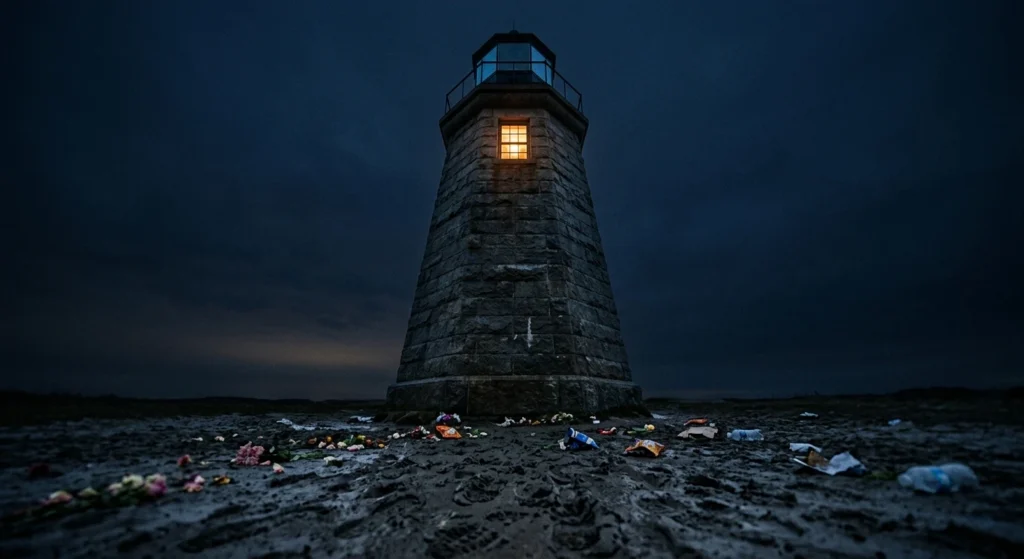
He hangs himself. The novel’s final image is his feet, slowly rotating, pointing first one direction and then another like compass needles that have lost their north.
There is nothing heroic in that image. Huxley does not give John a martyr’s death. He gives him an ending — quiet, ambiguous, observed by no one who understood what they were seeing.
The Question You Take With You
The standard modern parallel for Brave New World is that social media is soma. It is not a wrong parallel. It is just one that has been made so many times it has become its own kind of sedative — a thought that feels like insight but requires nothing.
The more uncomfortable version goes like this.
Think about the last time you were genuinely bored — not understimulated in a way you immediately resolved by picking up your phone, but actually bored, sitting with nothing, letting your mind do whatever it does when it is not being directed. For most people this has become an almost inaccessible state. Not because boredom has been outlawed but because the infrastructure for avoiding it is so frictionless, so constant, so well-designed around the specific texture of your preferences, that choosing boredom requires an act of will that choosing entertainment does not.
Now consider that boredom — unstructured, uncomfortable, unresolved — is one of the primary conditions under which people figure out what they actually want. Not what they have been offered, not what the algorithm surfaces because it resembles what they wanted last Tuesday, but what they would reach for if reaching required effort. The World State’s genius is not that it fills every moment with pleasure. It is that it makes the space between pleasures too small for anything inconvenient to grow in.
Huxley’s question is not whether you use soma. It is whether you would notice if you did.
The reader Huxley is writing for is not a drone or an Epsilon. They are an Alpha — intelligent, capable, well-resourced. The uncomfortable reading of Brave New World is not that the World State is coming. It is that people with every advantage, every freedom, every cognitive capacity to choose otherwise are choosing, in small consistent increments, the path of least resistance to the next comfortable moment. Not because anyone is making them. Because the option is there and the other option is harder and the difference between the two is easy to not think about.
John died trying to demonstrate that choosing the harder thing was possible. He failed, partly through his own damage and partly because the world he was demonstrating against was not watching him the way he needed to be watched. It was watching him the way it watched everything else.
The question the novel leaves is not what Huxley thought about the future. It is what you think about your own present. Not in the abstract — not ‘society is too distracted’ as a general observation made comfortably from within the distraction — but specifically. What have you already given up without quite deciding to? What have you let atrophy because maintaining it cost more than the available alternatives? What would you choose, honestly, if the World State sent you its invitation tomorrow and the small print was exactly as advertised?
Most people, if they answer honestly, do not know.
That is what Brave New World is actually about.
Whether Huxley Won
Huxley did not write a book with a lesson. He wrote a book with a question, and he was scrupulous enough not to answer it for you — which is why John dies without redemption and Mustapha Mond remains in his office, entirely sane, entirely comfortable with what he has chosen.
The novel does not tell you that freedom is worth the suffering it costs. It shows you a man who believed this and could not live by it. It does not tell you that the World State is wrong. It shows you the most intelligent person in the World State explaining, with full knowledge of what he traded, why he made the trade — and leaving you to sit with the fact that his reasoning holds.
The island Mond offers is still available. It is the choice to read difficult books and sit with what they ask. To let boredom be boredom for long enough to hear what it has to say. To want the thing that costs something rather than the thing that doesn’t.
Whether that choice is worth it is the one question Brave New World refuses to answer on your behalf.
Frequently Asked Questions about Brave New World
What is Brave New World about?
Brave New World is a 1932 novel by Aldous Huxley set in a future society called the World State, where human beings are engineered and conditioned from birth to fit assigned social roles. Everyone is kept content through a pleasure drug called soma, engineered relationships, and the elimination of art, religion, and family. The novel follows Bernard Marx, an Alpha who feels like a misfit, and John the Savage, a man raised outside the World State who cannot survive contact with it. At its core, the book asks whether happiness is worth having if it costs you everything that makes life meaningful.
What is the main message of Brave New World?
Huxley’s central argument is that the greatest threat to human freedom is not oppression but comfort — that people will surrender individuality, depth, and meaning willingly if the alternative is made pleasurable enough. Unlike 1984, where control is imposed by force, Brave New World imagines a society people would choose. The novel does not tell you this is wrong. It asks whether you would choose differently.
How does Brave New World compare to 1984?
Both are dystopian novels but they operate on opposite principles. Orwell’s 1984 imagines control through surveillance, fear, and pain — a boot stamping on a human face. Huxley’s Brave New World imagines control through pleasure, distraction, and engineered contentment. Many readers find Huxley’s version harder to dismiss, because the World State does not need to threaten anyone. It only needs to keep everyone comfortable.
Why does John the Savage kill himself at the end?
John retreats to a lighthouse to live simply and apart from the World State. He cannot maintain the integrity of his gesture — the crowds arrive, film him, turn his suffering into entertainment. The morning after participating in a soma-fuelled orgy he had resolved to resist, John wakes to find that the World State has absorbed him just as it absorbs everything. His suicide is not a martyrdom. It is the collapse of a man who had no world to belong to — not the Reservation, not London, and not the self-made exile he attempted.