

Think and Grow Rich is not a book about thinking. It is not really a book about growing rich. It is a book about how thoroughly a man can sell you something if he tells you exactly what you already want to hear — and it is also, underneath all of that, a book with ideas genuinely worth your time. Both things are true.
Most summaries of this book skip that tension entirely. They give you the 13 principles, tell you Napoleon Hill interviewed five hundred millionaires, and send you on your way. The problem is that when you go looking for any evidence that Hill actually did what he claims — the twenty years of research, the conversations with Carnegie, the access to the greatest business minds of a generation — you come back empty. And once you know that, you cannot read the book the same way.
But you can still read it. That is the honest position. And it requires holding two things at once: the fraud, and the ideas that survived it.
“It is a book about how thoroughly a man can sell you something if he tells you exactly what you already want to hear — and it is also, underneath all of that, a book with ideas genuinely worth your time.”
The Story Hill Told — and the One the Evidence Tells
1908. Napoleon Hill claims he sat across from Andrew Carnegie — the steel baron who had recently been the richest man in the world, and who was now, systematically, giving it away — and something remarkable happened. Carnegie offered Hill a commission: spend twenty years studying the most successful men in America, find the principles that explain their success, and give them to the world. Hill accepted. The twenty years became the book. The book became, by most estimates, one of the best-selling titles in the history of publishing.
The problem is that Carnegie’s most thorough biographer, David Nasaw, searched the historical record for any trace of that meeting. He found none. Hill did not begin claiming the conversation had taken place until after Carnegie died in 1919 — at which point Carnegie was no longer in a position to say otherwise. According to Wikipedia’s account of the book, in 1908, the year Hill claims the pivotal meeting occurred, he spent much of the year on the run from authorities following a lumber fraud in Alabama.
Did You Know
Carnegie’s biographer David Nasaw — who spent years researching the steel baron’s life — found no evidence of any kind that Hill and Carnegie ever met. Hill only began claiming the meeting had occurred after Carnegie died in 1919, at which point Carnegie could not contradict him.
Hill did meet Thomas Edison — briefly, in 1923. Beyond that, the claimed interviews with Henry Ford, John D. Rockefeller, Theodore Roosevelt, and Alexander Graham Bell have no documentary support outside Hill’s own writing. Before Think and Grow Rich, Hill had published an eight-volume work called The Law of Success in 1928, which attempted the same mission on a far larger and more expensive scale — a project that also, as it happened, came attached to a scheme involving a high school sales contest that Hill privately acknowledged might land him in jail.
None of this is secret. It sits in the historical record for anyone willing to look. And yet the book’s origin myth — Carnegie’s commission, the twenty years, the five hundred millionaires — has been reprinted in the introduction of every edition since 1937 as though it were verified biography.
Hill’s life before and after the book adds depth to the picture without requiring exaggeration. He founded businesses that collapsed. He was charged with fraud more than once, and warrants were issued for his arrest in at least two states. For a period in the 1930s, around the time Think and Grow Rich was being written, he was a member of a New York group that historians describe as a cult. The FTC later pursued him for false advertising. His own authorized biographers concede that some of his most famous claims were “somewhat contrived.” This is a generous reading.
Think and Grow Rich is not a novel. It is a prescriptive philosophy that asks for your trust. Hill tells you, repeatedly, that if you follow these principles, success is not merely possible but inevitable. He cites twenty years of research as the evidence. If the research is fabricated, the evidence is fabricated. And if the evidence is fabricated, the reader is the only one left to decide what is actually true.
That is what this summary does. Not throw the book out. Not repeat the mythology. Think about it.
The Architecture Under Think and Grow Rich’s 13 Principles
Before deciding what to keep, you need to understand what Hill is actually selling.
The title is deliberately provocative and deliberately incomplete. Hill is not claiming you can think your way to a bank balance — or not quite. His argument is more specific: between the idea of something and the physical reality of that thing, there is a process. That process runs through the mind. And the quality of what you produce depends almost entirely on how deliberately you manage it.
Hill calls this the philosophy of achievement, and it moves in a sequence.
It begins with desire — not preference, not ambition in the vague sense most people mean it, but what Hill calls a burning desire. A specific, quantified, fixed target. Not “I want to be wealthy” but a precise figure, a precise date, and a precise account of what you will give in exchange. Hill is insistent on the precision: vague desire produces vague results. This is the foundation. Everything else depends on whether the desire is real.
From desire, Hill moves to faith — which he defines not as religious belief but as a state of mind that can be manufactured through repetition. If you repeat an idea to yourself often enough, with enough emotional force, the subconscious eventually accepts it as fact. He calls the technique autosuggestion: feeding statements into the subconscious until belief is no longer an act of will but a settled condition. This is the step where most critical readers start to raise their hands, and not without reason.
Alongside faith, Hill places specialized knowledge — the idea that general knowledge is effectively useless for building wealth, and that what matters is deep, specific expertise in the field where your desire lives. He adds imagination (the capacity to build plans from raw information), organized planning (turning those plans into workable sequences), and decision (the discipline to commit rather than drift between options).
Three further principles carry particular weight in Hill’s framework. Persistence — which Hill elevates to something close to a moral category, arguing that most people fail not because their plans are wrong but because they stop before the plans have time to work. The mastermind — a small group of people with complementary knowledge and aligned purpose, whose combined thinking Hill argues produces something greater than what any of them could generate alone. And the subconscious mind — which Hill describes as the gateway between conscious intention and what he calls Infinite Intelligence, a kind of universal reservoir of ideas available to the disciplined thinker.
The final two principles — brain as a transmitter and receiver of thought vibrations, and the sixth sense as the faculty that activates when all other principles are functioning — are where the book moves most decisively from psychology into something closer to mysticism.
The architecture beneath all thirteen steps is simpler than the number suggests: know exactly what you want, believe without reservation that you will have it, acquire the specific knowledge your plan requires, surround yourself with people who multiply your capacity, and refuse to stop. Every principle is an elaboration of one of those five moves.
The useful ideas are not hard to find. But they are buried inside enough mysticism that most readers either swallow it whole or throw out everything — and miss the thing worth keeping either way.
The Ideas That Hold Up
Four Ideas Worth Your Time
Goal specificity · Specialized knowledge · The mastermind principle · Persistence and decision-making. Each of these holds up to scrutiny independently of who wrote them and why.
Hill’s critics tend to throw the whole book out. That is the easier move — once you know who he was, dismissing everything he wrote feels like intellectual hygiene. But it is also lazy. The question worth asking is not whether Hill was a trustworthy person. He wasn’t. The question is whether the ideas work independently of the man who wrote them. Some of them do. Clearly. And pretending otherwise just to keep the critique clean is its own form of dishonesty.
Four things in this book hold up. Not as mystical principles. As observations about how people actually function.
Desire Has to Be Specific
Hill’s insistence on what he calls definiteness of purpose sounds, in his telling, like a motivational exercise. Write down the exact amount of money you want. Write down the date you intend to have it. Read the statement aloud twice a day. The ritual has aged badly enough that it is easy to skip past the idea inside it.
The idea is this: vague desire produces vague action. A person who wants to “be successful” does not know what to work toward, cannot measure whether they are making progress, and has no way to tell when they have arrived. A person who wants a specific thing by a specific date has a problem they can actually solve.
This is not mysticism. It is one of the most replicated findings in psychology. Edwin Locke and Gary Latham spent decades studying goal-setting — their research consistently showed that specific, challenging goals produce significantly better performance than vague or easy ones. The mechanism is not the subconscious transmitting desire into the universe. It is that a clear target focuses attention, increases persistence, and makes feedback meaningful. You cannot tell whether you are making progress toward “success.” You can tell whether you are making progress toward a number.
Hill wraps this in language about burning desire and emotional intensity, which modern research is more skeptical of — the emotional charge matters less than the specificity. Most people’s ambitions are too vague to be useful. They want better, more, different — and then wonder why they keep arriving somewhere that looks roughly the same as where they started. Hill’s instruction to get precise is the right instruction for the wrong reason, which still makes it the right instruction.
“Vague desire produces vague action.”
In 1937 this looked like common sense. In 2026 it turns out to be one of the few things he got more right than he knew.
Hill’s argument is blunt: general knowledge is almost worthless for building wealth. What matters is specific, deep knowledge in the field where your desire lives. He is contemptuous of people who treat a broad education as preparation for success — the well-read generalist who knows a little about everything and cannot do anything at an exceptional level. Find your field. Go deep. Become the person who knows more about this particular thing than almost anyone else.
The economy has spent the intervening eighty years proving him right about this in ways he could not have anticipated. The premium on being generally educated has eroded steadily. The premium on being deeply, specifically skilled in something people need has grown. The professional who can do something difficult well — who has spent years developing a capability that takes real time to build — is in a fundamentally different position than the one who can talk intelligently about many things and do none of them at a high level. The first is hard to replace. The second is not.
The Mastermind — Strip the Mysticism, Keep the Idea
Hill’s mastermind principle is the one that has aged worst in its framing and best in its substance. He describes the mastermind as a coordination of knowledge and effort in a spirit of harmony between two or more people — and then suggests that this coordination produces a third mind that is more powerful than the sum of its parts, as though minds in proximity generate a new entity.
This is the language that loses people. It sounds like a seance.
Set it aside. What Hill is actually describing is this: the people you spend the most time thinking with determine the ceiling of your thinking. Your peer group is not a social fact about your life — it is a cognitive environment. The quality of the questions you encounter, the standards you absorb as normal, the ambitions that feel realistic or unrealistic to you — all of this is shaped more by the five people you talk to most often than by anything you consciously decide about your own potential.
The research on peer effects in adult performance is substantial and consistent. Proximity to high-performing peers raises individual performance — not through mysterious mind-merging but through the thoroughly unglamorous mechanism of changing what you consider ordinary. When the people around you treat difficult things as achievable, difficult things start to feel achievable to you. When mediocrity is the ambient standard, mediocrity is what you produce without noticing.
Most people treat their social environment as a given rather than a choice. Hill’s instruction — deliberately build around you a group of people whose standards you want to absorb — is one of the most actionable things in this book. The framing is wrong. The advice is right.
“The people you spend the most time thinking with determine the ceiling of your thinking.”
Persistence and Decision — Where Hill Is Most Precise
Hill’s observation about decision-making is so clean it almost reads like something discovered much later. Successful people, he says, reach decisions quickly and change them slowly. People who do not succeed take a long time deciding and change course at the first sign of resistance. He does not offer this as a personality trait you either have or lack — he presents it as a discipline that can be built.
He is right, and it matters more than it appears to. Indecision is not neutral. Every option held open is consuming something — attention, energy, the cognitive resources that could be spent executing a decision already made. The person who is still deciding is not resting. They are working, at full cost, for no output. Hill’s insistence on deciding and committing, treating a changed decision as a significant event rather than an ordinary adjustment, is genuinely useful in a culture that treats optionality as a virtue and pivot as a strategy.
The persistence argument is where the book is most easily caricatured — it sounds like “just don’t quit” dressed in philosophy. But Hill’s version is more specific than that. He argues that most failures happen within reach of success, that the point of maximum resistance in any worthwhile endeavour comes just before the thing breaks open, and that people who stop at that point will never know how close they were. He uses the metaphor of a gold miner who stops three feet from the vein.
The phenomenon the metaphor describes is real. The person who quits a business during the hardest year, who stops the project one revision before it works, who leaves the job six months before the skill compounds into something valuable — these are not edge cases. They are the norm. Persistence is not the whole story. But Hill is correct that most people abandon things too early, and that staying is harder than starting in ways they did not anticipate when they began.
The Ideas to Leave Behind
The useful ideas in Think and Grow Rich do not redeem the useless ones. They exist alongside them, and the reader who cannot tell the difference is the one Hill was counting on. Three things in this book are worth putting down and leaving where they fall.
Visualization Is Not a Mechanism
Hill’s treatment of faith and autosuggestion is the book’s central move, and it is the one that does the most damage.
The argument runs like this: if you repeat a statement to yourself often enough, with enough emotional intensity, the subconscious mind eventually accepts it as reality. Once the subconscious accepts something as real, it begins working — automatically, below the level of conscious effort — to make it so. The subconscious is the transmitter. Belief is the signal. Reality is what the signal produces.
This is not how minds work. And the evidence against it is specific enough to be worth naming.
Gabriele Oettingen is a psychologist at New York University who has spent decades studying what happens when people visualize positive outcomes. Her findings are consistent enough to be uncomfortable for anyone who has taken the manifestation literature seriously: people who vividly imagine their desired future in isolation — who picture success without also picturing the obstacles between here and there — consistently perform worse than people who do neither. The good feeling produced by the visualization appears to reduce the motivational pressure to act. The mind, in some measurable sense, treats the imagined outcome as partial progress toward the real one. Desire satisfied in fantasy is desire partially spent.
This does not mean that belief in your own capacity is irrelevant. It is not. Self-efficacy — the specific belief that you can execute the actions required to reach a goal — has robust effects on performance. The research on this, associated with Albert Bandura’s work from the 1970s onward, is some of the most replicated in psychology. But self-efficacy is not the same as Hill’s faith. Believing you can do the work is different from believing the outcome will arrive because you have trained your subconscious to expect it. The first belief changes your behaviour. The second changes your feeling about your behaviour while leaving the behaviour itself untouched.
Hill collapses this distinction. He writes about desire, belief, and autosuggestion as though the mechanism connecting them to outcomes is the subconscious operating as a kind of internal engine. Write the statement, read it aloud twice a day, feel the emotion — and the subconscious takes over from there. What he is selling is the idea that the psychological state is sufficient. It is not. The psychological state matters, but it matters because of what it causes you to do, not because of what it causes to happen.
The ritual is not the engine.
“The ritual is not the engine.”
The reader who mistakes Hill’s faith for the useful thing in his framework — who invests in the ritual while neglecting the plan — is doing exactly what the book most loudly warns against and most quietly encourages.
The Evidence Was Never There
Even if the interviews happened exactly as Hill claimed, the methodology fails.
Hill interviewed successful people. He found patterns in what they had in common — desire, persistence, specialized knowledge, the mastermind, and so on. He concluded that these patterns explain the success. What he did not do — what no one in this tradition ever does — is interview the people who had all the same patterns and did not succeed.
This is not a minor gap. It is the entire problem.
Every quality Hill identifies in his five hundred millionaires almost certainly also exists in five hundred people who worked just as hard, believed just as completely, built their masterminds and developed their specialized knowledge and read their statements aloud twice a day — and whose businesses failed, whose investments collapsed, whose plans were overtaken by a recession or a competitor or a piece of bad timing they could not have seen. Hill’s framework offers no account of those people, because it was never built from their stories.
Nassim Taleb named this the problem of silent evidence. We see the winners — we never see the graveyard of people who did all the same things and are not here to tell you about it. The 13 principles may be common among the successful. They may be equally common among the unsuccessful. Without the comparison, you do not know — and Hill was never interested in finding out, because the answer might not have sold.
Here is the real-life version of this problem. Think and Grow Rich is cited as an influence by a striking number of people who went on to build significant wealth. It is also almost certainly cited as an influence by an enormous number of people who followed its prescriptions earnestly and built nothing of the kind — but whose testimonials do not appear in the book’s marketing, and whose experiences do not complicate the origin story. What you see is the confirmation. What you do not see is everything else.
Sex Transmutation — Leave It
Hill devotes a full chapter to what he calls sex transmutation — the idea that sexual energy is the most powerful form of human drive, and that channelling it away from its primary expression and into creative or professional effort produces extraordinary results. He lists the most creative and productive men in history and suggests they were uniformly highly sexed individuals who had learned to redirect that energy.
Skip it. Engaging with it seriously requires more effort than it returns.
How to Read This Book
Think and Grow Rich is worth reading.
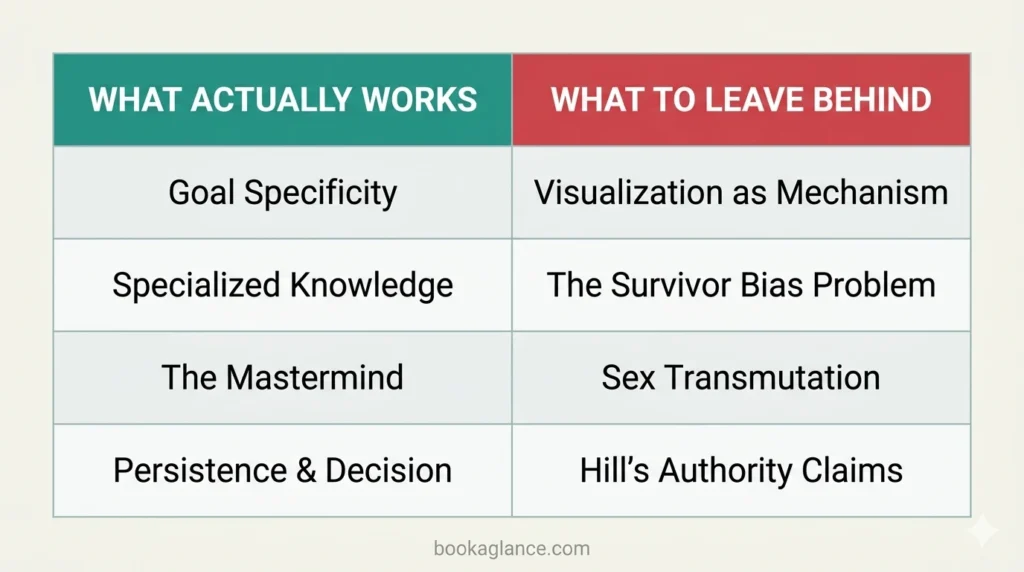
It is worth reading not because Hill was a trustworthy source — he wasn’t — and not because the 13 principles constitute a proven formula for success — they don’t. It is worth reading because four of its core ideas are genuinely useful, stated with a clarity that later writers have rarely matched, and buried inside a book that most people either consume uncritically or dismiss without reading. The reader who approaches it with their critical thinking intact will get more from it than either of those groups.
Take the goal-specificity seriously. Hill’s insistence on a precise, quantified, dated desire is the most actionable thing in the book, and it is the part most easily skipped because it feels like homework. It is not homework. It is the difference between a direction and a destination. Most people who feel stuck are not lacking motivation — they are lacking a specific enough target for motivation to attach to. Hill is right about this, the research supports it, and the version of this idea in James Clear’s Atomic Habits — where the specificity of implementation intentions determines whether habits form at all — is essentially the same argument made eighty years later with better evidence behind it.
Take the specialized knowledge argument seriously. Go deep into something. The person who knows one thing at an exceptional level is more valuable, more resilient, and harder to replace than the person who knows many things adequately. In a world where adequate knowledge of almost anything is available instantly and for free, the premium has shifted entirely to depth. This is not a 1937 insight that aged well. It is a 2026 reality that the book happened to predict.
Use the mastermind principle — under its real name. Build a peer group of people whose standards you want to absorb. Not a networking group. Not a mutual appreciation society. People who are doing things you respect, who will tell you the truth, and around whom ordinary becomes a higher bar. Viktor Frankl, writing from a context about as far from Napoleon Hill’s as it is possible to imagine, reached a version of the same conclusion from a different direction: the people who maintained meaning and purpose in the most dehumanising conditions were consistently those who had something — or someone — to maintain it for. The social environment is not decoration around your life. It is one of the primary forces shaping what your life becomes.
Apply Hill’s persistence argument, but pair it with honest assessment. Stay longer than feels comfortable. Most worthwhile things take longer than the people doing them anticipated, and most people leave before the compound interest of sustained effort has time to show. But persistence is not the same as stubbornness, and Hill occasionally blurs that line. The man who spent thirty years mining in the wrong location was not three feet from the vein — he was in the wrong location for thirty years. Persistence applied to a fundamentally sound plan is a virtue. Persistence applied to a broken one is a different problem entirely, and Hill does not spend much time on how to tell the difference. Pair his argument with your own honest assessment of whether the plan is sound, and the advice becomes genuinely useful.
Apply skepticism to everything involving the subconscious as mechanism. Faith, autosuggestion, visualization, the sixth sense, thought vibrations, Infinite Intelligence — these sections can be read as motivational framing if you find motivational framing useful. They should not be read as causal explanation. The planning, the expertise, the peer environment, the sustained execution — those are the engine. If the ritual helps you show up to do the actual work, use it. If it produces a feeling of progress that substitutes for the actual work, it is costing you more than it is giving you.
And know who wrote it. This matters not to invalidate the useful ideas — an idea does not become false because a dishonest person stated it — but to protect your own judgment. Hill asks you, repeatedly, to trust him. To take his word for the research, the interviews, the twenty years of study. He asks for a degree of deference that, given what we know about his life, he is not owed. The useful ideas in this book stand up to scrutiny on their own terms. Apply that scrutiny and you do not need to trust him. You can verify for yourself what holds and what doesn’t — which is exactly what he would prefer you not do, and exactly what this summary has been trying to help you do from the first paragraph.
The Thing That Outlived the Con
The book became more influential than its author deserved, and some of that influence landed in the right places.
Hill was, in all likelihood, a man who half-believed his own mythology — the grifter who eventually sold himself the story. That does not make the useful ideas less useful. It makes the whole thing more interesting: a genuinely complicated book by a genuinely complicated man, which produced genuinely complicated results.
The 13 principles seeded an entire industry. Every major personal development book of the past eighty years is in some conversation with this one — Stephen Covey’s careful architecture of habits and principles in The 7 Habits of Highly Effective People, Robert Kiyosaki’s blunt insistence on financial literacy and asset-building in Rich Dad Poor Dad, the behaviour-change research that underlies Atomic Habits — all of it is downstream of the tradition Hill helped establish.
The 7 Habits of Highly Effective People is, in part, an attempt to build what Hill was reaching for on a more honest foundation. Rich Dad Poor Dad borrowed the popular format and some of the central arguments about money and belief, and produced its own complicated relationship with the line between motivating truth and useful oversimplification.
Think and Grow Rich is not what it claims to be. Its foundation story is almost certainly false. Its evidentiary basis does not bear scrutiny. Its central mechanism — the subconscious as transmitter of trained desire — is not how minds work.
And it contains four ideas that are worth your time, stated with a directness that later versions have sometimes lost in their effort to be more rigorous.
Read it that way. Take what holds. Leave what doesn’t. And reserve the trust Hill asks for yourself instead — because that, more than any of the 13 principles, is the actual secret the book is built around.
Frequently Asked Questions
What is the main message of Think and Grow Rich?
Hill’s central argument is that the gap between wanting something and having it is bridged by the mind. Specifically: a precise, emotionally charged desire — combined with a plan, specialised knowledge, a strong peer group, and sustained persistence — can translate almost any goal into reality. The book’s claim is not that thinking is sufficient, but that undisciplined thinking is why most people fail.
What are the 13 principles in Think and Grow Rich?
The 13 principles are: desire, faith, autosuggestion, specialised knowledge, imagination, organised planning, decision, persistence, the mastermind, sex transmutation, the subconscious mind, the brain, and the sixth sense. Hill presents them as a sequential philosophy of achievement rather than an independent checklist — each principle builds on the ones before it.
Is Think and Grow Rich worth reading?
Yes, with caveats. Four of Hill’s ideas hold up clearly under scrutiny: the goal-specificity argument, the case for specialised knowledge, the mastermind principle, and his analysis of decision-making and persistence. These are genuinely useful and stated with a clarity that later writers have rarely matched. The book’s weaknesses — particularly the visualisation-as-mechanism claim and its evidentiary foundation — are significant enough to require a critical reader rather than a credulous one.
Did Napoleon Hill really interview Andrew Carnegie?
Almost certainly not. Carnegie’s biographer David Nasaw, who spent years researching his subject, found no evidence of any kind that Hill and Carnegie ever met. Hill began claiming the meeting occurred only after Carnegie’s death in 1919, at which point Carnegie could not contradict the account. The Carnegie origin story is the founding myth of the book — and it appears to be fabricated.
What is the secret in Think and Grow Rich?
Hill refers repeatedly to “the secret” without ever naming it directly — a deliberate rhetorical device designed to make readers feel they must identify it themselves. Most readers and commentators identify it as the principle of burning desire: the idea that a specific, emotionally intense, clearly defined desire is the starting point for all achievement. Whether that constitutes a secret rather than a restatement of basic goal-setting theory is a reasonable question.