

In 2016, Mark Manson published a book with the central thesis that you should stop buying self-help books. It has sold over 10 million copies, spawned a Universal Pictures documentary, a sequel, and a brand. Make of that what you will.
The Subtle Art of Not Giving a F*ck is not a book about caring less. It is a book about how to choose your suffering. Manson knew the second title would not sell as well — which, given what the book actually argues, is one of the better ironies in recent publishing history.
Most people who have read this book took three things from it: care less, stress less, stop trying to impress people. That is not wrong, exactly. But it is a significant reduction of what Manson is actually doing. The real argument — buried beneath the provocative title, the profanity, and the breezy blog-post voice — is closer to Stoicism and Viktor Frankl than to the “chill out more” philosophy the branding suggests. Manson is not telling you to stop caring. He is telling you that you are currently caring about the wrong things, that you cannot stop caring altogether even if you try, and that the path to a meaningful life runs directly through suffering rather than around it.
That is a harder sell than the title. It is also a better book.
The Subtle Art of Not Giving a F*ck is not a book about caring less. It is a book about how to choose your suffering.
This post covers what the book actually argues — and is honest about where that argument holds up and where it breaks down.
Three Subtleties Most People Read Past
Manson opens with a clarification that most readers promptly ignore. Not giving a f*ck, he writes, does not mean being indifferent. A person who finds no emotion or meaning in anything is not enlightened — they are a psychopath. The point is not indifference. The point is selection.
Three subtleties open the book — and most readers sail straight past them. The first: not giving a f*ck means being comfortable with being different, not with being numb. The second: to stop caring about adversity, you first have to care about something more important than the adversity. You do not escape your problems by caring less; you transcend them by caring about something larger. The third: you are always choosing what to give a f*ck about, whether you realize it or not. The only question is whether that choice is deliberate or accidental.
That third point is the one worth sitting with. Right now, today, you are giving your attention and energy to something. Perhaps it is a colleague who criticized your work in a meeting three weeks ago and whose opinion you have been arguing against in the shower every morning since. Perhaps it is a comparison you made last night between your life and someone else’s feed — a comparison that took four seconds and has been running quietly in the background for twelve hours. You did not choose to care about these things. But here you are, caring about them with remarkable consistency.
Manson’s argument is not “care about nothing.” It is “you only have a certain number of f*cks to give in a lifetime, and you are currently spending them on things that were never worth the cost.” That reframe — from “care less” to “spend better” — is the book in a sentence. Everything else is the explanation of why it is harder than it sounds.
The Feedback Loop from Hell
Most self-help books have a specific problem — one Manson identifies and avoids: they make you feel bad for feeling bad.
The structure of a standard self-help book runs roughly like this: here is the person you could be, here is the gap between that person and you, here is the technique that closes the gap. The implicit message throughout is that your current feelings — the anxiety, the dissatisfaction, the sense that something is missing — are problems to be solved rather than states to be inhabited. Feel bad long enough and you will feel bad about feeling bad. Feel bad about feeling bad long enough and you will feel bad about feeling bad about feeling bad.
Manson calls this the Feedback Loop from Hell. It is the meta-layer of suffering that modern life has added on top of ordinary suffering: the anxiety about the anxiety, the self-criticism about the self-criticism, the feeling that you should by now have figured out how to stop feeling this way.
The loop runs faster now than it did when Manson wrote the book. Each phone check is a small invitation to compare, to evaluate, to update your sense of where you stand relative to other people. Most of those updates are not neutral — social media by design surfaces the curated peaks of other people’s lives, not the troughs. The result is a background hum of inadequacy that has become so familiar most people no longer notice it is there. They just feel vaguely worse on Sunday evenings than they do on Saturday mornings and cannot quite explain why.
Manson’s solution to the feedback loop is not “feel better.” It is “stop trying to feel better.” The attempt to eliminate negative experience is itself a negative experience. Accepting that some portion of life will always be uncomfortable — not as a defeat but as a fact — short-circuits the loop. You stop adding the meta-layer. The original suffering remains, but it is now just the suffering, rather than the suffering plus the guilt about the suffering plus the anxiety about the guilt.
This sounds obvious stated plainly. It is one of those ideas that reads as simple and proves remarkably difficult to actually do. The reason it is difficult — the real reason — comes down to values.
The Values Framework — and Why Yours Might Be Working Against You
Here is where Manson earns his pages.
The central practical argument of the book is that the quality of your life is determined by the quality of the values you are optimising for — and that most people have never examined their values closely enough to notice that some of them are quietly making everything worse. Not through malice. Through the simple fact that a value which cannot be measured, cannot be controlled, or depends entirely on other people’s responses is a bad value to organise a life around, regardless of how culturally approved it is.
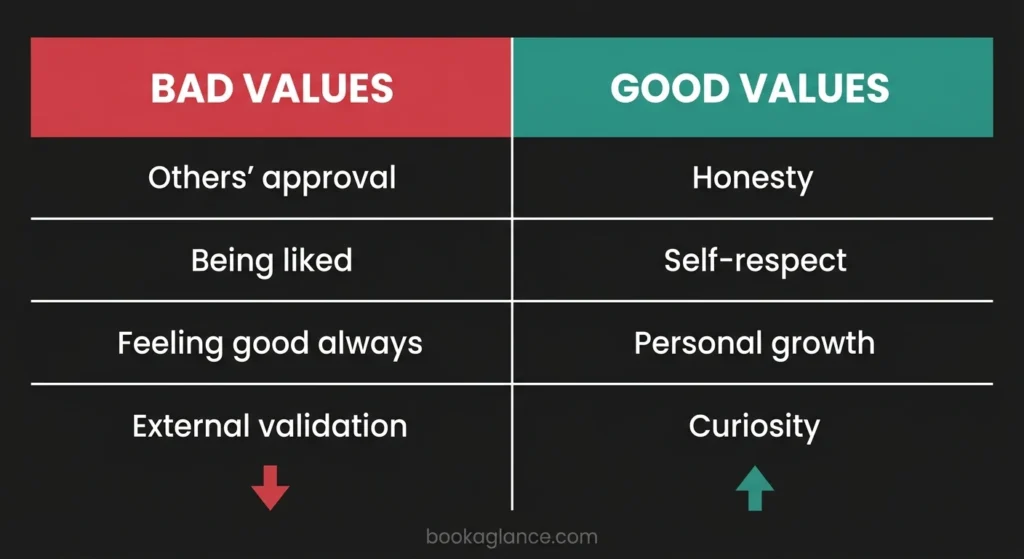
Manson draws a distinction between good values and bad values. Good values are reality-based, internally controllable, and constructive. Bad values are superstition-based, externally dependent, or destructive. The examples he gives are worth dwelling on because they are not the examples you expect. He does not say “money is a bad value.” He says approval is a bad value. He does not say “ambition is wrong.” He says being liked is a bad value.
The difference matters. Money, used as a proxy for security or freedom, is at least something you can act on. Whether other people approve of you is not. You cannot directly control another person’s opinion. You can influence it — through your behaviour, your presentation, your choices — but the final verdict sits outside you. This means that if your primary operating value is that people around you think well of you, you have built your sense of self on ground you do not own. Every social interaction becomes a performance review. Every silence from someone who matters becomes a threat assessment. The anxiety that follows is not a personality flaw. It is the logical output of a value that cannot be satisfied by anything you do.
The anxiety that follows is not a personality flaw. It is the logical output of a value that cannot be satisfied by anything you do.
Most summaries reduce this to “choose better values” and stop there. That reduction misses the actual difficulty. Knowing that approval-seeking is a bad value does not make you stop seeking approval. The desire to be liked is not a conscious strategy — it is a deeply embedded orientation that shapes perception before the conscious mind gets involved. The person who checks their phone three minutes after sending an important message, not because they expect a reply that fast but because the waiting feels intolerable — that person is not practising a strategy. They are expressing a value.
Manson addresses this through what he calls the self-awareness onion: three layers of understanding that have to be peeled back before the value change is possible. The surface layer is knowing what you feel. The second layer is asking why you feel it — what beliefs or assumptions are producing the feeling, and what prior experiences or ingrained patterns are keeping those beliefs in place. This second layer is where most self-examination stalls, because it requires sitting with an uncomfortable question long enough for an honest answer to surface rather than a comfortable one. The third layer, and the one most people never reach, is asking what your personal values are and whether those values are the actual source of the recurring pain.
Most self-examination stops at layer one. You feel anxious. You note the anxiety. You try to reduce it. Manson’s argument is that the anxiety is not the problem — it is the symptom. The problem is the value the anxiety is protecting. Change the value, and the anxiety about that particular thing dissipates. Keep the value and try to feel better anyway, and you are working against yourself.
The same pattern runs through Rich Dad Poor Dad — both books are fundamentally asking what mental models you are running your life on, and whether those models are working for you or against you. The specific domains differ. The diagnostic question is the same.
The Suffering Argument
Manson asks a question the book never quite lets go of: what pain do you want in your life? What are you willing to struggle for?
Not “what do you want.” What are you willing to suffer for.
The distinction matters because desire is cheap. Everyone wants to be fit, financially independent, respected in their field, happy in their relationships. The desire requires nothing of you. The suffering required to get there is where most desires end. Manson’s point is that the people who actually achieve the things others only want are not people with stronger desires — they are people who find the associated suffering either tolerable or meaningful. The person who runs marathons does not simply want the medal more than everyone else. They genuinely like running, including the parts that hurt. Or they like who they become through the discipline of doing something hard regularly. Either way, they have found meaning in the suffering, which makes the suffering something other than pure cost.
Not theoretically — specifically.
The Question That Changes Everything
Manson’s sharpest test is not “what do you want?” Anyone can answer that. It is “what pain are you willing to accept to get there?” Most desired lives collapse at this question. The answer is where you find out what you actually value.
This is where Manson gets closest to Viktor Frankl — whose Man’s Search for Meaning makes the same argument from a context considerably more extreme. Frankl argued that suffering is not the opposite of meaning but one of its sources. The capacity to choose how you respond to unavoidable suffering, to find something worth holding onto inside it, is what separates a life with meaning from a life that is merely comfortable. Manson is making a secular, pragmatic version of the same argument: you cannot have a life without problems, so the only real question is which problems you want to have.
This reframes ambition entirely. The question is not “what do I want to achieve?” The question is “what suffering is this achievement worth?” Someone who wants to write a novel but does not want to sit with the discomfort of bad first drafts, the months of uncertainty about whether it is working, the sustained solitude required to produce anything — that person does not actually want to write a novel. They want to have written one. These are different desires, and only one of them leads anywhere.
Manson calls the practical application of this the Do Something Principle. When you are stuck — paralysed by uncertainty or fear or the absence of motivation — the answer is not to wait for the right feeling to arrive before you act. Action comes first. Motivation follows action, not the other way around. Do something, anything related to the thing you are avoiding, and the doing creates the emotional momentum that the waiting was supposed to produce. The action does not have to be large. It has to happen.
This is, in different language, what James Clear argues in Atomic Habits — that behaviour precedes identity rather than following from it. The action is not the result of having become someone; it is how you become someone.
This is where the book connects, unexpectedly, to what Cal Newport argues in Deep Work — that the ability to do hard things consistently is itself the skill, and that the people who develop it are not people who find hard things easy. They are people who have stopped requiring that hard things feel good before they begin. The suffering is not incidental. It is the mechanism.
Where the Book Earns Its Reputation
A drunk driver hits your car. The accident is not your fault. Dealing with the aftermath — the insurance claim, the repairs, the time lost, the lingering anxiety about driving — is your responsibility. You are the one who has to live in your life. Nobody else can do that part for you, regardless of who caused the problem.
This is the responsibility/fault distinction — the most practically useful idea in the book — and it holds up fully under pressure.
It sounds obvious until you notice how often people get stuck precisely at this junction. The sticking point is fairness. The reasoning runs: this was not my fault, therefore I should not have to deal with it, therefore I will wait until the person responsible acknowledges that and does something about it. The waiting can last years. The person who caused the problem may never acknowledge it. Meanwhile, the person waiting has outsourced their recovery to someone who has shown no particular interest in providing it.
Think of the colleague whose careless comment about your work in a meeting two years ago still surfaces whenever your confidence dips. You did not cause that dynamic. But whether you keep carrying it is your call, not theirs. Manson’s point is that fairness is irrelevant to the question of what you do next. The question of fault is backwards-looking. The question of responsibility is forwards-looking. You can hold both simultaneously — this was genuinely wrong AND I am the one who has to decide what happens now — but only if you stop treating responsibility as an accusation rather than a description of where the agency actually sits.
The second idea that earns full credit is the death chapter, which closes the book. Manson borrows from Stoic memento mori practice — the deliberate contemplation of mortality as a tool for clarity — and makes it practical rather than morbid. When you hold the fact of your death in mind, the things you have been spending your f*cks on either survive that examination or they do not. The colleague’s opinion of your presentation. The social comparison that has been running since last Tuesday. The approval you have been quietly seeking from someone who probably thinks about you a fraction as often as you imagine. Most of these do not survive the examination. Death is, in Manson’s framing, not the problem — it is the solution. The anxiety clarifier. The thing that makes the values question answerable rather than abstract.
Where the Book Gets Harder to Defend
The chapter on victimhood is the most contested section of the book, and the controversy is not entirely misplaced.
Manson’s argument runs like this: even if you were genuinely wronged, adopting a victim identity is disempowering. Your recovery, under that identity, requires the person who harmed you to acknowledge what they did, apologise, change. Those things are outside your control. The responsibility principle says: take ownership of your response regardless of fault. This keeps the agency with you rather than with the person who wronged you.
The argument is defensible. In its narrow form — that recovery from harm requires eventually redirecting focus from the harm itself to what you do next — it has support from actual psychology. The problem is the application. Manson applies the principle too broadly and with insufficient care about the difference between ordinary difficulty and genuine harm. He has a tendency to reach for examples involving real trauma and apply the same “you are responsible for your reaction” logic without adequately accounting for what that logic costs in those cases. The reader with a painful history who has worked hard to understand what happened to them does not need to be told they are choosing their victimhood. That framing is not wrong in every circumstance. It is wrong in more circumstances than the book acknowledges.
The deeper limitation runs underneath this, and Manson never quite surfaces it. His biography is a specific one — a young American man who, in his mid-twenties, dropped his life and spent years travelling, building a blogging business, testing ideas against his actual experience in real time. The book is saturated with that experience. The advice to stop caring what people think and do what you actually want is excellent advice if the cost of nonconformity is embarrassment. It is different advice if the cost is financial precarity, social isolation, or consequences that a different set of circumstances makes genuinely severe. The freedom to not give a f*ck is itself unevenly distributed, and the book never grapples with that honestly.
This does not make the book wrong. It makes it incomplete. The philosophical framework is sound. The specific applications need to be stress-tested against your actual life rather than Manson’s.
The Verdict
Read it. But read it as philosophy, not permission.
Every self-help section is stacked with books that tell you what you want to hear — that the right mindset, the right habit, the right morning routine will close the gap between the life you have and the life you want. Manson does not do that. He tells you the gap will never fully close, that you are going to keep having problems until you die, and that the only meaningful question is whether your problems are worth having. That is a more honest starting point than most of the genre offers, and it is worth reading for that honesty alone.
The values framework is the part to take seriously. The question — what are you actually optimising for, and is that value internally controllable — is one of those questions that most people have never asked themselves directly and find uncomfortable once they do. The discomfort is the point. Manson is not offering comfort. He is offering clarity, which is a different and rarer thing.
The suffering argument is worth keeping too. What pain are you willing to accept in service of something that matters to you? Not theoretically — specifically. The answer to that question, held honestly, tends to sort the genuine desires from the ones that were always just desires about having rather than desires about doing.
Hold the victimhood chapter lightly. Take what is useful from it — the distinction between responsibility and fault, the idea that recovery eventually requires redirecting agency toward what comes next — and set aside the parts that flatten real complexity into breezy assertions.
And keep the central irony somewhere in mind. This is a book about prioritising what matters, written by a man who built a multi-million dollar brand on the back of it. That does not invalidate the ideas. But it is a useful reminder that the messenger and the message are two different things, and that reading a book about not giving a f*ck has never, in itself, made anyone give fewer of them.
The work is still yours to do. It always was.
Frequently Asked Questions
What is the main message of The Subtle Art of Not Giving a F*ck?
The book argues that caring about everything leads to misery, but the solution is not indifference — it is selection. Manson’s central point is that you have a finite amount of attention and energy, and the quality of your life is determined by what you choose to spend them on. The book is less about caring less and more about caring deliberately about the right things.
Is The Subtle Art of Not Giving a F*ck worth reading?
Yes — particularly if you have grown tired of self-help books that tell you to think positively and visualise success. Manson’s approach is more honest than most of the genre, and the values framework and suffering argument are useful ideas. The book has real weaknesses, especially in the chapter on victimhood, but the philosophical core holds up.
What are the key ideas in The Subtle Art of Not Giving a F*ck?
The four most important ideas: the feedback loop from hell (why trying to feel better often makes you feel worse), the values framework (good values are internally controllable; bad values depend on other people), the suffering argument (choose the pain you are willing to accept, not just the outcome you want), and the responsibility/fault distinction (something can be your responsibility without being your fault).
How many copies has The Subtle Art of Not Giving a F*ck sold?
The book has sold over 10 million copies since its publication in September 2016, making it one of the best-selling self-help books of the past decade. Manson’s full catalogue across all titles has sold over 20 million copies combined.
What is the feedback loop from hell in Mark Manson’s book?
Manson uses this term to describe the way modern life adds a meta-layer of suffering on top of ordinary suffering — feeling anxious about feeling anxious, feeling bad about feeling bad. The feedback loop is driven by the cultural message that negative emotions are problems to be solved rather than normal states to be inhabited. Manson’s argument is that accepting negative experience, rather than fighting it, is what short-circuits the loop.
Is The Subtle Art of Not Giving a F*ck related to Stoicism?
Yes, significantly. Manson draws on Stoic principles throughout, particularly the focus on what is within your control versus what is not. The values framework directly echoes Stoic thinking — only internally controllable values are worth organising a life around. The book’s argument about choosing your suffering also parallels Stoic ideas about voluntary discomfort and the relationship between struggle and meaning.