
George Orwell was dying when he wrote Animal Farm. Tuberculosis ravaged his lungs, his bank account was nearly empty, and he knew publishers would likely reject a book critiquing Stalin—Britain’s wartime ally. Yet something drove him to sit in his cold cottage, rain hammering outside, weaving what would become one of history’s most dangerous stories.
The book was rejected four times. When it finally published in 1945, the controversy was immediate. Some loved it. Others condemned it outright. Countries banned it. But here’s the irony: decades later, the CIA funded its first animated adaptation. Today, seventy-nine years after publication, it remains forbidden in several nations. References appear everywhere—from The Simpsons to BoJack Horseman, in political debates and corporate boardrooms.
What did Orwell write that still makes dictators uncomfortable?
On the surface: a fairy tale about farm animals overthrowing their drunken master. Beneath: a surgical dissection of how power corrupts, how propaganda manipulates, how revolutions betray themselves. Orwell aimed his critique at Stalin, yes. But he struck something deeper—the universal mechanics of authoritarianism, the psychology of the oppressed, the patterns that repeat across all ideologies and eras.
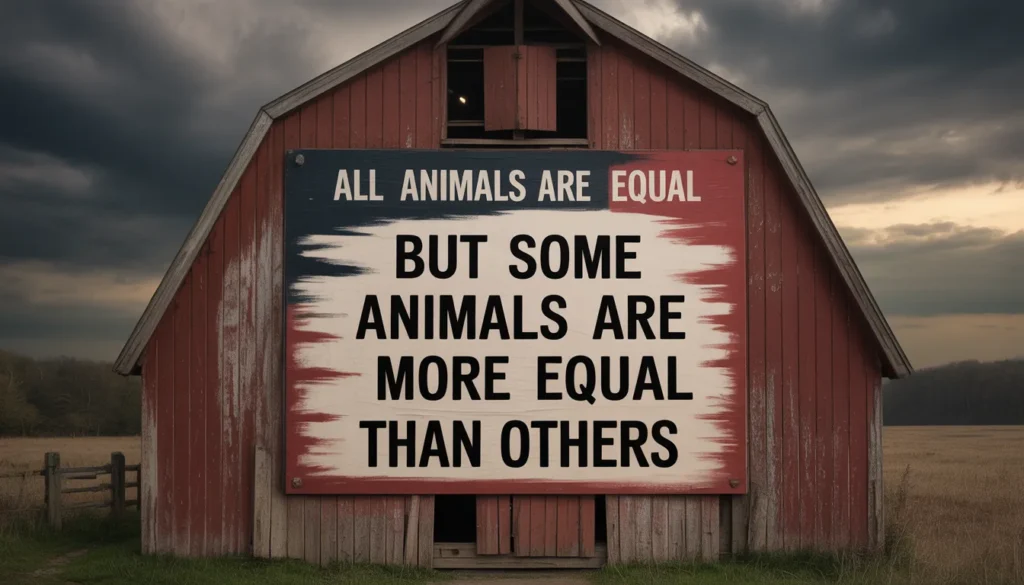
The famous line everyone knows: “All animals are equal, but some animals are more equal than others.” What most miss: the psychological brutality of how we get there. The exhausted workhorse who believes harder work will save him. The propagandist who weaponizes language. The masses who bleat slogans without understanding them. The cynics who see everything but do nothing.
This isn’t just Stalin’s story. It’s ours. The book’s relevance hasn’t faded because human nature hasn’t changed. The mechanisms Orwell exposed—how ideals corrupt gradually, how language becomes a weapon, how good people enable tyranny through silence—these patterns remain as fresh as tomorrow’s headlines.
Animal Farm succeeded not because it’s comfortable, but because it disturbs. Not because it offers solutions, but because it forces us to ask: Which character am I? When do I stop questioning authority? At what point does my exhaustion make me complicit?
Orwell understood something uncomfortable: The farm isn’t a faraway place. It’s wherever power goes unchecked. The animals aren’t abstract symbols. They’re us, at different moments, making different choices.
Let’s examine why this slim book—barely 30,000 words—continues to haunt readers nearly eight decades later.
The Story in Brief: Revolution Betrayed
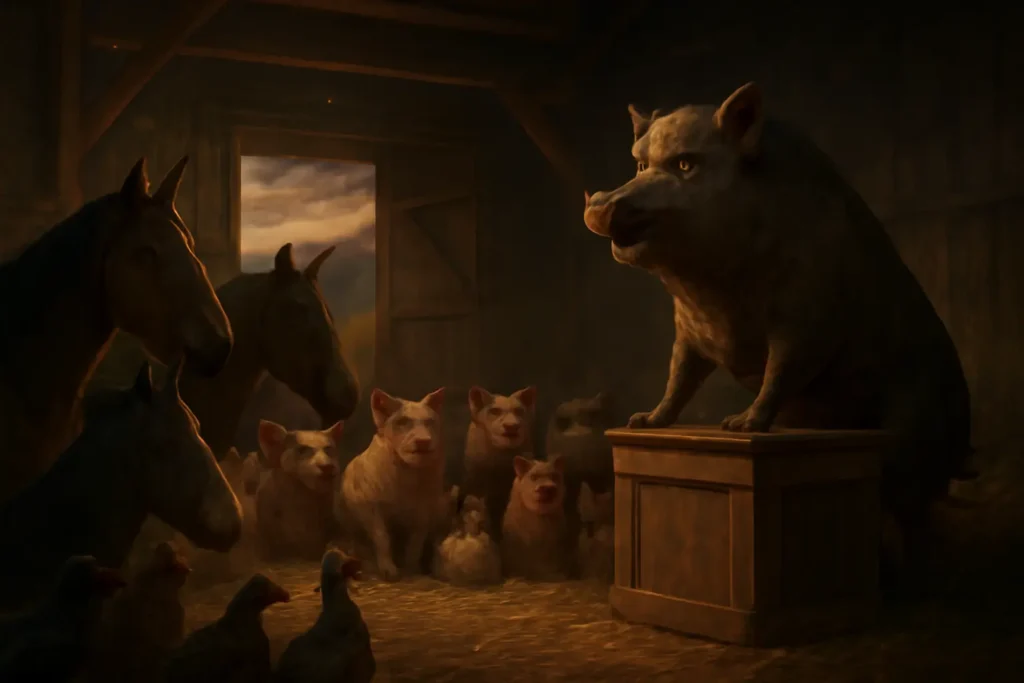
Manor Farm starts like countless others—animals exploited by a drunk, negligent farmer named Mr. Jones. The pigs, being the cleverest, organize a rebellion after Old Major, an elderly boar, delivers a rousing speech before his death. He describes a dream: a world where animals control their own destiny, free from human tyranny. “Man is the only creature that consumes without producing,” he declares. He teaches them a song called “Beasts of England”—an anthem of rebellion that spreads through the farm like wildfire. The vision is simple: “All animals are equal.”
The rebellion succeeds. One night, Jones forgets to feed the animals. Starving and furious, they break into the storage shed. Jones and his men try to whip them back into submission. The animals fight back. Within hours, Jones and his family flee the farm. The revolution is complete.
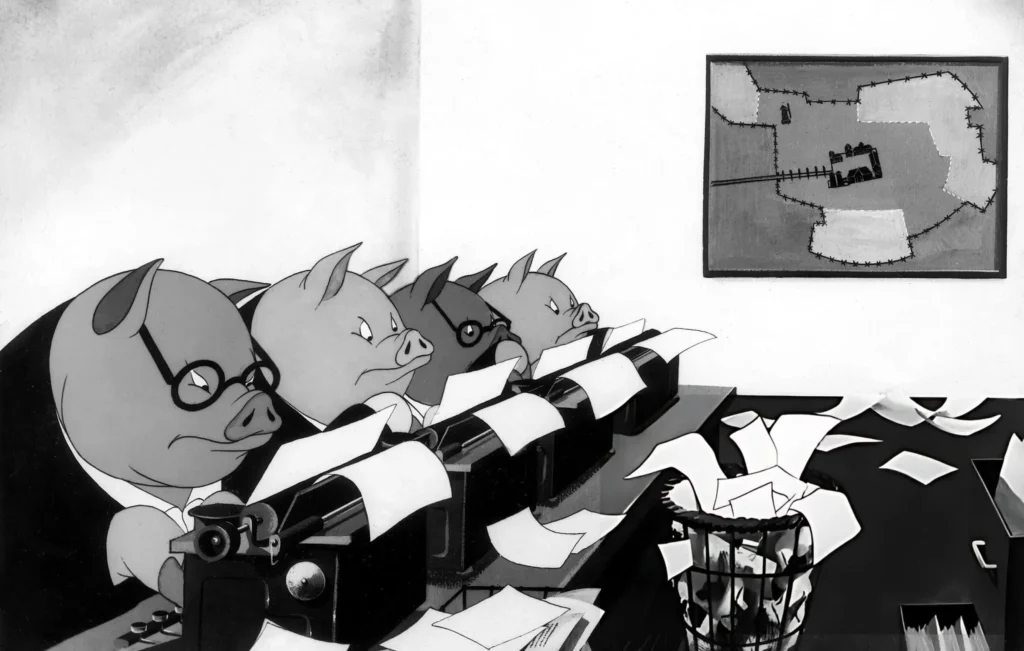
The pigs immediately take charge. They’re literate. They can read and write. So they draft the Seven Commandments—the new society’s founding principles. Whatever goes upon two legs is an enemy. Whatever goes upon four legs, or has wings, is a friend. No animal shall wear clothes. No animal shall sleep in a bed. No animal shall drink alcohol. No animal shall kill any other animal. All animals are equal.
The farm prospers at first. Everyone works. The harvest is theirs. They rename the place “Animal Farm.” There’s a collective pride in building something new. The pigs, particularly Napoleon (a large, fierce-looking Berkshire boar) and Snowball (more vivid and inventive), become the decision-makers. Squealer, a brilliant speaker, handles communications.
Word spreads to neighboring farms. Jones tries retaking his property, leading humans in an armed assault. The animals fight back in what becomes known as the Battle of the Cowshed. Snowball, who’d studied military strategy, leads the defense brilliantly. The animals win. Snowball is decorated for bravery. He seems the natural leader.
Why mention this battle? Because it establishes Snowball at his best—making his later demonization even more effective. Heroes are easier to destroy when everyone remembers their heroism.
But Napoleon is playing a different game. Months earlier, he’d taken nine newborn puppies, claiming to “educate” them privately. No one sees them again. Not yet.
Notice the long-game planning here. Authoritarians don’t improvise their coups. They prepare. While everyone debates windmills, Napoleon is building his private army.
Then the cracks appear.
It starts small. The milk from the cows disappears. Squealer explains the pigs need it for brain work—leading is exhausting. The apples, too. Hardly anyone objects. Leadership does require energy, right? Besides, Squealer reminds them, “Surely, comrades, you do not want Jones back?”
Snowball proposes building a windmill to generate electricity and reduce labor. His plans are detailed, visionary. Napoleon opposes it without explanation. During the crucial vote, Napoleon lets out a high-pitched whimper. Nine enormous dogs—those missing puppies, now fully grown and vicious—burst into the barn. They chase Snowball off the farm. He’s never seen again.
Napoleon declares himself leader. No more debates. No more votes. The Sunday meetings where animals discussed farm business? Abolished. He announces they’ll build the windmill anyway—but it was his idea all along, he claims. Snowball stole the plans. Snowball was a traitor working for Jones from the beginning.
See the pattern forming?
The pigs move into the farmhouse. They start sleeping in beds. When the animals check the Commandments, something’s changed. “No animal shall sleep in a bed with sheets.” Squealer explains they’d misremembered. Surely the Commandments never forbade beds entirely—just the decadent human practice of sheets. The animals doubt their own memories.
Work intensifies. The windmill construction is brutal. Boxer, the massive cart-horse, becomes the farm’s backbone. His personal motto: “I will work harder.” Napoleon is always right, he tells himself. When problems arise, Boxer works longer hours. When he’s exhausted, he blames himself for not working hard enough. The other animals follow his example—if Boxer trusts Napoleon, shouldn’t they?
The windmill is completed. A storm destroys it overnight. Napoleon immediately blames Snowball—the traitor sabotaged them. The evidence? Pig footprints that Napoleon “analyzes” as Snowball’s. He offers rewards for Snowball’s capture.
Paranoia spreads. Napoleon announces Snowball is sneaking onto the farm at night, causing accidents, stealing corn. Several animals begin “confessing” to crimes—conspiring with Snowball, planning sabotage. Napoleon’s dogs tear out their throats in front of everyone. The pile of corpses grows. The animals are silent, terrified.
If you’re thinking this feels extreme, remember: public violence isn’t about punishment. It’s about messaging. Who dares question authority after watching throats ripped out? Fear doesn’t need logic. It just needs visibility.
Fear takes root.
The Commandment about killing gets quietly altered: “No animal shall kill any other animal without cause.”
The pigs start trading with neighboring humans—the very humans they’d revolted against. They sell farm products for money. A human farmer named Frederick agrees to buy timber, pays with forged banknotes, then attacks the farm with armed men. The Battle of the Windmill destroys the windmill again. The animals win, barely, but many are wounded.
Sound familiar? When things go wrong, blame sabotage. Blame traitors. Blame external enemies. Never blame the system. Never question the leaders who made the deal.
Napoleon celebrates the “victory.” He begins drinking whiskey from Jones’s old supply. The Commandment about alcohol? Now reads: “No animal shall drink alcohol to excess.”
Years pass. Boxer ages. He’s promised a peaceful retirement. Instead, he collapses from exhaustion mid-labor. Napoleon promises he’s being sent to the veterinarian for treatment. A van arrives. Benjamin, the cynical old donkey who can read, runs after it shouting. The side of the van says “Alfred Simmonds, Horse Slaughterer and Glue Boiler.”
Boxer is being sold for whiskey money.
Squealer explains the van had recently been purchased by the veterinarian—the previous owner’s sign hadn’t been painted over yet. Boxer died peacefully in excellent care, he assures them, his final words praising Napoleon. The pigs hold a memorial dinner. With whiskey purchased from Boxer’s sale.
More time passes. The pigs start walking on two legs. Wearing clothes. Carrying whips. The sheep, trained to bleat “Four legs good, two legs bad,” now bleat incessantly: “Four legs good, two legs better.”
One Commandment remains on the barn wall, painted over the original seven: “All animals are equal, but some animals are more equal than others.”
The story ends with neighboring human farmers visiting for dinner. They’re playing cards with the pigs in the farmhouse, laughing and drinking together. The ordinary animals peer through the window from the cold outside. They look from pig to human, human to pig, pig to human again.
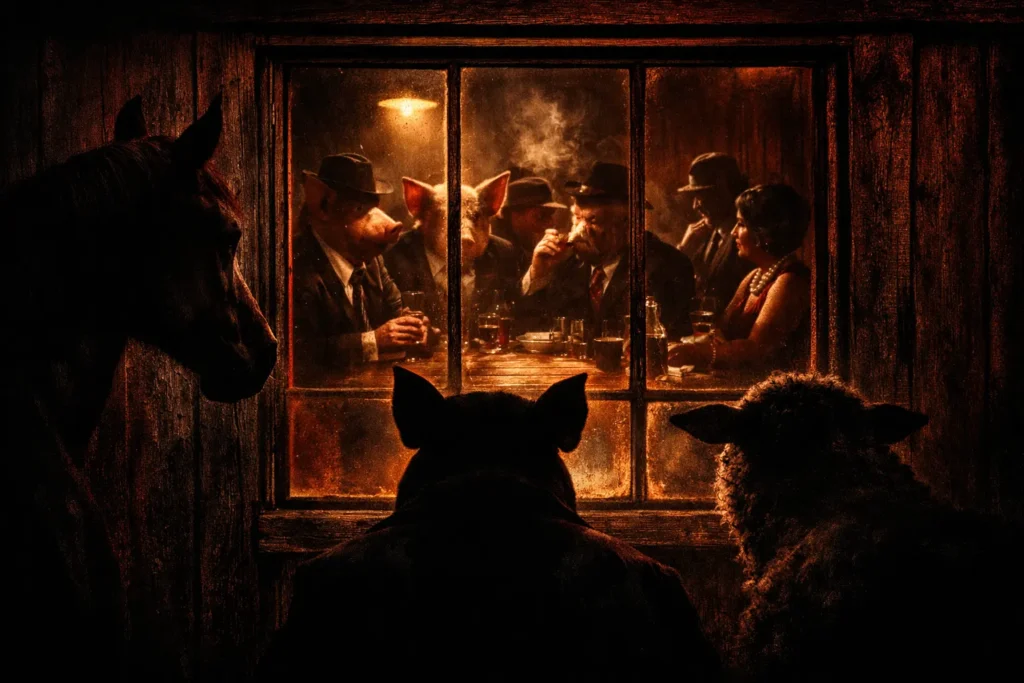
They can’t tell which is which.
That’s the revolution’s final state. Not modified. Not compromised. Completely inverted. The oppressed became the oppressors, using the same tools, wearing the same clothes, wielding the same power.
Orwell didn’t write a story about how revolutions can go wrong. He wrote about how they inevitably corrupt when power consolidates without accountability, when language becomes a weapon, when the exhausted stop questioning.
Now let’s examine the psychology underneath.
Boxer: The Tragedy of the Exploited Worker
Boxer is the book’s most heartbreaking character. He’s not a fool. He’s loyal, hardworking, and genuinely committed to making the revolution succeed. His two personal maxims define him: “I will work harder” and “Napoleon is always right.”
When the windmill collapses, Boxer doesn’t question. He works harder. When rations are reduced, Boxer doesn’t complain. He works harder. When animals are executed and blood soaks the ground, Boxer is troubled—but he trusts Napoleon must have good reasons. He works harder.
Here’s what Orwell understood about exploitation: It doesn’t require elaborate deception. It just requires exhaustion.
Boxer represents every person who’s ever believed that dedication alone will save them. Work hard enough, stay loyal enough, and you’ll be rewarded. The system will take care of you. Your effort matters. But Boxer’s loyalty becomes his prison. He’s too tired to think critically. By the time he finishes a sixteen-hour workday, he doesn’t have the mental energy to question why the pigs live in luxury while he sleeps in a stable.
Sound familiar? How many people do you know who are too exhausted from survival to examine the systems exploiting them?
Or think about gig economy workers, too burned out from multiple jobs to organize for better conditions. Activists so exhausted from constant crises they can’t strategize long-term. Parents working two shifts who don’t have energy to research school board candidates. Exhaustion doesn’t just prevent action—it prevents the thought that action is even possible.
The pigs understand this. They don’t need to convince Boxer that inequality is good. They just need to keep him working until his body gives out. And when it does—when Boxer finally collapses, his lungs failing—Napoleon sells him to a glue factory. The ultimate betrayal. Boxer’s final reward for unwavering loyalty is slaughter.
Orwell shows us something uncomfortable: good intentions and hard work aren’t enough. Without critical thinking, without questioning authority, dedication becomes complicity. Boxer isn’t stupid—he’s simply been conditioned to believe that doubt equals disloyalty.
The most chilling part? Boxer never understands what happened to him. He dies still believing Napoleon will save him, still trusting the system. That’s not a story about horses. It’s a story about us.
Squealer: The Anatomy of Propaganda
If Boxer represents the exploited, Squealer represents the machinery that keeps exploitation running smoothly. He’s Napoleon’s spokesperson, a brilliant manipulator who can “turn black into white.”
Let’s break down his tactics. They’re not abstract—they’re terrifyingly specific.
Tactic 1: Memory manipulation.
When the pigs take the milk and apples, animals question it. Squealer responds: “You do not imagine, I hope, that we pigs are doing this in selfishness? Many of us actually dislike milk and apples.” He reframes theft as sacrifice. The pigs aren’t taking extra—they’re bravely consuming things they hate for the greater good. Then comes the threat: “Surely there is no one among you who wants to see Jones come back?”
Notice what he does. He doesn’t defend the inequality. He makes questioning it seem dangerous. Jones becomes the boogeyman. Critique the pigs, and you’re inviting back the old oppressor.
Tactic 2: Rewriting history.
After Snowball is expelled, Squealer begins altering the past. Snowball wasn’t heroic at the Battle of the Cowshed—he was secretly fighting for Jones. The animals remember differently, but Squealer has documents. He has “evidence.” Slowly, their memories become unreliable. If Squealer says it and Napoleon confirms it, then maybe they misremembered. Maybe Snowball was always a traitor.
This is gaslighting at scale. Make people doubt their own experiences.
Tactic 3: Technical jargon and complexity.
Squealer rattles off statistics. He quotes production figures: “Comrades, our grain output has increased by 35% compared to Jones’s era!”—but no one can verify if Jones ever kept records, or if 35% is accurate, or if it accounts for their larger workforce, or what “output” actually measures. He uses complicated terms. He reads from papers covered in numbers. The animals can’t follow the math. They feel stupid for not understanding. So they stop asking questions. If it’s this complicated, the pigs probably know best.
Complexity becomes a weapon. Make people feel ignorant, and they’ll stop challenging you.
Tactic 4: Constant movement and emotional escalation.
Squealer doesn’t just speak—he performs. He skips side to side. He whisks his tail. His arguments come fast, layered, overwhelming. Before you can process one claim, he’s made three more. By the end, you’re exhausted and confused. It’s easier to just agree.
Tactic 5: The veiled threat.
Always, beneath everything, there’s an implication: Jones could return. Things could be worse. You don’t want to be labeled a traitor, do you? Squealer rarely makes direct threats. He doesn’t need to. The dogs lurking behind him make the point clearly enough.
Here’s the terrifying part: Squealer’s methods work. They work in the book. They work in real life. Every authoritarian regime uses these exact tools—control the narrative, rewrite the past, complicate simple truths, exhaust critics, threaten dissenters.
Orwell didn’t invent propaganda. He dissected it. And once you see Squealer’s playbook, you start recognizing it everywhere.
The Sheep, Benjamin, and Mollie: Three Types of Citizens
The other animals represent three ways people respond to authoritarianism.
The sheep are the herd.
They bleat slogans without understanding them. “Four legs good, two legs bad” becomes a mindless chant they repeat whenever discussion gets complicated. They’re not evil. They’re not even stupid. They’re just completely disengaged from critical thinking.
The pigs retrain them easily. When the pigs start walking upright, the sheep switch to “Four legs good, two legs better” without questioning the contradiction. They accept what authority tells them to accept. They believe what they’re told to believe.
Why? Because thinking is hard. Conformity is easy. If everyone’s bleating the same thing, there’s safety in joining the chorus. You don’t stand out. You don’t make waves. You belong.
The sheep are every person who’s ever repeated a talking point without examining it, who’s ever gone along with the crowd because dissent felt too risky.
Benjamin is the cynic.
The old donkey sees everything. He’s literate. He’s observant. He watches the Commandments change. He knows Boxer is being sent to slaughter. He understands exactly what’s happening.
And he does almost nothing.
Benjamin represents the people who know better but stay silent. He’s too detached, too cynical, too convinced that nothing ever changes. “Donkeys live a long time,” he says. He’s seen it all before. Why bother resisting? The pigs will do what pigs do. The pattern always repeats.
His inaction is its own form of complicity. When he finally runs after Boxer’s van, screaming the truth, it’s too late. That’s the tragedy of cynicism—it mistakes awareness for action. Seeing the problem doesn’t solve it. Benjamin’s intelligence becomes useless because it’s paired with passivity.
Mollie is the comfort-seeker.
The white mare loves ribbons and sugar cubes. She likes being admired. The revolution means work and equality—things that don’t interest her. So she leaves. She finds a human who’ll pamper her. She chooses personal comfort over collective freedom.
Mollie represents everyone who opts out when things get hard. She’s not fighting for the pigs or against them. She’s just… gone. Checked out. Pursuing her own small pleasures.
There’s honesty in that, maybe. At least she doesn’t pretend. But her absence means one less animal to question authority. One less voice to object.
These three—the mindless followers, the passive observers, the checked-out escapists—enable tyranny as much as the tyrants themselves. Evil doesn’t require everyone to be cruel. It just requires most people to be silent, distracted, or too exhausted to care.
Which one are you when things go wrong? Which one are you right now?
Animal Farm Character Archetypes
Which type of citizen are you?
Boxer
The Exhausted Worker
“I will work harder.” Loyalty without questioning. Too tired to think critically.
Squealer
The Propagandist
Turns black into white. Weaponizes language. Makes you doubt your own memory.
The Sheep
The Herd Follower
Bleats slogans without thinking. Safety in conformity. Never questions the crowd.
Which One Are You?
We contain all these characters at different times
Napoleon
The Power Seeker
Consolidates control methodically. Eliminates rivals. Builds authority slowly.
Benjamin
The Cynical Bystander
Sees everything. Does nothing. “Nothing ever changes.” Intelligence without action.
Mollie
The Comfort Seeker
Opts out when things get hard. Personal pleasure first. Checked out entirely.
Napoleon’s Playbook: How Tyranny Takes Root
Napoleon doesn’t seize absolute power overnight. He builds it methodically, using a playbook that’s been repeated by authoritarians throughout history. Let’s map the stages.
Stage 1: Establish yourself as necessary.
Napoleon doesn’t try to be loved. He’s not charismatic like Snowball. But after Old Major dies, someone needs to lead. Napoleon positions himself as the practical choice—the one who gets things done while others debate. He’s steady. Reliable. Safe.
Stage 2: Start with small, justifiable privileges.
The milk and apples aren’t tyranny. They’re reasonable accommodations for brain workers. Most animals accept this logic. After all, the pigs are organizing everything. Don’t they deserve something extra? It’s a tiny inequality. Hardly worth fighting over.
This is crucial. Napoleon doesn’t demand absolute power immediately. He establishes the principle that some inequality is acceptable. Once that line is crossed, moving it becomes easier.
Stage 3: Eliminate rivals before they become threats.
Snowball is popular. His windmill plans excite the animals. He’s a genuine threat to Napoleon’s control. So Napoleon acts decisively. The dogs—his private military, trained in secret for months—chase Snowball away. No trial. No vote. Just violence, quick and brutal.
Notice the timing. Napoleon waits until he has the force to win, then strikes when Snowball is most vulnerable.
Then comes the narrative control.
Snowball can’t defend himself because he’s gone. So Napoleon transforms him from hero into traitor. The Battle of the Cowshed, where Snowball led the defense? Actually, Snowball was fighting for Jones. Those medals and memories? Fabrications.
This is more sophisticated than simple lying. Napoleon creates an alternate narrative so complete that questioning it means denying “obvious” facts. The animals’ own memories become suspicious. If Napoleon says it happened this way, and Squealer confirms it with “documents,” then maybe memory is unreliable.
Next, the external enemy appears.
Jones is gone, but Napoleon keeps him present as a threat. Every problem gets blamed on Jones sympathizers. Every failure becomes sabotage by Snowball. The windmill collapses? Snowball did it. Crops underperform? Snowball’s agents are responsible.
The external enemy serves two purposes: it explains away failures, and it makes internal dissent seem like treason. Critique Napoleon, and you’re helping Snowball. Helping Jones. Betraying the revolution.
When words aren’t enough, violence follows.
The executions are Napoleon’s master stroke. He doesn’t just kill dissidents quietly. He makes it a spectacle. Animals are forced to confess—likely under torture—then slaughtered in front of everyone. The pile of corpses delivers a message: This is what happens to traitors.
After that, who dares object? The cost of speaking up is death. The safety of silence is survival.
Finally, the new normal settles in.
By the end, pigs walking upright isn’t shocking—it’s just how things are. The animals barely remember the original Commandments. The current state feels inevitable. Napoleon isn’t a tyrant; he’s just… in charge. That’s how it’s always been, hasn’t it?
This is the final stage: when the oppressed can’t even imagine an alternative. When the revolution itself becomes a distant fairy tale.
You’ve seen this pattern before. Maybe in governments. Maybe in corporations. Maybe in families or religious communities. The details change. The structure remains. Small compromises, eliminate threats, rewrite history, create enemies, instill fear, normalize control.
Napoleon didn’t invent tyranny. He just executed it perfectly.
Napoleon’s Tyranny Playbook
How Authoritarianism Takes Root
Establish Necessity
Position yourself as the practical choice while others debate.
Small Privileges
Start with justifiable inequalities. Move the line gradually.
Eliminate Rivals
Remove threats decisively before they can defend themselves.
Control Narrative
Rewrite history. Make questioning facts seem suspicious.
External Enemy
Blame outsiders for failures. Make dissent seem like treason.
Instill Fear
Public violence delivers a message. Silence becomes survival.
Normalize Control
The oppressed can’t imagine alternatives. This is how things are now.
The Seven Commandments: Watching Ideals Die
The Commandments aren’t just rules—they’re the revolution’s soul. Watch how each one dies:
The original seven are painted on the barn wall:
- Whatever goes upon two legs is an enemy.
- Whatever goes upon four legs, or has wings, is a friend.
- No animal shall wear clothes.
- No animal shall sleep in a bed.
- No animal shall drink alcohol.
- No animal shall kill any other animal.
- All animals are equal.
Memorize these. Because watching them change is watching your own principles erode in real time.
The pigs don’t erase them. That would be too obvious. Instead, they add subtle modifications—a word here, a phrase there. The animals, mostly illiterate, can’t verify. They just know something feels different.
“No animal shall sleep in a bed with sheets.” See? Beds were never forbidden. Just the human luxury of sheets.
“No animal shall drink alcohol to excess.” Moderate drinking was always acceptable.
“No animal shall kill any other animal without cause.” The executions weren’t violations—they were justified punishments.
Each addition chips away at the absolute principle. “Equal” becomes “equal, with conditions.” Freedom becomes “freedom, within limits.” Justice becomes “justice, as we define it.”
Eventually, all seven are erased and replaced with one: “All animals are equal, but some animals are more equal than others.”
It’s not even subtle anymore. It’s openly contradictory. But by this point, contradiction doesn’t matter. The animals are so beaten down, so confused about what the original Commandments even said, that they accept this nonsense logic.
Orwell shows us how principles die: not through dramatic rejection, but through gradual modification until the words mean nothing. You keep the language of equality while implementing hierarchy. You speak of freedom while tightening control. The vocabulary remains. The meaning disappears.
Watch the language people in power use. When they start adding qualifiers to absolutes—”free speech, but…” or “equal treatment, except…”—you’re watching Commandments change in real time.
Seven Commandments: Watching Ideals Die
How Principles Erode in Animal Farm
(Beginning)
(After Corruption)
Why Revolutions Fail: The Uncomfortable Truth
Here’s where Orwell gets really uncomfortable. Was this revolution doomed from the start?
The animals had one massive disadvantage: ignorance. Most couldn’t read. Most couldn’t do math. They depended entirely on the pigs to organize, plan, and communicate. The moment the pigs monopolized education, the power imbalance became inevitable.
Knowledge is power. Not metaphorically—literally. The pigs could read. They could write. They controlled information. The other animals had to trust whatever the pigs told them because they had no way to verify independently.
Think about how this works today. Company executives understand balance sheets; workers don’t. Politicians read full bills; voters see headlines. Tech platforms control algorithms; users just scroll. The information asymmetry isn’t a bug—it’s the system. Those with knowledge set the terms. Those without knowledge accept them.
Orwell was a democratic socialist. He believed in the revolution’s goals—genuine equality, worker control, ending exploitation. But he didn’t romanticize revolution. He understood that overthrowing oppressors doesn’t automatically create freedom. If you don’t address power structures, education, and accountability, you just replace one set of oppressors with another.
The tragedy isn’t that bad pigs corrupted a good revolution. The tragedy is that the revolution created conditions for corruption. No checks on power. No educated populace to hold leaders accountable. No mechanisms to remove leaders peacefully. Napoleon didn’t hack the system—he used it as designed.
This is what makes Animal Farm so brutal. Orwell’s not saying, “Be careful who leads revolutions.” He’s saying, “Revolution without structural safeguards inevitably corrupts.”
Was there a way to succeed? Maybe. If all animals were educated. If power was genuinely distributed. If there were term limits, transparency, peaceful transitions. If, if, if.
We see this pattern play out everywhere. Financial literacy programs get cut while predatory lending thrives. Media literacy isn’t taught in schools while misinformation spreads. Complex legal language keeps people dependent on expensive lawyers. The people with power benefit from everyone else’s confusion. And they call it “protecting people from complexity.”
But those protections require foresight, organization, and sustained effort. The animals, exhausted and desperate, just wanted Jones gone. They didn’t think about what comes after. By the time Napoleon consolidated power, it was too late.
The uncomfortable truth: good intentions aren’t enough. Anger at injustice isn’t enough. You need systems that prevent power from corrupting. Without those, you’re just rotating oppressors.
The Ending: Why Orwell Left Us With Despair
Orwell could have given us hope. A final uprising. Boxer’s death inspiring revolution 2.0. The younger animals learning from mistakes and trying again.
He didn’t.
Instead: pigs and humans, indistinguishable, playing cards and laughing together. The animals outside in the cold, looking through the window, unable to tell oppressor from oppressor.
Why this bleak ending?
Because Orwell wanted us to understand something: the cycle doesn’t break automatically. Oppression doesn’t end just because time passes. The farm doesn’t liberate itself.
The pigs have become humans. Not symbolically—literally. They walk upright. Wear clothes. Carry whips. Trade with neighboring farms. The revolution’s complete inversion is total. Every single principle has been violated. And the most horrifying part? The pigs don’t see themselves as hypocrites. They see themselves as leaders doing necessary things. They’ve rationalized every betrayal.
The animals looking through the window represent us. Watching powerful groups merge, watching them protect each other’s interests, watching them exploit everyone below while maintaining they’re fundamentally different.
But they’re not different. That’s the point. Pig or human, communist or capitalist, revolutionary or reactionary—when power concentrates without accountability, the results look identical.
Orwell didn’t write a happy ending because there isn’t one. Not yet. The story doesn’t end with the last page. It ends when we—the ones looking through the window—decide we’ve seen enough.
The book doesn’t offer solutions. It offers a warning: This is what happens when you stop questioning. This is what happens when exhaustion replaces vigilance. This is what happens when we let others think for us.
The ending is bleak because the reality is bleak. But bleakness isn’t the same as hopelessness. Orwell gave us this story so we’d recognize the pattern before we’re trapped in it.
The question isn’t what the animals should have done. The question is: What will we do?
Why This Book Haunts Us 80 Years Later
Animal Farm endures because the patterns are universal. Orwell aimed at Stalin, but he hit something deeper—the mechanics of how power corrupts anywhere, under any ideology, in any era.
You don’t need a revolution to see these patterns. They appear in corporate cultures where executives insist “we’re all family” while cutting benefits and suppressing unions. They appear in organizations that start with idealistic missions—equality, community, justice—then slowly develop hierarchies, inner circles, and people more equal than others.
Watch how language gets weaponized. Companies rebrand layoffs as “rightsizing.” Governments call surveillance “security.” Bad news becomes “challenging opportunities.” Just like Squealer turning “theft” into “necessary sacrifice,” modern institutions use vocabulary to disguise uncomfortable realities.
Look at how exhaustion works. Boxer’s endless labor isn’t just a metaphor for Soviet work camps. It’s every person working two jobs who’s too tired to research candidates before voting. Every employee too burned out to question why productivity rises while wages stagnate. Exhaustion is a political tool. Keep people struggling to survive, and they won’t have energy to organize resistance.
The external enemy tactic shows up constantly. Politicians blame immigrants, or the other party, or foreign nations for domestic problems. Corporate leaders blame market conditions, competitors, regulations—anything except their own decisions. Create an enemy, and people unite against it instead of examining who’s actually in charge.
And the herd mentality? Social media perfected it. Algorithms show us information confirming what we already believe. We exist in echo chambers, surrounded by people bleating the same slogans. Dissent gets drowned out. Nuance disappears. Just like the sheep mindlessly repeating “Four legs good, two legs bad,” we share hot takes without investigating, retweet without reading, believe because everyone we follow believes.
Here’s what makes Animal Farm genuinely prophetic: Orwell understood that the danger isn’t just authoritarianism. It’s our vulnerability to it. The animals weren’t stupid. They were tired, trusting, and gradually conditioned to accept unacceptable things. Sound familiar?
The book remains relevant because human nature hasn’t evolved. We’re still exhausted workers like Boxer. Still susceptible to manipulation like the sheep. Still cynical bystanders like Benjamin. Still seeking comfort like Mollie. We contain all these characters, activated by different circumstances.
The question isn’t whether these patterns exist. The question is: Can you recognize them before it’s too late?
Who Should Read This
Read Animal Farm if you want to understand power—how it’s gained, maintained, and justified. It’s essential for anyone in leadership positions, because it shows what not to become. It’s crucial for anyone being led, because it shows what to watch for. Read it if you’re part of any organization with hierarchy—because you’ll recognize the patterns. Read it if you’re exhausted and wondering why nothing changes—because it explains how exhaustion serves power. Read it if you’ve ever felt like you’re going crazy questioning something everyone else accepts—because it shows how gaslighting works at scale.
Don’t read it expecting comfort. This book disturbs. It doesn’t offer easy solutions or happy endings. If you want inspiring stories about successful revolutions, look elsewhere.
Do read it if you’re willing to ask uncomfortable questions about systems you’re part of. About workplaces that demand loyalty without offering security. About movements that started with ideals but developed hierarchies. About your own moments of being Boxer, or Benjamin, or a sheep bleating slogans.
The book is short—you can finish it in an afternoon. But it’s dense. Every character serves a purpose. Every detail matters. This isn’t light reading. It’s a surgical examination of how tyranny works.
High school students often read it too early. The allegory is obvious, but the psychological depth requires life experience. You need to have seen propaganda work. Watched institutions corrupt. Felt exhaustion prevent action. Then you understand why it’s a masterpiece.
Read it slowly. Pay attention to the moments when Commandments change, when animals doubt their memories, when Boxer chooses loyalty over questions. Those moments are the lessons.
Final Verdict: A Warning That Never Expires
Animal Farm is not our history. It’s our mirror.
Orwell wrote about Stalin’s Russia, yes. But he also wrote about British colonialism. American capitalism. Every system where power concentrates and ordinary people pay the price. He wrote about the eternal struggle between those who rule and those who serve, and how easily the second group becomes the first when given opportunity.
The genius is its universality. You can’t read it as a comfortable critique of someone else’s system. Whatever ideology you hold, whatever country you’re in, whatever era you’re living through—this book examines you. It asks: When do you stop questioning authority? What exhaustion makes you complicit? Which of these characters are you right now?
Seventy-nine years after publication, it’s still banned in multiple countries. Still controversial. Still uncomfortable. That’s how you know it’s working. Books that tell convenient truths don’t threaten anyone. Books that expose how power actually operates get banned.
The bleakness isn’t nihilism. It’s honesty. Orwell refused to lie. He refused to promise that awareness alone fixes things, or that time heals tyranny. The farm doesn’t liberate itself. The cycle doesn’t break automatically.
But here’s what the book gives us: pattern recognition. Once you’ve seen Napoleon’s playbook, you spot it everywhere. Once you’ve watched Squealer manipulate language, you hear it in press conferences and board meetings. Once you’ve understood Boxer’s exploitation, you recognize it in yourself and others.
That recognition is the first step. Not the solution—the first step. Orwell didn’t write this book to save us. He wrote it so we couldn’t claim we didn’t know. So we couldn’t say we didn’t see it coming.
The question the book leaves us with isn’t “What would you have done on Animal Farm?” The question is: “What are you doing now, in the systems you’re part of, watching power concentrate, watching language get twisted, watching exhaustion prevent resistance?”
Because the farm isn’t over there. It’s here. It’s wherever we are, whatever we’re building. And the animals looking through that window—confused, cold, unable to tell oppressor from oppressor—they’re us.
The warning doesn’t expire. It just waits to see if we’re listening.