
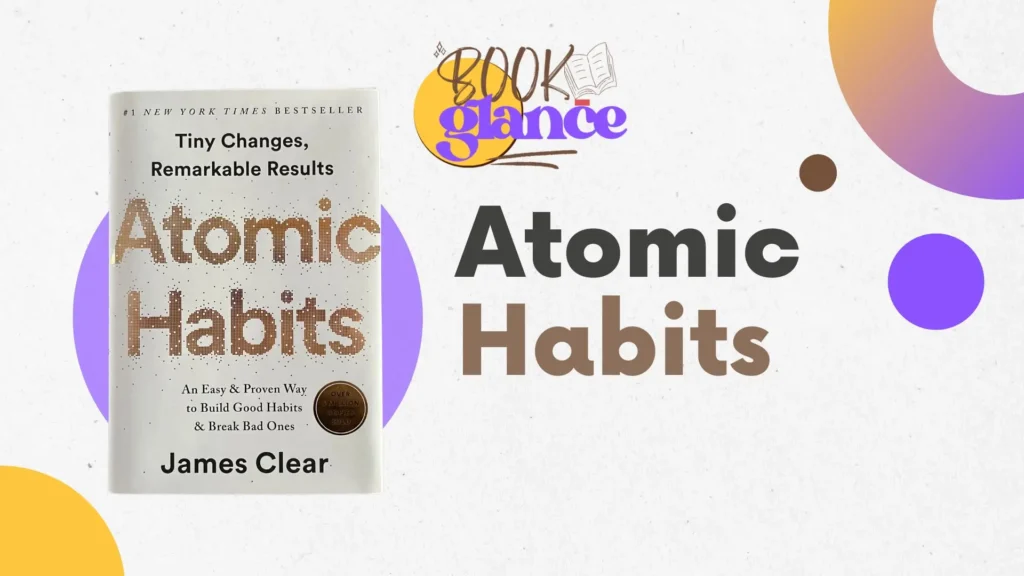
If you get 1% better each day for one year, you’ll end up 37 times better by year’s end. Get 1% worse? You’ll decline to nearly zero. Atomic Habits by James Clear reveals why your results have almost nothing to do with goals and everything to do with systems. You’ll learn the Four Laws that make good habits inevitable and bad habits nearly impossible.
One-Sentence Takeaway
Atomic Habits shows that remarkable results come from tiny changes repeated consistently—using a four-part framework that works with human psychology instead of fighting it.
“You do not rise to the level of your goals. You fall to the level of your systems.”— James Clear,Atomic Habits
Who This Helps & What You’ll Learn
Read this if you’ve set New Year’s resolutions that failed by February. If you know exactly what you should do but can’t make yourself do it consistently. If you’re tired of relying on willpower and want a systematic approach.
You’ll learn:
- The Four Laws of Behavior Change that work with your brain’s wiring, not against it
- Why identity transformation beats goal-setting every time
- Environment design strategies that make good habits automatic
- The 1% rule and why small improvements compound exponentially
- How to break bad habits by inverting the Four Laws
Why It Matters
You need a system for building habits that actually stick. Every January you start strong—gym memberships, reading goals, productivity apps. By February, you’re back where you started. The cycle repeats, and each failed attempt chips away at your confidence.
But here’s what really frustrates you: you already know what to do. You don’t need another article explaining why exercise is important. The problem isn’t knowledge—it’s the maddening gap between knowing and doing. You feel like you lack discipline, watching others succeed at habits you can’t maintain.
Here’s the truth: you don’t lack discipline—you lack a system. Most habits fail because we rely on motivation (which fades) and willpower (which depletes). Winners and losers at the Olympics have identical goals. The difference? Daily systems.
Without a framework, you’ll keep fighting the same battle. But master the Four Laws, and you’ll design environments where good habits happen automatically. The math is brutal: 1% daily decline leads to nearly zero within a year. But 1% daily improvement? You’ll be 37 times better. Your life’s trajectory depends on the systems you build today.
Core Concepts Overview
Before diving into the Four Laws, you need to understand the complete ecosystem. At the foundation: you don’t rise to your goals, you fall to your systems. This explains why Olympic winners and losers often have identical goals but radically different results. Goals give direction; systems make progress.
Every habit runs through the Habit Loop—a four-stage cycle:
- Cue: Trigger that starts the behavior
- Craving: Motivation to act
- Response: The habit itself
- Reward: Benefit you receive
The Four Laws work because they target each stage precisely. Law 1 affects the cue. Law 2 affects the craving. Law 3 affects the response. Law 4 affects the reward. You’re not fighting your brain—you’re working with its existing wiring.
But there’s a deeper level: identity-based habits outlast outcome-based goals. “I’m trying to quit smoking” still identifies as a smoker. “I don’t smoke” is a different person. When behavior flows from identity, you don’t need willpower—you’re just acting like who you are.
The Four Laws: Your Complete Framework
This is the operating system for building any habit or breaking any bad one.
Law 1: Make It Obvious
What it does: Makes the cue unavoidable so your brain can’t miss it.
How to apply it: Use implementation intentions—research from Peter Gollwitzer shows that being specific doubles follow-through rates. Instead of “I’ll exercise more,” specify “I will exercise at 6am in my living room on Monday, Wednesday, Friday.” Clear himself uses habit stacking: “After I pour my morning coffee, I will write for 10 minutes.” The coffee automatically triggers writing.
Clear struggled with guitar practice until he bought a stand and placed the guitar in the center of his living room—impossible to ignore. Practice went from once per week to daily. Same person, different visibility.
To break bad habits: Make the cue invisible. Anne Thorndike at Massachusetts General Hospital didn’t eliminate junk food—she just made water more visible throughout the cafeteria. Water sales jumped 25%, soda dropped 11%.
Law 2: Make It Attractive
What it does: Creates desire so you actually want to do the habit.
How to apply it: Use temptation bundling—pair what you need to do with what you want to do. Ronan Byrne, an engineering student, hacked his stationary bike to power his laptop and TV. The electronics only worked while cycling. He watched the entire Game of Thrones series while losing weight. Or join a culture where your desired behavior is normal. The Polgar sisters became chess prodigies because their father created an environment where chess mastery was expected. All three became champions.
To break bad habits: Make them unattractive. Calculate the cost. A pack-a-day smoking habit costs $5,110 per year. Transfer $14 daily to a “Dream Vacation” account. Watching the balance grow makes NOT smoking attractive.
Law 3: Make It Easy
What it does: Reduces friction so starting requires minimal effort.
How to apply it: The Two-Minute Rule—scale your habit down until it takes two minutes or less. “Read 30 pages” becomes “Read one page.” Twyla Tharp, choreographer with 160 Broadway credits, has one rule: put on gym clothes and call a cab to the gym. That’s her entire habit. Most days she works out for two hours once she’s there, but the habit is just “call the cab.”
Clear describes preparing for his morning routine by laying out journal, pen, and coffee supplies the night before. His morning routine doesn’t start when he wakes up—it starts the night before when he reduces morning friction to zero.
To break bad habits: Add friction. Nir Eyal bought a $10 outlet timer and set it to cut power to his router at 8pm. If he wanted internet after 8pm, he had to physically unplug the timer and rewire the router. That added friction broke his evening distraction habit within a week.
Law 4: Make It Satisfying
What it does: Provides immediate reward so your brain wants to repeat the behavior.
How to apply it: Track visually. Jerry Seinfeld’s method: get a wall calendar and mark an X after completing your habit. Your only job: don’t break the chain. The visual progress becomes addictive while you wait for long-term results. When an insurance salesperson struggled with calls, he used two jars—one filled with beans, one empty. Every completed call meant moving one bean. He could physically see his productivity.
To break bad habits: Make them immediately unsatisfying. Bryan Harris, entrepreneur, signed a contract: if he didn’t publish an article every Monday, he’d pay his trainer $200. The immediate pain of losing money outweighed the pleasure of skipping. He published for 52 consecutive weeks.
“Every action you take is a vote for the type of person you wish to become.”— James Clear,Atomic Habits
Identity-Based Habits: The Deeper Transformation
The Four Laws are the mechanism. But there’s a deeper level that makes habits permanent: identity change.
Clear reveals three levels of change:
Level 1: Outcomes — “I want to lose 20 pounds” (temporary—motivation disappears after achieving)
Level 2: Process — “I’ll go to the gym three times weekly” (better, but still requires willpower)
Level 3: Identity — “I’m a healthy person” (permanent—behavior flows naturally from belief)
When someone offers you a cigarette, there are two ways to decline. “No thanks, I’m trying to quit” still identifies as a smoker—willpower required. “No thanks, I don’t smoke” is a different identity—no willpower needed. The second person isn’t resisting temptation; they’re acting consistently with who they are.
How to shift identity:
Step 1: Decide who you want to become. Not what you want to achieve, but what type of person. “I’m the type of person who shows up on time” beats “I want to be punctual.”
Step 2: Prove it with small wins. Every action is a vote for that identity. One pushup is a vote for “I’m athletic.” One page read is a vote for “I’m a reader.” Accumulate enough votes, and you win the election—you become that identity.
Alcoholics Anonymous succeeds through identity transformation. Members don’t say “I’m trying not to drink”—they say “I’m a non-drinker.” They establish identity first: “I’m a person who attends AA meetings.” Over time, it evolves: “I’m a sober person.” Behavior follows identity.
Practical Examples & Environment Design
Theory is clear—now let’s see it in action.
Clear’s personal gym habit reveals all Four Laws working together. He chose a gym on his direct route home from work—two-minute detour (Law 3: Easy). He packed his gym bag the night before and placed it by his door (Law 1: Obvious). He paired the gym with his favorite podcast, which he only allowed himself during workouts (Law 2: Attractive). He bought a wall calendar and marked an X after every session. After a 100-day streak, continuing the chain became its own reward (Law 4: Satisfying).
For eating habits, environment beats willpower. Clear keeps healthy food at eye level in clear containers—you see fruit immediately. Unhealthy snacks go on high shelves in opaque containers. Research from Brian Wansink at Cornell shows that when candy moved from transparent to opaque containers, consumption dropped 28%. Same people, different environment, different outcomes.
For phone addiction, Clear charges his phone in a different room during work hours. You can’t check mindlessly if it requires walking to another room. He also enabled grayscale mode—removing dopamine-triggering colors. Instagram in grayscale looks boring.
For writing, Clear uses implementation intentions: “When I pour my first coffee at 6am, I will write for 10 minutes.” This eliminates decision fatigue. He doesn’t decide whether or when to write—the decision’s already made. Coffee triggers writing automatically.
Environment Design Examples:
- Water pitcher on counter, always visible; soda in back of bottom fridge shelf
- Fruit bowl at eye level; chips require step-stool to reach top cabinet
- Workout clothes laid out before bed; gym bag blocks the door
- Phone charges in bathroom; Kindle on nightstand
- Productive apps on home screen; social media buried in folders
The pattern: make good habits the path of least resistance; make bad habits require climbing a mountain.
Real-World Application: Your Roadmap
Week 1: Audit Your Habits
Create a Habits Scorecard. List every habit from the moment you wake up. Mark each as positive (+), negative (−), or neutral (=). Be brutally honest—this isn’t about judgment, it’s about awareness. Choose ONE habit to build and ONE to break this month. Not five. One.
Week 2-3: Apply the Four Laws
Write your implementation intention: “I will [BEHAVIOR] at [TIME] in [LOCATION].” Be absurdly specific. Not “I’ll meditate more” but “I will meditate for two minutes at 6:15am on the blue cushion by my bedroom window.”
Use temptation bundling. Pair your needed habit with something you want. Set up tracking—buy a wall calendar and red marker. After completing your habit, mark a giant X. Your only job: don’t break the chain.
Apply the Two-Minute Rule ruthlessly. “Read one page.” “Do one pushup.” “Write one sentence.” Make starting so easy you can’t say no.
Week 4: The Valley of Disappointment
Here’s what most habit books ignore: results lag behind effort. Imagine an ice cube at 25°F. You heat the room to 26°, 27°, 28°, 29°, 30°, 31°—still frozen. Then 32°—suddenly, it melts. Habits work the same way. You’re putting in effort during the plateau where you see no visible results. Most people quit here, assuming the system doesn’t work. But breakthrough comes from consistency through the valley.
British Cycling was mediocre for decades—one Olympic gold medal from 1908 to 2003. Then Dave Brailsford took over and applied “the aggregation of marginal gains”—improving everything by just 1%. Redesigned bike seats, rubbed alcohol on tires for better grip, tested massage gels for recovery, taught riders optimal hand-washing to avoid infection. Hundreds of tiny improvements. Within five years: 60% of gold medals at the 2008 Olympics. Between 2007 and 2017: 178 world championships, 66 Olympic medals, five Tour de France victories. The improvements weren’t visible month-to-month. They compounded over years.
Common Mistakes That Sabotage Success
Starting too big: “I’ll work out for an hour every day” violates Law 3. Your brain sees this as overwhelming and creates resistance. Apply the Two-Minute Rule without ego. “Put on gym shoes” is your habit. Build the identity of someone who shows up.
Focusing on goals instead of systems: Winners and losers both want gold medals. The difference is daily training protocols. Shift to systems thinking: “I’m building an identity as a person who values health.”
Trying to change everything at once: Ten simultaneous habits means none get the focus needed to become automatic. Master one keystone habit completely before stacking the next.
Missing twice: Missing once is an accident. Missing twice is the start of a new habit—the habit of NOT doing the thing. It breaks your identity and destroys momentum. Clear’s most powerful rule: never miss twice. If you miss Monday’s workout, do something—even one pushup—on Tuesday.
Ignoring environment: You might resist junk food for days or weeks, but eventually, in a moment of weakness, the path of least resistance wins. Don’t rely on future-you to have more discipline. Engineer inevitability.
Final Verdict & Next Steps
Read Atomic Habits if you’ve repeatedly failed at building habits using willpower alone. If you want a scientific, systematic approach backed by neuroscience. If you’re willing to start absurdly small (even when your ego resists) and trust the compounding process. If you value practical frameworks with clear steps over theoretical discussions.
Skip or supplement if you want deep neuroscience explanations—read The Power of Habit by Charles Duhigg for that depth. Or if you need clinical therapy-level support for trauma or addiction—this is self-help, not clinical treatment.
Comparison to Other Habit Books:
vs. The Power of Habit: Duhigg explains WHY habits work (neuroscience, fascinating case studies). Clear explains HOW to build them (practical four-part framework). Read Duhigg first to understand the science, then Clear to implement it.
vs. Tiny Habits: BJ Fogg focuses on celebration and emotion after tiny habits. Clear focuses on environment design and systems. If you respond to celebration, try Fogg. If you prefer systems, choose Clear.
Honest Limitations: The framework assumes you control your environment—not everyone can redesign their workspace or choose what food enters their home. It assumes individual behavior change is the solution (Western/individualistic perspective). It doesn’t address trauma, clinical depression, or addiction at clinical levels. And the 1% rule is metaphorical—some actions are binary (ask someone to marry you or don’t).
Your Transformation: You started wanting to understand why your habits fail. You now have a complete behavior-change operating system, the identity framework that goes deeper than goals, and the diagnostic tool to troubleshoot failures. This knowledge doesn’t expire. Whether you want to meditate daily, write consistently, or break phone addiction, you now have the framework that makes good habits inevitable.
Next Steps:
Today: Complete the Habits Scorecard. Choose ONE habit. Write your implementation intention.
This week: Buy a wall calendar and marker. Apply Law 1 to your chosen habit. Redesign one environment.
This month: Track daily—don’t break the chain. Apply “never miss twice” religiously. Build your identity through daily votes.
Long-term: Master one habit before stacking another. Trust the compounding. Remember: you don’t rise to your goals—you fall to your systems.
The trajectory of your life is determined by the systems you build today. Start with 1%.
Book Details
Book: Atomic Habits: An Easy & Proven Way to Build Good Habits & Break Bad Ones
Author: James Clear
Genre: Self-Help / Personal Development
Publication Year: 2018
Publisher: Avery
Pages: 320
ISBN: 978-0735211292
Summary Length: 2,047 words
Reading Time: ~8 minutes
BUY THE BOOK: Get Atomic Habits on Amazon
AUTHOR WEBSITE: Visit James Clear’s Website