

The word “priority” entered the English language in the 1400s. For the next five hundred years, it had no plural form. There was no such thing as “priorities” — because the concept itself resisted multiplication. You had one. The thing that came before everything else. Then, sometime in the twentieth century, we invented the plural. We began talking about our “top five priorities,” our “quarterly priorities,” our “three priorities for this meeting.” We said the word enough times that it stopped meaning anything.
Greg McKeown noticed this. It is the best paragraph in Essentialism, and it appears on page sixteen.
What follows from that observation is a sustained argument for going back to the singular. Not as a productivity hack. Not as a time-management system. As a philosophy — a way of deciding, at every choice point, whether this particular thing belongs in your life at all.
McKeown calls people who live this way Essentialists, and the contrast he draws with everyone else is deliberate and a little uncomfortable. Non-Essentialists, he argues, react to whatever appears in front of them. They say yes by default, no by accident. They confuse being busy with making progress, and they end up contributing a little to a lot of things and a lot to almost nothing.
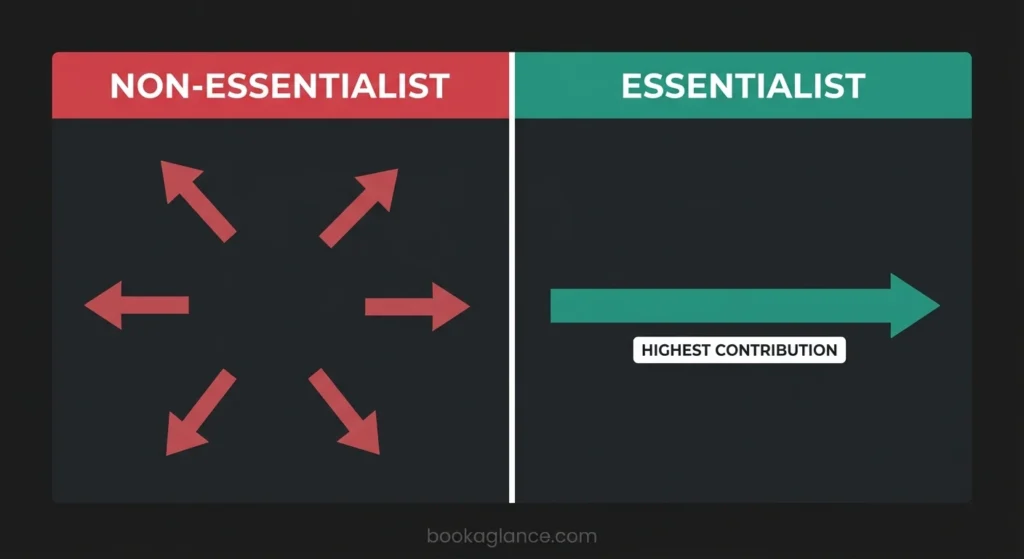
The Essentialist does the opposite:
“Only once you give yourself permission to stop trying to do it all, to stop saying yes to everyone, can you make your highest contribution towards the things that really matter.” — Greg McKeown, Essentialism
That is the entire book in one sentence. McKeown knows this. Essentialism is not a book that hides its argument — it announces it on page one and spends 250 pages finding different ways to demonstrate why it matters.
For readers who already know instinctively that they are doing too much, the repetition can feel like being told repeatedly that the building is on fire. For readers who genuinely believed that doing more was the path forward — that the answer to feeling overwhelmed was better systems, more efficient mornings, one more habit — the repetition is the point. The assumption it replaces took years to build.
The Sharpest Idea in the Book Has Nothing to Do with Saying No
The sharpest thing in Essentialism is not the framework. It is not the decision criteria, or the advice on saying no, or the chapters on sleep and play that most productivity books ignore entirely. The sharpest thing is a single observation McKeown makes early, before the practical tools arrive.
Success, he argues, is its own undoing.
Not failure. Not burnout. Not bad decisions. Success — the specific experience of getting genuinely good at something — contains within it the mechanism of its own destruction. The sequence runs like this: you focus, you improve, you get results. The results attract options. The options arrive dressed as opportunities. The opportunities feel like exactly the kind of thing you should say yes to, because they are the direct consequence of everything you worked for. And so you say yes to them, and in doing so you distribute your attention across a wider and wider surface until the focus that produced the original results has been thinned past the point of use.
McKeown calls this the paradox of success. Jim Collins, writing about companies rather than individuals, called it the Undisciplined Pursuit of More in How the Mighty Fall. They are describing the same mechanism from different altitudes.
You have watched this happen to someone. The best individual contributor on any team who got promoted into management and spent the next three years in back-to-back meetings about work they used to actually do. The freelancer who built a reputation for one very specific thing and whose inbox is now full of requests for adjacent things that feel rude to refuse — because each one is technically within reach, and the money is good, and the relationship matters. The restaurant that was brilliant when it had eight items on the menu and became forgettable when it had forty.
The promotion that turned you into an administrator of the thing you used to make. That is the paradox.
What McKeown is arguing is that the moment of greatest risk is not when things are going badly. It is when they are going well enough that the doors begin to open. Because the natural human response to an open door is to walk through it — and almost no one stops to check where the corridor leads.
The Essentialist’s response is not to refuse every door. It is to ask, before walking through any of them, a harder question than most people are willing to sit with: is this the most important thing I could be doing with my time right now? Not “is this good?” Not “does this make sense?” Those questions produce a yes almost every time, because there is always a reasonable case for a reasonable opportunity. The Essentialist question is narrower and less comfortable: is this the best? And if the answer is not a clear, unconditional yes — if a case has to be constructed for it — then in practice it is a no.
That principle has a name in the book. And it is the clearest tool McKeown offers for making the philosophy operational.
The 90/10 Rule — and Why Most Good Opportunities Aren’t Good Enough
Most people use a binary when they evaluate an opportunity: does this make sense or does it not? Is it a good idea or a bad idea? That binary, McKeown argues, is the problem. Because almost everything that reaches you has already passed a basic quality filter. The bad ideas are easy. The hard ones — the ones that create the actual mess — are the reasonable opportunities. The things you could say yes to without embarrassing yourself. The things that would be fine.
Fine is what the 90/10 rule is designed to eliminate.
The mechanics are simple. When evaluating an option, identify the single most important criterion for that decision — not five criteria, one — and score the option against it on a scale of one to one hundred. Anything below ninety is a no.
Not an eighty. Not an eighty-five. Ninety.
The 90/10 Rule
Identify the single most important criterion for any decision. Score the option against that criterion from 1–100. Anything below 90 is a no. If the answer isn’t an immediate, unconditional yes — it’s already a no.
The logic is that a sixty or seventy is easy to refuse, and a ninety-five is easy to accept. The decision that costs people most is the eighty — the thing that is genuinely good but not quite right. The thing you take because it would feel strange to refuse it, because turning down a good opportunity reads socially as ingratitude or arrogance, and because the downside is not obvious until you are three months in and the thing that should have had your full attention has been getting forty percent of it instead.
This is where most productivity systems fail. They help you do more of the things you have already agreed to. They optimise the list without questioning how anything got onto it in the first place. Essentialism is not interested in helping you execute a bad list more efficiently. It is interested in the list itself — in the moment before the commitment, when the door is still open in both directions.
The 90/10 rule is deliberately extreme because the pressure to say yes is extreme. You need a standard high enough to push back against the social gravity of “this seems reasonable.” Most opportunities seem reasonable. Most things you have agreed to seemed reasonable at the time. That is not the right threshold.
What makes the rule actually useful is what it reveals when you apply it honestly. If the answer is not immediately, obviously yes — if you have to construct the argument for it, if you find yourself saying “well, technically this fits because…” — you already have your answer. The rule does not make the decision for you. It makes visible a decision you had already made and were talking yourself out of.
Why Saying No Feels Like a Character Flaw
There is a specific discomfort that comes before every genuine refusal, and McKeown addresses it directly enough that it is worth stopping on.
The discomfort is not about the decision. You often know what the right answer is. The discomfort is about what the refusal says about you — or rather, what you believe it says about you. That you are difficult. That you are not a team player. That you are arrogant enough to think your time is more valuable than the other person’s request. That you do not care.
None of this is stated out loud. It is the internal narration that runs between the moment someone asks and the moment you answer. And it is almost always wrong in the same direction: it treats yes as generous and no as selfish, which is precisely backwards.
McKeown makes the point bluntly. Every yes is a no to something else. Always, without exception — because time is the one resource that does not replenish. When you say yes to the meeting, you say no to the work. When you say yes to the project, you say no to the people who needed your full attention on the one you already had.
Cal Newport makes the same argument from a different angle in Deep Work — every commitment carries an attention cost beyond the time it takes, a residue that follows you into the next task. The meeting that ends at three does not stay in the meeting room.
The question is not whether to say no. The question is whether you choose which things to say no to, or whether you let the sequence of requests make that choice for you.
Most people let the requests choose. They say yes to what arrives, which means the shape of their days is determined entirely by other people’s priorities. The inbox is always someone else’s agenda. The meeting invite is always someone else’s agenda. The “quick favour” is always someone else’s agenda. And people who cannot say no spend their careers being extraordinarily useful to other people’s essential things, while their own remain perpetually pending.
Living by design, McKeown argues, means the choices are made in advance — before the request arrives, by having a clear enough sense of what matters that the answer to most things is not a negotiation but a simple application of what you already decided.
What This Book Gets Right That Almost Nobody Else Does
The productivity section of any bookstore is full of books about doing more. Systems for squeezing additional output from the same hours, morning routines that start at 4:30 a.m., batching and blocking and optimising every minute from waking to sleep. Essentialism does not live in that genre, and the chapters that make this clearest are the ones that would make most productivity authors deeply uncomfortable.
Play, McKeown argues, is not a reward for finishing work. It is a condition for doing work well. The research he draws on suggests that play is how the mind makes unexpected connections, finds novel solutions, and recovers the creative capacity that disciplined focus depletes. The Essentialist does not treat play as indulgence or scheduling failure. They treat it as a necessary input into the quality of everything else. Most professionals reading this will realise they have not done anything genuinely playful — aimless, non-productive, rule-free — in longer than they can remember. McKeown’s point is that this is not irrelevant to their work performance.
Sleep is treated with the same seriousness. Not as a compromise between ambition and biology, but as the primary mechanism by which the brain maintains its ability to distinguish what is actually important from what merely feels urgent. Sleep deprivation does not just make you tired. It degrades the specific cognitive function — executive decision-making — that essentialism most depends on. You cannot identify the vital few from the trivial many if the part of your brain responsible for evaluation is running on four hours.
The chapter on buffers is the most practically useful thing in the book and the least quoted. McKeown’s observation is simple: we consistently underestimate how long things take, which means we consistently schedule without slack, which means that any single delay cascades into everything that follows it. The Essentialist does not plan for the perfect scenario. They plan for the realistic one — which means building in more time than seems necessary, because the gap between the planned version of a project and the actual version is almost always larger than anticipated.
Atomic Habits makes a parallel argument: systems matter more than goals, and the system is only as good as what it excludes. The buffer is part of the system. The breathing room is the design.
The deepest chapter — the one that sets Essentialism apart from similar books — is the one McKeown calls editing. The Essentialist’s primary skill is not deciding what to add but what to remove. Not acquisition but subtraction. The metaphor he uses is the film editor, not the director: the director shoots everything; the editor makes the film. The skill is not in generating possibilities but in having the discipline to cut the ones that are good but not essential — the ones that would have made the final cut if everything else had not been better.
Most people live like directors who have never hired an editor. Their lives accumulate.
Commitments that made sense three years ago remain on the calendar because removing them feels like a statement about what they once thought was important. Projects that should have been killed at the halfway point continue because sunk cost feels like obligation. Relationships that drain more than they give continue because the end of them would require an explanation.
The Essentialist edits — continuously, without sentimentality, with the same clarity they bring to the question of what to add. This is the most difficult part of the whole project.
Where McKeown’s World Doesn’t Look Like Yours
The examples in this book are drawn almost entirely from a specific ecosystem: Silicon Valley executives, Stanford MBA graduates, corporate vice presidents redesigning their careers over long lunches. The person who appears most often in McKeown’s pages is someone who has already accumulated enough success that their problem is not scarcity but abundance — too many good options, too many people wanting their time, too many doors opening at once. The paradox of success is a real problem. It is also, by definition, a problem that requires a certain kind of success first.
This matters because the book’s central instruction — say no to the non-essential, protect your highest contribution, design your life rather than defaulting to it — assumes a degree of freedom over one’s time and commitments that is not equally distributed. The nurse working double shifts does not have a calendar full of optional meetings to decline. The person three months behind on rent does not have the luxury of refusing good-enough work while they wait for great work.
This is the book’s real limitation, and it is not a small one. McKeown gestures at it only briefly, in a passage about how even the busiest people can find fifteen minutes of space if they look for it — which is true and also somewhat beside the point.
What saves the philosophy from its framing is that the core observation is not actually about privilege. It is about the mechanism of attention, and the mechanism works the same way regardless of the scale at which you are operating. The nurse who says yes to every extra shift until she cannot function at any of them is experiencing the paradox of success in a different register. The person who takes every freelance gig that arrives rather than protecting time for the one thing they actually do well is living by default in the same way McKeown describes. The scarcity is different. The dynamic is identical.
The useful move — the one this book never quite makes explicit — is to separate the philosophy from the ecosystem McKeown illustrates it with. The philosophy is not “quit the meetings you don’t like.” It is narrower and more portable than that: figure out where your attention produces its highest return, and protect it from everything that produces less. At whatever scale your life operates. With whatever constraints you actually have, not the ones McKeown’s reader has.
Viktor Frankl, writing from circumstances that made McKeown’s Silicon Valley examples look trivial, reached a similar conclusion about the relationship between meaning and choice in Man’s Search for Meaning: that even within severe constraint, the question of where to direct one’s attention remains. The scale of constraint changes. The question does not.
McKeown does not acknowledge this. That is a real gap. It does not make the book wrong.
What the Essentialist Actually Does Differently
Most people make decisions reactively — responding to what arrives, in the order it arrives, with the resources that remain after everything else has been handled. Their lives are shaped by the cumulative weight of reasonable yeses: the request that seemed fair, the opportunity that seemed good, the commitment that seemed manageable until it joined every other commitment that seemed manageable and the total became unmanageable.
The Essentialist does one thing differently, and it happens before any of that: they decide, in advance, what the answer is. Not to every specific request — that is impossible — but to the category. They know what their essential thing is. They know what a yes to something else costs. And because they know those two things, the decision that requires everyone else to deliberate for twenty minutes takes them approximately ten seconds.
McKeown is right that most people have never genuinely asked themselves what their highest contribution is. Not what they are good at, or what earns the most money, or what other people expect from them — what they are uniquely positioned to do that matters, and that would not happen, or not happen as well, if they were not doing it. The question feels self-important. It also turns out to be the only question that makes any of the other decisions legible. The vital few only become clear once you have named the one.
Essentialism is an imperfect book. It repeats itself in the second half. Its examples live in a zip code most readers will never visit. It describes a practice — editing your own life without sentimentality — that is significantly harder than McKeown makes it sound, and it does not fully account for the structural reasons why some people have far less to edit with.
But the word “priority” was singular for five hundred years because it described something real: the one thing before everything else. We lost that when we turned it into a list. This book is an argument for finding it again.
The scale changes. The question does not.
Frequently Asked Questions
What is the main idea of Essentialism by Greg McKeown?
Essentialism argues that most people spread their time and energy across too many things, producing mediocre results across all of them. McKeown’s solution is to identify the single most important contribution you can make and protect your ability to make it — saying no to everything that competes with it, however reasonable those things might seem.
What is the 90/10 rule in Essentialism?
The 90/10 rule is McKeown’s decision-making tool: identify the single most important criterion for any opportunity, score it from 1 to 100 against that criterion, and reject anything below 90. The logic is that an 80 — good but not quite right — is the most expensive kind of yes, because it costs time without producing your best work.
What is the difference between an Essentialist and a Non-Essentialist?
McKeown argues that Non-Essentialists say yes by default and no by accident, letting other people’s requests shape their days. Essentialists decide in advance what their highest contribution is and apply that decision to incoming requests — meaning most things get a no not because they are bad, but because they compete with the one thing that matters most.
Is Essentialism worth reading?
The core philosophy is genuinely useful and the book makes its argument clearly. Its main limitation is that most examples come from Silicon Valley executives with significant control over their time — readers without that level of autonomy will need to adapt the ideas to their actual constraints. The philosophy scales down. The examples do not always.