
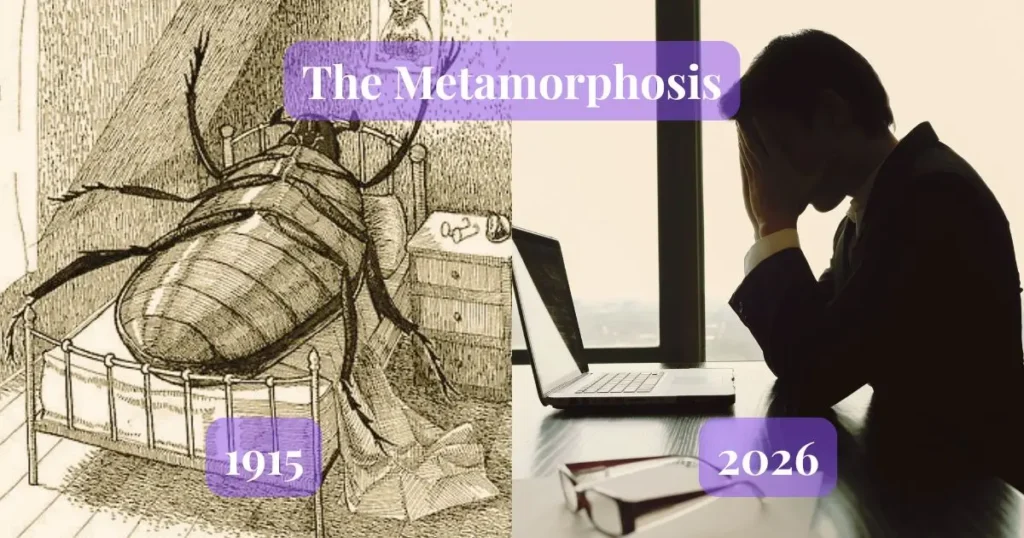
What “Kafkaesque” Really Means
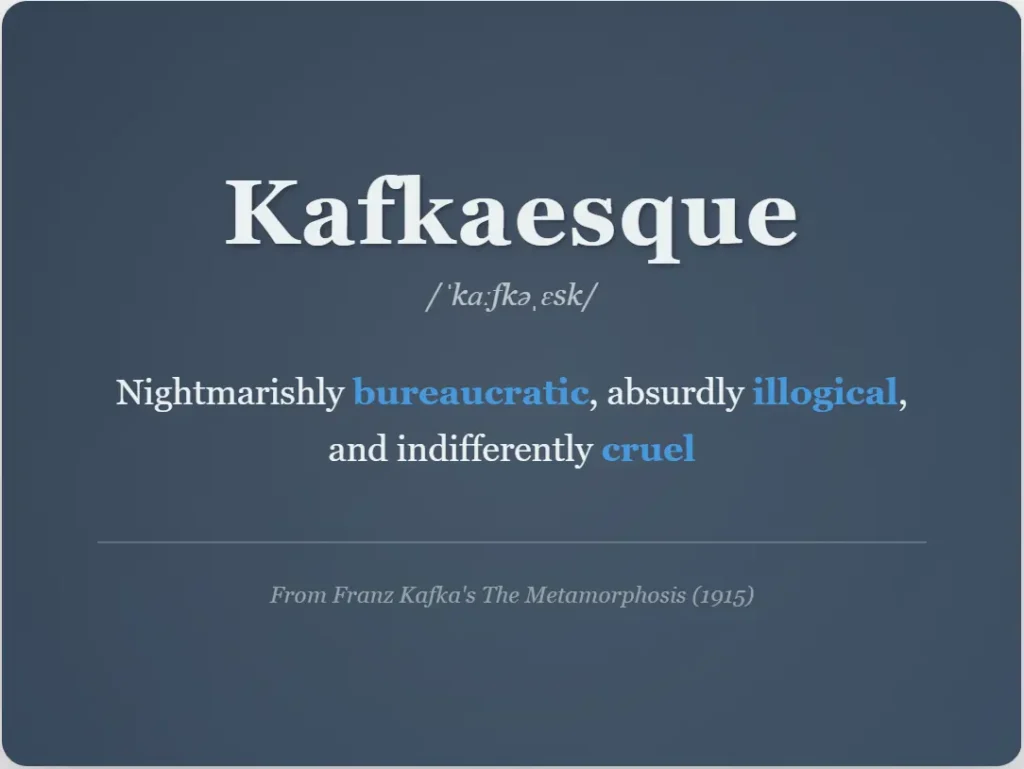
“Kafkaesque” describes situations that are nightmarishly bureaucratic, absurdly illogical, and indifferently cruel. It’s that feeling when you’re trapped in a system that doesn’t care about you as a person—only as a function.
Franz Kafka’s The Metamorphosis (1915) embodies this perfectly: a traveling salesman wakes up transformed into a giant insect. His first thought? Missing work. Not his horrifying new body—his job performance review.
This 60-page novella has haunted readers for over a century because it names something we all feel: the alienation of modern life, the quiet dehumanization of work culture, the way our worth gets measured by our productivity. In 2026, post-pandemic, it reads less like fantasy and more like documentary.
Why This Matters in 2026
You need a framework for understanding alienation. Not the abstract philosophical kind—the kind you’re living through right now. The kind that made millions realize during the pandemic that they’d been sacrificing their lives for employers who viewed them as disposable.
Here’s what’s at stake.
The Work Problem: Gregor Samsa is a traveling salesman who hates his job. He works endless hours for a boss he despises, plagued by bad food and no real relationships. But he can’t quit—his family depends on his income. Does this sound like anyone you know? Maybe someone you see in the mirror?
The Real Problem: Here’s what really frustrates you. You know you’re caught in the same trap Gregor was. You know your job is consuming your life. You know your family’s love feels conditional on what you provide. You know you’re performing a version of yourself that has nothing to do with who you actually are. But knowing doesn’t change anything. Each day you wake up and do it again. The cycle repeats: obligation, exhaustion, resentment, guilt, repeat.
The Deeper Truth: This shouldn’t be so hard. Humans have achieved remarkable things—yet we can’t escape jobs that kill our souls? Something’s fundamentally broken about how we’ve organized work and worth. You deserve to understand the system that’s crushing you. You deserve a framework that names what’s happening.
What You’re Losing: Without understanding how alienation operates at four distinct levels, you’ll keep attributing your exhaustion to personal failure. You’ll keep thinking “I just need to work harder” or “I’m not disciplined enough.” You’ll miss seeing that Gregor’s 1915 nightmare is your 2026 reality—that the pandemic didn’t create new problems, it just made visible what was always there.
But understand these four levels of alienation and you’ll see the system clearly. You’ll stop blaming yourself for systemic failures. You’ll recognize when work culture is dehumanizing you, when family relationships are transactional, when you’re losing your authentic self. That clarity is the first step toward doing something about it.
The Story in Brief
Gregor Samsa wakes up transformed into a giant insect. Thin legs. Armored brown back. Can’t flip over. And his first thought? “How will I catch my train to work?”
Not horror at his body. Not fear. Work anxiety. Notice what Gregor worries about first?
His family discovers him—mother, father, sister Grete. His boss’s chief clerk arrives to interrogate why he missed his shift. Not “Are you okay?” but “Why aren’t you producing?” The clerk lectures about job performance while Gregor struggles with his insect body. When Gregor finally opens the door, the clerk flees. His father drives Gregor back into his room with a stick and newspaper.
Part II: Grete becomes reluctant caretaker. She brings rotting food, clears his room while he hides under the couch. The family learns their finances aren’t desperate—father has savings, mother could work, they just chose not to. They let Gregor destroy himself for them.
Watch how quickly sympathy becomes resentment. Sound familiar?
They decide to remove furniture so Gregor has more crawling space. Mother faints seeing him. Father comes home, pockets full of apples, and pelts Gregor with fruit. One lodges in his back—a wound that festers for the rest of the story. A symbol of family violence masquerading as discipline.
Part III: Three lodgers move in. Gregor, neglected and starving, becomes invisible. His room turns into storage for junk. One evening Grete plays violin for the lodgers. Gregor, drawn by the music, crawls out. The lodgers see him, disgusted, threaten to leave without paying.
Grete snaps. “We must get rid of it,” she tells her parents. She refuses to call the creature her brother anymore. “It must go.”
Gregor retreats. Dies alone at 3am.
The tragedy isn’t the death. It’s what happens next.
The family feels relieved. They take a happy day trip into the countryside. The sun shines. They discuss Grete’s future—she’s become a beautiful young woman, time to find her a husband. They’ve moved on before Gregor’s body is cold. They never grieved because there was nothing to grieve. They never loved Gregor the person. They loved Gregor the paycheck.
That opening line deserves a closer look—here’s what makes it brilliant:
The Genius of the Opening Line
“As Gregor Samsa awoke one morning from uneasy dreams he found himself transformed in his bed into a gigantic insect.”
This might be the most famous opening line in modern literature. But here’s what gets lost in translation: the German original uses the word “ungeheuren Ungeziefer”—which doesn’t just mean “insect” or “bug.” It means “monstrous vermin.”
More specifically, and this matters to understanding the whole story, in Middle High German, Ungeziefer literally means “unclean animal not suitable for sacrifice.” Think about words that define worth in your own life—”productive,” “essential,” “valuable.” Now imagine the opposite.
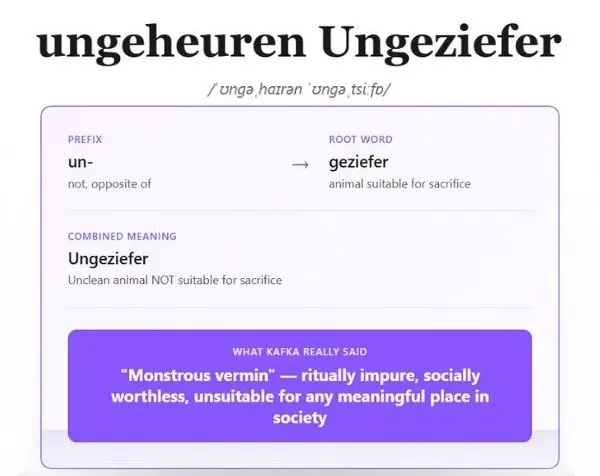
Kafka chose a word that means “ritually impure” and “unsuitable for offering.” Gregor hasn’t just lost his human body. He’s lost his social worth, his fitness for any meaningful place in society. He’s become refuse. Garbage. Something you dispose of, not something you value.
The brilliance of Kafka’s opening is what it doesn’t do. There’s no dream sequence. No gradual transformation. No explanation of how or why. The narrator states it as matter-of-factly as describing the weather. “He found himself transformed.” Like noticing you’re out of coffee.
The horror isn’t dramatized—it’s presented as fact, and everyone just has to deal with it. You feel this flatness in your own life when systems fail you and nobody acts surprised.
This is how Kafka creates the Kafkaesque effect from sentence one. The extraordinary treated as ordinary. The nightmare delivered in bureaucratic prose. The world doesn’t stop or gasp when the impossible happens. It just continues, indifferent, and you’re the one who has to adjust.
That opening line tells you everything you need to know about the world Gregor inhabits: arbitrary, absurd, and utterly unmoved by individual suffering.
Understanding these themes requires examining how Kafka structures alienation at four distinct levels—and how each one maps onto your life with disturbing precision.
Four Levels of Alienation: The Core Theme
Everyone mentions that The Metamorphosis is “about alienation.” Other summaries list it, then move on. We’re going to understand it—at four distinct levels that build on each other, creating total isolation. And you’ll see exactly how each one operates in your life right now.
Level 1: Alienation from Work
Before his transformation, Gregor is already alienated from his work. He hates his job as a traveling salesman. He despises his boss. The work is meaningless to him—he’s “plagued with the torture of traveling, worrying about train connections, eating miserable food at all hours, constantly seeing new faces, no relationships that last or get more intimate.”
But he can’t quit. His parents owe money to his employer, and Gregor is paying off their debt. He’s trapped. His body shows up for work, but his mind and spirit checked out years ago.
This is every soul-crushing job where you spend hours pretending to care about metrics that don’t matter, producing things you don’t believe in, enriching people you’ll never meet. Gregor’s alienation from work is the quiet desperation of everyone who’s ever thought “I’m wasting my life” while sitting in another pointless meeting.
When Gregor transforms and can’t work, watch what happens. His value evaporates instantly. His father, who claimed to be too ill to work, suddenly finds employment. His mother takes in sewing. His sister gets a sales job. They were capable all along—they just let Gregor sacrifice himself.
The moment he stops producing income, they treat him like a burden. Not slowly or reluctantly. Immediately.
This is the core horror: your humanity is conditional on your productivity. Stop producing, and people stop pretending you matter. Gregor’s transformation just makes visible what’s always true—you’re valued for your output, not your existence.
The pandemic revealed this brutally. “Essential workers” were praised—then exposed to disease for minimum wage while executives worked safely from home. Office workers realized they’d been sacrificing their lives for employers who’d fire them via Zoom without hesitation. Gregor died in 1915, but we’re still living his nightmare.
Level 2: Alienation from Family
Gregor believed his family loved him. He was wrong. They loved his paycheck.
Before the transformation, they accepted his support without gratitude. They didn’t celebrate his sacrifice—they expected it. His father could work but chose not to. His mother could contribute but didn’t. They let Gregor destroy himself for them, and they felt entitled to it.
The transformation reveals the truth. When Gregor can’t provide money, their affection disappears. His mother can barely look at him. His father attacks him twice—once with a cane and newspaper, once with apples. His sister Grete, initially sympathetic, grows resentful and eventually declares “it” must go.
The final scene is devastating. After Gregor dies, the family doesn’t grieve. They’re relieved. They take a happy day trip into the sunshine. They’re already planning Grete’s future marriage. They’ve moved on in hours.
This hits different when you realize how many family relationships are transactional. Your parents are proud when you get the prestigious job, disappointed when you choose a lower-paying path you actually enjoy. Your spouse respects you more when you’re climbing the ladder, less when you’re struggling. Your children admire you for your success, question your worth when you fail.
We don’t say this out loud, but Kafka does: family love often comes with terms and conditions. Produce. Succeed. Earn. Or watch the affection drain away.
Gregor’s family doesn’t reject him because he’s an insect. They reject him because he’s no longer useful. The insect body just gives them permission to say what they already felt.
Level 3: Alienation from Society
Even before transforming, Gregor is socially isolated. No friends. No relationships outside his family and job. No community. His life is work-home-work-home, an endless loop with no meaningful human connection.
The story shows how modern work deliberately isolates you. Gregor is constantly traveling, never in one place long enough to form bonds. Every interaction is transactional—customers, coworkers, the chief clerk who shows up only to threaten his job security.
There’s no solidarity, no genuine care. Just a system that extracts your labor and discards you when you’re spent.
When the chief clerk arrives to interrogate Gregor about missing work, notice what doesn’t happen: nobody asks if he’s okay. Nobody expresses concern for his wellbeing. The only question is “Why aren’t you producing?”
This is the Kafkaesque nightmare. You’re trapped in systems that see you as a function, not a person. Bureaucracy without humanity. Authority without accountability. Sound familiar?
The lodgers in Part III complete the picture. They’re strangers living in Gregor’s home, and they have more rights than he does. When they complain about seeing him, he’s the one who must hide. Society’s comfort matters more than his existence. He’s banished from his own space because he makes the paying customers uncomfortable.
This is the alienation of modern life: surrounded by people but utterly alone. Your neighbors don’t know you. Your coworkers are friendly but not friends. You’re a consumer, a user, a data point—but not a human being anyone actually sees.
Level 4: Alienation from Self
The deepest alienation is from himself. Gregor’s consciousness remains human, but his body is insect. He thinks and feels like he always did, but he can’t communicate, can’t move properly, can’t do anything that defined him. The disconnect between mind and body mirrors how work alienates you from your authentic self.
Think about it: how much of who you are disappears when you clock in? The things you care about, the person you actually are—all of it gets suppressed to perform your job role. You develop a “work persona” that has nothing to do with your real personality.
You smile when you’re miserable. You’re enthusiastic about things you find meaningless. You become a stranger to yourself.
Gregor’s transformation is literal, but we do this metaphorically every day. We contort ourselves into shapes that fit what the system demands. We lose touch with our desires, our values, our authentic responses. We don’t even notice it happening until one day we wake up and think “Who am I? What happened to the person I used to be?”
The tragedy is that even as an insect, Gregor clings to his old identity. He worries about his family’s finances. He wants to return to work. He can’t imagine a self that exists apart from his economic function. He’s so alienated from his true self that he doesn’t know what else he could be.
This is what Kafka understood: the deepest violence isn’t what capitalism does to your body. It’s what it does to your sense of self. You internalize the idea that your worth equals your productivity. You become complicit in your own dehumanization. And even when the system discards you, you blame yourself for failing to be useful enough.
This four-level framework works because Kafka maintains Gregor’s human consciousness throughout—a brilliant craft technique that creates the story’s deepest horror.
Gregor’s Humanity Trapped in Insect Form
Here’s what makes Kafka’s craft brilliant: Gregor never stops being human inside.
His body is insect. He has thin legs, an armored back, mandibles, the ability to crawl on walls. He can’t speak human language—only incomprehensible squeaks and clicks emerge. He eats rotten food and hides in dark corners. His physical form is completely transformed.
But his consciousness remains untouched. He still thinks in full sentences. He worries about his family’s wellbeing. He feels shame, love, longing, and resentment. He recognizes himself as Gregor Samsa even when everyone else sees only vermin. When Grete plays violin, he’s moved by the music and dreams of sending her to the conservatory. His mind hasn’t changed at all.
This disconnect creates the story’s deepest horror. Imagine being fully aware, fully yourself, trapped in a body that won’t obey you and a voice that can’t speak. Every thought clear, every feeling intact, but completely unable to express yourself or connect with others. You’re screaming on the inside while the outside world treats you like an object.
Kafka is showing what work alienation feels like from the inside. Your authentic self is still there—your thoughts, your desires, your humanity. But your life has become a shell that doesn’t fit who you are. You go through the motions, play the role, perform the function.
Inside, you’re screaming “This isn’t me!” But nobody hears. Nobody sees. They only see the role you play, not the person trapped inside it.
The mind-body split is also about visibility. Gregor’s insect form is what people see and react to. His human consciousness is invisible. Similarly, in modern work culture, what’s visible is your output, your performance, your metrics. Your inner life—your exhaustion, your dreams, your actual humanity—is invisible. It doesn’t count. It doesn’t matter. You could be dying inside, and as long as you meet your quotas, nobody notices or cares.
Kafkaesque Style: Absurdity as Mirror
Kafka’s writing style is itself Kafkaesque. The prose is flat, detached, almost bureaucratic. The narrator describes Gregor’s transformation with the same tone you’d use to report a broken appliance. No drama. No emotional heightening. Just: this happened, and now everyone has to deal with it.
This matter-of-fact tone is crucial to the effect. If Kafka had written this as horror, with gasping and shrieking and gothic atmosphere, it wouldn’t work. The horror comes from how ordinary everyone treats the extraordinary. Gregor worries about missing his train. His family worries about the chief clerk’s visit. The chief clerk lectures about workplace performance. Nobody responds appropriately to a man turning into an insect because everyone is trapped in their own Kafkaesque systems where absurdity is routine.
This is the genius: Kafka shows that you already live in an absurd world. You just pretend it’s normal. A man destroys his health working a job he hates to pay off debt his parents incurred—and we call this “responsibility.” A family depends entirely on one person’s income, then resents him for not earning more—and we call this “family dynamics.” An employer sends management to your home when you miss one day of work—and we call this “professional accountability.”
The absurdity isn’t the transformation. The absurdity is the system Gregor inhabited before he transformed. Kafka just made it visible.
There’s dark humor here too. Gregor struggles to get out of bed because his insect body won’t cooperate, and his main concern is punctuality. His mother faints twice, but Gregor worries he’s being an inconvenience. The lodgers complain about the quality of dinner, unaware there’s a giant insect in the next room.
These moments would be funny if they weren’t so devastating. The humor highlights the absurdity of everyone’s priorities. We laugh, but it’s the laughter of recognition—you do the same thing. You stress about email response times while ignoring your collapsing mental health. You attend mandatory fun events instead of addressing toxic workplace cultures. You optimize productivity while your actual life crumbles.
Kafka holds up a mirror, and the reflection is absurd. The question is whether you’ll keep pretending it’s normal.
The Family’s Transformation: The Hidden Metamorphosis
The title is plural in implication. It’s not just Gregor who transforms.
His father transforms from a defeated, dependent man into an employed worker who regains his authority. He starts wearing a uniform and refuses to take it off even at home, as if the work identity has consumed his personal self. He becomes harsher, more commanding, more willing to use violence against his son.
His mother transforms from someone who wanted to protect Gregor into someone who can’t bear to look at him. Maternal love has limits, apparently. Those limits are crossed when your child stops being economically viable.
His sister Grete undergoes the most dramatic transformation. She begins as caretaker, dutifully bringing Gregor food and cleaning his room. But the burden wears on her. She grows resentful. Her sympathy turns to disgust, disgust to hatred. By the end, she’s the one who demands they get rid of “it.” She refuses to acknowledge the creature as her brother. “We must try to get rid of it,” she tells her parents. “It will be the death of you both.”
After Gregor dies, she blossoms. The final scene shows her stretching “her young body” as the family discusses finding her a good husband. She’s grown into a beautiful woman with prospects. Gregor’s death freed her to have a life.
Here’s the dark irony: the family transforms into healthier, more independent, more capable people. Gregor’s death is good for them. They’re relieved. They’re hopeful. They have a future again.
The metamorphosis that matters isn’t Gregor’s transformation into an insect. It’s the family’s transformation from dependent parasites into self-sufficient adults. They needed him to disappear. His economic utility was crushing them too—not with burden, but with the comfort of not having to try. Once he’s gone, they discover they’re capable after all.
Ask yourself: would your family be relieved if you stopped being useful?
Kafka is showing how economic dependence corrupts relationships. Gregor thought he was helping his family. Really, he was enabling their dysfunction and trapping himself in a martyr role. His death liberates everyone—including, finally, himself.
The family doesn’t grieve because there’s nothing to grieve. They never loved Gregor the person. They loved Gregor the paycheck. When the money stopped, so did their affection. The insect body just made their existing feelings visible.
Modern Reflections: What Gregor Shows Us About Ourselves
You don’t need to turn into an insect to live Gregor’s life.
This is about you. Right now. Today.
The job you hate but can’t leave. The family whose love depends on what you provide. The version of yourself you perform for others while your authentic self suffocates. Gregor’s body caught up with what work had already done to his soul. His transformation made visible what happens invisibly to millions of us every day.
“You don’t need to turn into an insect to live Gregor’s life. You’re probably already doing it.”
You’re probably already doing it.
How many of us have jobs we hate but can’t quit because of debt, bills, or family expectations? How many of us define ourselves by our careers, then wonder who we are when we’re not working? How many of us perform happiness and enthusiasm while dying inside, maintaining a work persona that has nothing to do with who we actually are?
The pandemic made Gregor’s nightmare visible. Millions realized they’d been sacrificing their lives for employers who viewed them as disposable. “Essential workers” risked their health for poverty wages while being called heroes—the ultimate Kafkaesque move: praise without protection, gratitude without compensation. Meanwhile, office workers discovered that relationships they thought were friendships were just workplace proximity. Without the office, those connections evaporated.
“Quiet quitting”—doing only what your job requires and nothing more—became controversial because it revealed an uncomfortable truth: we’ve normalized expecting people to sacrifice their entire lives for work. Setting boundaries is now rebellion. Rest is laziness. Having a life outside your career is lack of ambition.
Gregor died believing his worth depended on his productivity. We’re still making that same mistake.
The question Kafka asks is brutal: if you stopped producing, stopped earning, stopped performing—would the people who claim to love you still want you around? Would you even know who you are without your job title and salary?
That’s not a question about insects. That’s a question about you.
Final Verdict: Who Should Read This
The Metamorphosis is short—about 60 pages, readable in an hour. But don’t read it quickly. This is a story that sits with you, that makes you look at your life differently.
Read this if you’ve ever felt trapped in a job that’s killing you. If you’ve wondered whether your family loves you or just what you provide. If you’re tired of performing happiness while feeling empty inside. If you’ve noticed that “work-life balance” is code for “work more efficiently so you can work even more.”
This isn’t escapist fiction. It’s a mirror. Some readers find it depressing—and yeah, it is. Gregor dies alone and forgotten, and there’s no redemption arc or happy ending. But there’s clarity. Kafka names what we usually can’t say out loud about work, family, and the quiet desperation of modern life.
You’ll finish this novella in an afternoon, but you’ll think about it for years. You’ll notice Kafkaesque moments in your own life—the absurd bureaucracies, the dehumanizing systems, the moment you realize you’re valued for what you do, not who you are.
Similar books to try: The Stranger by Albert Camus (absurdist alienation), Notes from Underground by Dostoevsky (existential isolation), The Trial by Kafka (bureaucratic nightmare), Bartleby, the Scrivener by Herman Melville (work refusal).
Final thought: Gregor Samsa woke up as an insect, but he’d been dehumanized long before that morning. The body just caught up with what work had already done to his soul. Read this to see the system clearly. Then decide what you’re going to do about it.