

Atticus Finch is one of the most beloved characters in American fiction. He is also, if you read carefully, a portrait of everything that can go wrong when a good man decides that doing the right thing is enough. To Kill a Mockingbird is not a novel about courage triumphing over prejudice. It is a novel about courage operating inside a system designed to make it irrelevant — and about what that costs the people the courage was supposed to save.
Harper Lee published the novel in 1960, the year the Civil Rights Movement was cresting into its most dangerous and most visible phase. It won the Pulitzer Prize in 1961. The 1962 film, with Gregory Peck as Atticus, became the kind of movie people showed their children as an object lesson in decency. For six decades, To Kill a Mockingbird has been taught in American schools as a book about empathy, moral courage, and the importance of standing up for what is right.
All of that is true. None of it is the whole story.
The novel Harper Lee actually wrote is more honest than the one the curriculum describes — and more uncomfortable. It is a novel in which the good man loses. The innocent man dies. The children grow up and carry the knowledge of what their town is capable of. And the lesson they take is not “justice prevailed.” The lesson they take is something closer to: now you know.
This summary covers the novel in full — the plot, the characters, the themes, and the argument Lee makes that most readers absorb without quite naming. It also takes the critical questions seriously. The white savior critique of Atticus is real and worth examining. So is the question of what the novel is actually about when you remove the inspirational framing and read what Lee put on the page.
Maycomb, Alabama: Where Everyone Already Knows
The most important thing about Maycomb is that nothing in it is surprising.
The fictional Alabama town in which the novel is set — Depression-era, dust-slow, hierarchical in the precise way that small Southern towns were hierarchical — is not a place where injustice arrives and shocks people. It is a place where injustice is the furniture. Everyone in Maycomb knows what happened between Tom Robinson and Mayella Ewell before the trial begins. Everyone in Maycomb knows what the verdict will be. The children know. The lawyers know. Tom Robinson, waiting in the county jail, knows.
What makes the trial dramatic is not suspense about the outcome. It is the spectacle of a community enacting, in public, something it prefers not to say aloud.
Scout Finch, the novel’s narrator, is six years old when the story begins and nine when it ends. She tells the story from a distance of many years, which creates the novel’s double vision: the child’s bewilderment at what adults do, and the adult’s understanding of why they did it. This gap — between what Scout saw and what she now understands — is where the novel lives. Lee uses it to show the reader the same events twice: once through the eyes of a child who cannot yet understand what she is witnessing, and once through the layered attention of someone who has had time to reckon with it. Lee constructs a coming-of-age story that refuses to deliver the comfort the form usually promises.
Scout’s world is bounded by her street, her school, and the courthouse. She narrates with the directness of a child who has not yet learned which observations are acceptable to make aloud — which means she says, plainly and without malice, the things that the adults around her have learned to leave unsaid. This is not a narrative trick. It is a literary device that lets Lee show the reader the town’s ugliness without the protective coating of adult social performance. Through Scout, we see Maycomb as it is, not as it presents itself.
The town operates on a set of invisible rules that everyone understands and no one fully states. Black residents live on one side of town. They go to a different church, use a different entrance to the courthouse balcony, are addressed by first name by white residents who expect their own names to be accompanied by a title. The lawyer’s daughter and the poor white family from the edge of town do not mix. The family with the reclusive son is a source of neighbourhood mythology rather than neighbourly concern. None of this is written into the law of Maycomb. All of it is enforced as if it were.
When Harper Lee describes this world through a child’s eyes, she does something that the academic summaries tend to miss: she makes the injustice feel banal rather than dramatic. Maycomb’s racism is not the hooded-figure variety. It is the polite kind — the kind that sits in church pews and attends county fairs and makes considered conversation, and then walks into a jury room and convicts a man it knows is innocent without particularly troubling itself about the contradiction. That banality is the novel’s most disturbing claim. The evil in Maycomb is not exceptional. It is local, familiar, and sustained by people who would be offended to be called evil.
The Depression-era setting matters more than the curriculum usually acknowledges. Maycomb’s white residents are themselves struggling — the Cunninghams pay Atticus in hickory nuts because they have no cash, and the Ewells are barely surviving on the margins. The social hierarchy Lee draws is not one of comfortable people secure in their dominance. It is one of frightened people whose primary psychological asset is their position above someone else. Tom Robinson’s conviction is not, finally, about hatred. It is about the terror of a community that cannot afford to admit what it has done. Animal Farm is the allegorical version of the same dynamic — ordinary creatures who sustain a corrupt system not because they are evil but because the alternative requires them to see themselves clearly. Maycomb’s jurors are the same calculation in human clothes.
That reorganisation never comes. Maycomb does not change.
The Trial: What Atticus Is Actually Doing
The case against Tom Robinson should not survive cross-examination. Atticus makes sure of it — and it doesn’t matter.
The facts are these: Mayella Ewell, a nineteen-year-old white woman, accuses Tom Robinson, a Black field worker and father of three, of entering her family’s property and raping her. The prosecution presents this as settled. Atticus, appointed by the court to defend Tom, takes it apart systematically. The physical evidence shows Mayella’s injuries were concentrated on the right side of her face — injuries consistent with a left-handed attacker. Tom Robinson’s left arm is entirely useless, having been caught in a cotton gin as a boy and rendered dead from the elbow down. He could not have inflicted those injuries. Bob Ewell, Mayella’s father, is demonstrably left-handed. Atticus gets him to prove it in the courtroom.
Tom himself testifies. He says he often helped Mayella with chores out of pity, because she had no one else to help her. He says that on the day in question, she kissed him — and that when her father appeared at the window and saw it, he threatened to kill her. Tom ran. The case against him is not just weak. It is, by the evidence presented in open court, a straightforward fabrication.
The jury convicts him anyway. They are out for several hours, which Atticus tells Jem is actually extraordinary — that a jury taking that long to convict a Black man in Maycomb is itself a kind of progress. Jem does not find this comforting. Neither should the reader.
What Atticus is doing in that courtroom is real and it matters. He is the only white adult in Maycomb willing to stand in front of the community and say, plainly, that what is happening is wrong. The physical courage this requires is easy to underestimate from a distance. Bob Ewell spits in his face outside the courthouse. His children are taunted. He receives a visit in the night. In 1930s Alabama, defending a Black man against a white woman’s accusation with the vigour and conviction that Atticus brings to the trial is not a safe thing to do.
And yet.
Tom Robinson is convicted. He is sent to the county prison to await appeal. Weeks later, during an exercise period, he tries to run. He is shot dead. The prison guards report that he was trying to escape. Atticus drives to Tom’s home to tell his wife Helen. That scene is reported in a single paragraph, and Lee does not linger on it. She doesn’t need to. The reader already understands what the novel has been building toward: that everything Atticus did — the preparation, the evidence, the eloquent closing argument, the genuine moral courage — was insufficient to save the life of the man he was defending.
This is not a failure of Atticus as a character. It is the novel’s central argument, stated in the plainest possible terms. Good men operating within broken systems do not fix the systems. They demonstrate the brokenness in high relief, and then they go home.
The children watch the verdict from the segregated balcony, sitting with the Black members of the community — the only people in the courthouse who stand when Atticus walks out. Scout doesn’t understand, at first, why Reverend Sykes asks them to rise. She will spend the rest of the novel, and arguably the rest of her life, coming to understand it. That moment — the Black community standing for the white lawyer who lost — is the most quietly devastating image in American popular fiction, and it is barely a sentence long.
The Mockingbirds: Innocence and What It Costs
The title arrives late in the novel, almost as an aside.
Atticus has given Scout and Jem air rifles for Christmas, with the standard cautions about what is acceptable to shoot. Miss Maudie, their neighbour, fills in the specific prohibition. Mockingbirds are not to be harmed. They don’t damage gardens, don’t nest in corncribs, don’t trouble anyone. They only sing. Killing one isn’t sport. It isn’t even useful. It is simply the destruction of something that existed entirely for the pleasure of others, and that poses no threat to anyone.
Lee makes the symbol do double duty so quietly that many readers absorb it without consciously registering it. There are two mockingbirds in the novel.
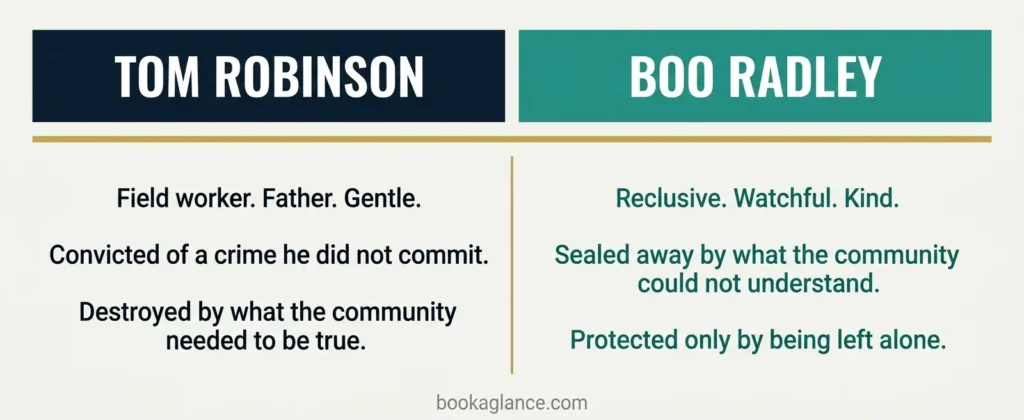
The one everyone names is Tom Robinson — a gentle man of impeccable character, whose only relevant act in the events leading to the trial was feeling sorry for a lonely woman and helping her with tasks no one else would help her with. He is destroyed not by malice, exactly, but by the community’s inability to absorb the implications of the truth about what happened in the Ewell yard.
The second mockingbird is Arthur Radley.
Boo Radley — the neighbourhood ghost, the subject of the children’s summer mythology — has not left his house in years. The Radley place is two doors down from the Finches, and for Scout and Jem’s early childhood it functions as the neighbourhood’s repository of fear: the source of a rumour, the origin of a legend, the site of the unknown. The children concoct scenarios. They dare each other to touch the front gate. They perform plays reconstructing events that may or may not have happened inside.
What they eventually discover, through the slow accumulation of small details, is that Boo has been watching them with quiet attention and considerable gentleness. He is the one leaving gifts in the knothole of the oak tree at the edge of his property — carved soap figures shaped like Scout and Jem, a pocket watch, a spelling medal, small offerings from someone who cannot come out to give them in person. When Nathan Radley, Boo’s brother, discovers the knothole and fills it with cement, Scout notes that Jem cries, for reasons she cannot fully explain.
Boo’s containment is not legally mandated. It is the product of a community that decided, a long time ago, that he was easier to mythologise than to know. Whatever happened in the Radley house in Boo’s youth — the precise details are never given — resulted in a man sealed away from the world, known only through stories that grew in the absence of facts. There is one of these in every community — the person who cannot be explained neatly, so the community explains them wrong and keeps the explanation. Boo is harmless, possibly the most genuinely kind figure in the novel, and the town has enclosed him in fear so effectively that he cannot step outside without becoming an event.
Both mockingbirds are destroyed by the same mechanism: people’s need to manage what they do not understand by containing it rather than reckoning with it. Tom Robinson is too inconvenient to be innocent, so he is convicted. Boo Radley is too difficult to be simply a man, so he becomes a legend. The sin the title names is not cruelty in the explicit sense. It is the casual, self-protective willingness of ordinary people to eliminate the things that complicate their picture of themselves.
At the novel’s end, when Boo saves Scout and Jem from Bob Ewell’s attack in the dark, and Sheriff Heck Tate rules that Ewell fell on his own knife, Scout understands what is being done and why. Exposing Boo Radley to the attention of Maycomb — the inevitable parade of gratitude and scrutiny that would follow a public acknowledgement of what he did — would be, in her father’s words, like shooting a mockingbird. The kindest thing is to let him disappear back into the quiet.
She walks him home. He goes inside. She never sees him again.
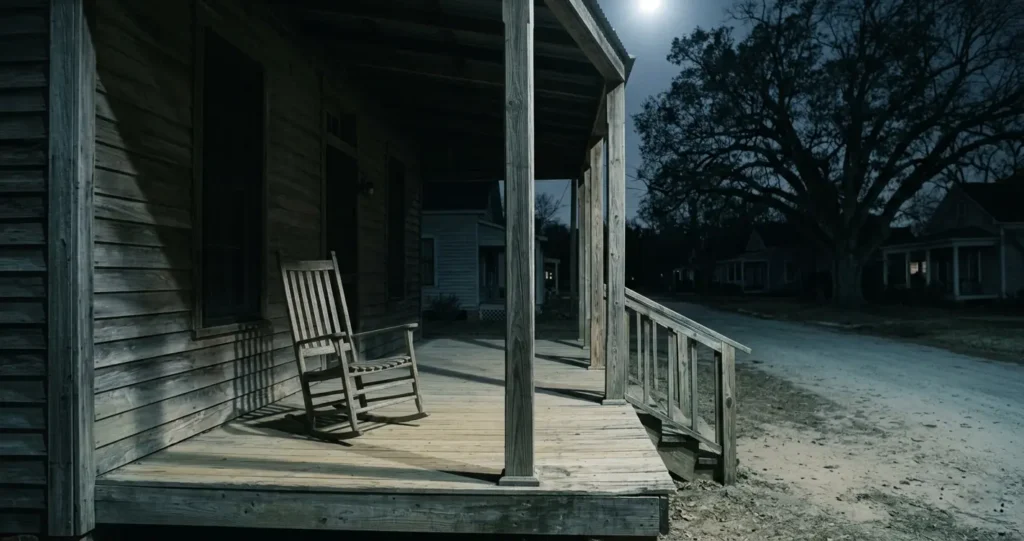
There is no triumph in this ending. There is only the recognition that some people can only be protected by being left alone — and that a community which cannot make room for them in any other way has not actually protected anyone. It has simply found a more palatable form of containment.
The Limits of Good Intentions
The white savior critique of To Kill a Mockingbird has been made often enough that it has become its own kind of received wisdom — stated in classrooms as a counterweight to the admiration, then moved past without being fully examined. It deserves better than that.
The critique, stated plainly: To Kill a Mockingbird centres the story of a Black man’s wrongful conviction and death on the moral development of a white family. Tom Robinson, whose life is the novel’s highest stake, gets relatively little interiority. We learn he is gentle, that he pitied Mayella, that he has a wife and children and a ruined arm. We do not get his fear in the jail cell, his private understanding of what is coming, his experience of the trial from the inside. His death is reported in a paragraph. The novel’s emotional energy is distributed almost entirely among the Finches — Atticus’s courage, Scout’s growing understanding, Jem’s loss of innocence. The Black community of Maycomb, who stand for Atticus in the courtroom balcony, who receive the news of Tom’s death with the weight of people who already knew this was how it would end, exist at the edges of a story that is nominally about them.
This is a real limitation. It is not the whole story.
Lee did not write a novel about Maycomb’s Black community because she was not in a position to write that novel with authority. What she wrote instead is a novel about what it looks like from inside the white community when a good man refuses to participate in a lie. That is a specific and legitimate subject. The fact that it is not the only subject worth writing about does not make it worthless. The question is not whether Lee should have written a different book. The question is what this book actually does.
What it does, among other things, is make the Ewells legible. Bob Ewell is the novel’s villain, but Lee is careful not to let him be merely a monster. He is a man at the absolute bottom of Maycomb’s white social order — poorer than anyone respectable, known as a drunk, his children barely attending school, living on the edge of the town dump. His accusation against Tom Robinson is not, at its root, about hatred, though hatred is present. It is about the one social advantage he possesses: his whiteness. The jury’s verdict is the community agreeing to protect that advantage, because the alternative — acknowledging that a Black man’s testimony is more credible than a white woman’s, that the social order is not what everyone has agreed to pretend it is — is more than Maycomb can absorb.
This is the critique of whiteness that the inspirational reading tends to bury under Atticus’s nobility. The novel is not saying: here is a bad man in a good town. It is saying: here is what ordinary people do when the architecture of their society depends on a lie they have agreed to maintain. 1984 is the political dystopia that shows what happens when that lie is enforced by a state. To Kill a Mockingbird shows what it looks like when no enforcement is necessary — when the community maintains it voluntarily, because the truth is more threatening than the lie.
Atticus knows this. His closing argument is not an appeal to sympathy. It is a direct statement of what the jury is about to do and why it is wrong — delivered in full knowledge that it will change nothing. He tells the jury that the courts are the great leveller, the one institution in American society where all men are genuinely equal before the law. He believes this. The jury demonstrates, with its verdict, that he is wrong.
The question the white savior critique raises — who does this story serve? — is worth sitting with rather than answering quickly. The novel has moved millions of white readers toward a more honest reckoning with what their communities are capable of. Whether that movement constitutes an adequate use of Tom Robinson’s death is a genuine moral question. Lee does not resolve it. Neither should any summary that is being honest about what the novel does.
What the novel cannot be accused of is false comfort. Tom Robinson dies. The system does not reform. Atticus goes home to his children and his books. The most he can offer Scout, when she walks Boo Radley home and stands for a moment on his porch looking at the street from his perspective, is the lesson he has been trying to teach her since the beginning: that most people are decent when you finally see them. It is a generous lesson. It is also, given what the novel has just shown, an incomplete one.
Why TKAM Endures — and Why It Unsettles
A book about the damage done by a white community’s refusal to speak honestly has been removed from school curricula, in part, because speaking honestly requires language that makes white readers uncomfortable. The novel has been challenged and banned in American school districts almost continuously since its publication — first for the frank discussion of rape, later and more persistently for its use of racial slurs.
This tension is itself instructive. To Kill a Mockingbird uses the language that defined Tom Robinson’s social position in Maycomb because that language was used, constantly and without apparent self-consciousness, by the people who convicted him. Sanitising it — replacing slurs with epithets or ellipses, as some editions have done — changes the emotional temperature of the novel in ways that protect the reader at the cost of the book’s argument. The discomfort is the point. A Maycomb where no one uses that language is a Maycomb that never existed, and a novel about a different town with a different problem.
The parallel with Brave New World is uncomfortable but exact: both books describe communities that condition their members not to see certain things clearly, and both are periodically removed from the shelves by communities doing exactly that.
Then there is Go Set a Watchman.
Lee’s second novel, published in 2015 after decades during which she was believed to have written nothing else, was eventually understood to be an earlier draft of To Kill a Mockingbird — a manuscript written first, in which Scout returns to Maycomb as an adult and discovers that her father attended a Citizens’ Council meeting and holds views on segregation that are, by any measure, indefensible. The revelation convulsed readers who had spent their lives with Atticus Finch as a moral touchstone. It also, for many critics, reframed the earlier novel in uncomfortable ways.
The most generous reading is that the Atticus of To Kill a Mockingbird is the character as refracted through his daughter’s childhood perception — a man who was genuinely braver than his neighbours, genuinely committed to the specific principle of fair legal procedure, and genuinely limited in ways the child narrator could not yet see. The Atticus of Go Set a Watchman is what Scout finds when she is old enough to stop needing him to be perfect. Whether Lee intended this, or whether the earlier draft simply represents an Atticus she hadn’t yet fully formed, is a question she took with her. Harper Lee died in February 2016, eight months after the book’s publication.
What Go Set a Watchman did, whatever its origins, was make it harder to read To Kill a Mockingbird as uncomplicated testimony to one man’s heroism. It made the novel’s limitations structural rather than incidental. Atticus is not a saint who exists outside his community’s prejudices. He is a man of his time and place who happens to believe, more consistently than most of his neighbours, in the formal procedures of the law. That is a real thing. It is not everything.
The novel endures because it is honest about this in ways that even its most ardent critics tend to understate. It does not end in triumph. It ends in survival — Scout and Jem alive, their father intact, their understanding permanently altered. Maycomb unchanged. The children have been taught to be better than their town. They have not been given a town worth their improvement.
For sixty years, readers have found something in that gap worth returning to. Not comfort, exactly. Something more like recognition — the experience of watching a book name, with precision and without sentimentality, the distance between the world as it is and the world as the people in it claim to want it to be. That distance has not closed. The book refuses to become history.
Which is either the best or the worst thing you can say about it, depending on who you are and where you grew up.
Frequently Asked Questions
What is the main theme of To Kill a Mockingbird?
The novel’s central theme is the gap between individual moral courage and systemic injustice. Atticus Finch is genuinely brave — he defends Tom Robinson with full commitment knowing he will lose. The system convicts Tom anyway. Lee’s argument is not that good men are ineffective, but that goodness operating within a broken system demonstrates its brokenness without fixing it.
Who are the two mockingbirds in To Kill a Mockingbird?
The two primary mockingbirds are Tom Robinson and Boo Radley — both innocent, both harmless, both destroyed by a community’s inability to accommodate them. Tom is convicted and killed because the truth about what happened in the Ewell yard is more than Maycomb can absorb. Boo is sealed away from the world because the community found it easier to mythologise him than to know him.
Why has To Kill a Mockingbird been banned?
The novel has been challenged and removed from curricula for two primary reasons: its frank treatment of rape, and its use of racial slurs. The latter creates an irony the novel’s critics rarely acknowledge — a book about a community’s refusal to speak honestly is being removed, in part, because it speaks honestly about the language that community used.
What happens to Tom Robinson?
Tom Robinson is convicted by the jury despite overwhelming evidence of his innocence. He is sent to prison to await appeal. During an exercise period, he attempts to escape and is shot dead. Atticus drives to tell his wife Helen. The novel gives the event a single paragraph. That restraint is deliberate — the reader already understands what has happened and why, and Lee trusts them to feel it without elaboration.
Is To Kill a Mockingbird worth reading as an adult?
Yes — though the adult reading is a different experience from the school reading. The child who reads it encounters Atticus as a hero. The adult who reads it encounters a precise portrait of the best that a particular kind of goodness can achieve, and an equally precise measure of where it stops. The discomfort is the point. The book is better when it makes you uncomfortable than when it comforts you.
What Scout Actually Learns
The lesson Atticus gives Scout is not what the inspirational reading says it is.
He tells her, early in the novel, that you never really understand a person until you climb into their skin and walk around in it. This is the line that gets quoted at school assemblies — the distillation of everything the novel is supposed to teach. Empathy. Perspective. The moral imagination required to see another human being as fully real. It is a genuine lesson, offered by a man who means it completely.
What the novel then does is show the reader, with painstaking care, every person in Maycomb who also failed to do this.
The jurors did not climb into Tom Robinson’s skin. The Ewells did not climb into his skin. The neighbours who whispered about Atticus did not climb into his. And Atticus himself — decent, principled, genuinely brave Atticus — did not climb into Tom Robinson’s skin either, not fully. He treated Tom’s case as a matter of legal principle. He was right to. He was also wrong to think that legal principle, argued well, in a court of law, before a jury of Tom Robinson’s peers, was going to be enough.
The gap between what Atticus teaches and what the world delivers is the space in which Scout grows up. By the end of the novel she is nine years old and she has already learned something that will take most people a lifetime to accept: that the distance between a person’s values and their actions is where the real character lives, and that the distance in Maycomb, in most of the adults she knows, is enormous. Her father’s distance is smaller than most. It is not zero.
This is what makes the novel worth reading as an adult rather than as a school assignment. The child who reads it absorbs Atticus as a hero. The adult who reads it understands that Atticus is a portrait of the best that a particular kind of goodness can achieve — and a precise measure of where that goodness stops.
He is not a failure. He is a ceiling.
He is not a failure. He is a ceiling.
Atticus Finch is genuinely brave. He is also the best that a particular kind of goodness can achieve — and a precise measure of where that goodness stops. The question To Kill a Mockingbird leaves open is whether the ceiling can be raised, and by whom, and at what cost.
The question the novel leaves open is whether the ceiling can be raised, and by whom, and at what cost. The cost in To Kill a Mockingbird is paid by Tom Robinson, who pays it with his life. It is paid by Helen Robinson, who pays it alone. It is paid by the Black community of Maycomb, who stand for Atticus in the courthouse balcony because he is the best they have been offered, and who understand, without being told, that the best on offer is not enough.
Scout walks Boo Radley home. She stands on his porch in the dark and looks at her street from where he has been watching it all these years — and she sees her own childhood rearranged, every familiar thing now legible from the outside. She sees the oak tree with the knothole. She sees the Finch house, where she and Jem played and grew and came gradually to understand what their town was. For a moment she holds two perspectives at once — hers and his — and she understands what her father has been trying to teach her.
The freedom to choose one’s response to what happens — what Frankl called the last human freedom in Man’s Search for Meaning, writing about conditions far more extreme than Maycomb — is where Atticus locates his dignity. The defeat does not retroactively void the choice. But the choice does not retroactively undo the defeat either.
Both things remain true. They do not cancel each other out. Learning to hold them simultaneously — the genuine heroism and the genuine insufficiency, the love and the limitation, the courage and the cost — is what the novel actually teaches. Not the cross-stitch version. The full version.
Read To Kill a Mockingbird if you read it in school and came away with the inspirational reading intact. The version your teacher gave you was not wrong. It was incomplete. The complete version is darker and more honest and ultimately more worth your time — because it does not comfort you about what people are capable of. It shows you clearly what they are capable of, what they do anyway, and what the best among them manage to do within that constraint. Matt Haig’s The Midnight Library asks the same question from the other direction — not what can be done within a broken world, but what it would mean to choose the life you actually want inside it. They make useful companions.
Then it asks you, without asking directly, which of those people you intend to be.