
Verity is a better thriller than most people give it credit for and a less precise one than it thinks it is.
Most readers come away from this book with an opinion about the manuscript held with unusual conviction. Not “I lean toward it” or “I find it more plausible.” They say I know. People argue about this ending with the certainty they usually reserve for things they witnessed themselves. The interesting question — the one that almost no review bothers to ask — is what Colleen Hoover did to produce that certainty. What she built into the novel before the question arrived that made the answer feel so obvious.
The answer is the romance. And that is the novel’s most intelligent move.
What Verity Actually Does — and Why It Works
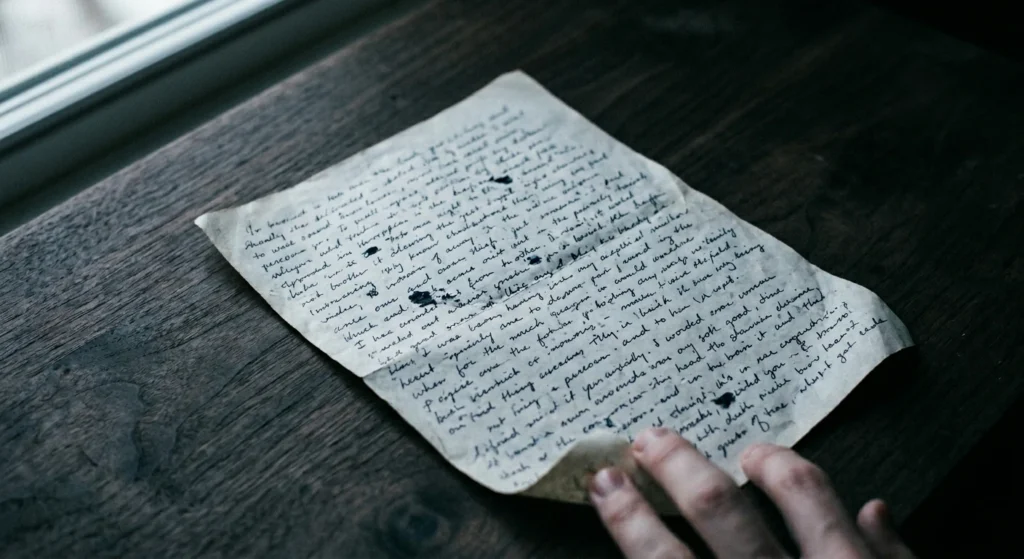
The premise is clean. Lowen Ashleigh, a struggling writer, is hired to complete the final books in a bestselling thriller series after the original author — Verity Crawford — is incapacitated following an accident. To do the job, she stays at the Crawfords’ house in Vermont, where Verity lies in a vegetative state in an upstairs bedroom and Jeremy Crawford, her husband, tries to hold what remains of his family together. Lowen finds a manuscript in Verity’s office. The manuscript is an autobiography. It describes, in clinical and disturbing detail, Verity deliberately causing the deaths of two of her three children.
That is the setup. What Hoover does with it is more interesting than a summary suggests.
The structure of Verity runs two tracks simultaneously. One track is the manuscript — Verity’s first-person account of her own monstrousness, read by Lowen in fragments across the novel’s middle section. The other track is the present-tense story unfolding in the house: Lowen and Jeremy, grief and proximity, the slow accumulation of feeling that becomes, by the novel’s second half, undeniable. These two tracks are not parallel. They are in direct conflict. And the conflict is the point.
By the time Lowen has read enough of the manuscript to begin forming a verdict about Verity, she has already fallen in love with Jeremy. This is not accidental. Hoover sequences the novel so that the romantic attachment comes first — not fully, not consciously, but enough to compromise objectivity. Enough that when Lowen reads Verity’s account of what she did to her children, she is reading it as a woman who has already begun to want Verity’s husband. Her judgment about the manuscript is not neutral. It cannot be. And neither, crucially, is the reader’s.
Because the reader falls too. Not for Jeremy specifically — though Hoover writes him with enough warmth and damage to make that plausible — but for the story Lowen is living. You are inside her perspective entirely. You feel what she feels. And by the time the manuscript asks you to decide whether Verity is a killer, you have already been shaped by weeks of pages in which Verity’s husband is rendered sympathetic and the woman upstairs is rendered in her own damning words.
Fall in love with the man, and suddenly you want the manuscript to be fiction.
The question the book leaves you with is not just whether Verity Crawford is a killer. It is whether you would have believed the same evidence if you had not already fallen in love with her husband. — bookaglance.com
Hoover is not just withholding information and releasing it strategically — she is actively constructing the emotional conditions under which the reader receives that information. The manuscript is not just a plot device. It is an unreliable text delivered to an already-compromised reader by an already-compromised narrator. The architecture is genuinely clever, and it does not get the credit it deserves from readers who are too busy arguing about the ending to notice how they got there.
The closest analogue in recent thriller fiction is Gillian Flynn’s work — specifically the dual-narrator structure of Gone Girl, where the reader’s relationship to each narrator is managed with similar precision. Verity does not execute this as cleanly as Flynn does, and the places where it falls short are worth naming honestly. But the ambition is real, and in its best passages the novel earns it.
Where it earns it most fully is in the manuscript sections themselves. Hoover writes Verity’s voice with a flatness that is more unsettling than any amount of gothic atmosphere. The autobiography does not read like the work of someone performing monstrousness. It reads like the work of someone describing their inner life with complete and terrifying honesty — someone to whom the expected emotional responses simply did not arrive, and who recorded that absence with the same precision a scientist might use to note an unexpected result. You know what this feels like to read — the difference between a passage someone constructed and one someone remembered. The manuscript reads like memory.
Whether or not the manuscript is true, it is an extraordinary piece of writing-within-writing, and it carries the novel through its middle section with a kind of dread that the surrounding plot cannot always match.
The Manuscript vs. the Letter — Here Is What the Text Actually Says
Every review of Verity presents the ending as a genuine ambiguity and declines to take a position. This is a reasonable approach — and, for reviewers who genuinely cannot decide, an honest one. But it has become the default for reviewers who have not thought carefully about what the text actually shows, which is something different from uncertainty. There is a reading of this novel that is more defensible than the other, and it is worth making the case for it.
The position here is: the manuscript is real.
The Verdict on the Ending
The manuscript is real. Not certainly — but probably, on the basis of what the novel actually shows. The ambiguity is genuine. The evidence is not equal.
Not certainly real — the letter is well-constructed enough that certainty is not available in either direction. But probably real, on the basis of what the novel actually shows rather than what the characters say about it.
The case for the manuscript begins with the quality of its voice. Verity’s autobiography is written in a register that is difficult to fake — not because it is lurid or extreme, but because it is specific in ways that serve no narrative purpose if the document is fiction. A writer constructing a psychological exercise in villainy would need the broad strokes: the coldness, the detachment, the central crimes. What they would not need, and what the manuscript includes in detail, is the texture of ordinary domestic life rendered through the eyes of someone who experiences it without the emotional responses it is supposed to produce. The granular strangeness of Verity’s relationship to her own children — not just the violence, but the quality of attention she brings to them in quiet moments — reads as observation rather than invention.
The case for the letter rests primarily on Verity’s own claim that she wrote the manuscript as a method-acting exercise — a technique for inhabiting a villain’s perspective in order to write one more convincingly. This is, as a craft rationale, not entirely implausible. Writers do inhabit perspectives they do not hold. But the letter asks the reader to believe that Verity constructed a 400-page first-person account of her own monstrousness — including the deaths of her children, rendered with parental intimacy and physical specificity — as a professional exercise. That the document contains nothing she actually did, only things she imagined doing well enough to transcribe in her own voice, in her own handwriting, and hide under the floorboards of her home.
People do not hide writing exercises.
The other piece of textual evidence that tips the balance is Verity’s behaviour in the house. If she is genuinely incapacitated, the surveillance-like quality of her presence — the sense Lowen repeatedly has of being watched, the moments that resist the medical explanation — is irrelevant atmosphere. If she is not genuinely incapacitated, it confirms the manuscript’s picture of someone capable of sustained, calculated performance. Hoover plants enough of these moments that they function as a pattern. And patterns in fiction, unlike patterns in life, are there because the author put them there.
The letter, read through this lens, is not an exoneration. It is the final exhibit. A woman capable of everything the manuscript describes would also be capable of writing a letter designed to produce precisely the doubt that Lowen experiences in the closing pages. The doubt is not a sign that Verity might be innocent. It is a demonstration that she is as good as the manuscript says she is.
Take that reading or leave it. But the book rewards a reading, and Hoover built the evidence to support one. The ambiguity is real. It is not equal.
Where the Book Falls Short
A review that only argues for what the novel does well is not a review — it is a press release. Verity has genuine limitations, and naming them specifically is more useful than the vague reservation most enthusiastic readers attach to their recommendations.
The weakest element is the thriller architecture in the novel’s second half. Once Lowen has read the manuscript and formed her position, the novel’s job shifts from building dread to sustaining it — and Hoover is less skilled at the second task than the first. The middle third of the book, which should be the tightest section, is where the pacing loosens. Scenes that exist to develop the Lowen-Jeremy relationship are allowed to run longer than the thriller frame can afford. The romantic momentum and the thriller momentum work against each other here in a way they do not in the first act, where their conflict is productive.
The Verity-in-the-house scenes are the specific casualty. Verity’s presence — physically in the building, never directly communicating, never definitively acting — is one of the novel’s most potent conceits. Hoover earns this conceit in the setup and then underuses it in the execution. The scenes in which Lowen encounters Verity are not as carefully written as the manuscript sections. The dread is announced rather than built. You will recognise this if you read the novel thinking about it rather than through it — the difference between a moment that makes you hold your breath and a moment that tells you you should be holding your breath.
The prose, too, is uneven in ways that matter more in a thriller than in other genres. Hoover has real instincts for pace and for the management of reader emotion. She also has a tendency toward construction that tells the reader what to feel rather than producing the feeling — a move that works in romance, where emotional instruction has a different function, and works less well in psychological suspense, where the reader’s emotional state should feel discovered rather than directed.
None of this is fatal. The novel’s core mechanism is strong enough to carry the structural weaknesses. But readers who come to Verity expecting the precision of Gillian Flynn or the atmospheric command of Tana French will find a book that achieves its effects with less economy than those benchmarks. It is propulsive where they are controlled. Felt where they are engineered. The distinction matters, and knowing which side of it you prefer matters more.
Who This Book Is For — and Who Should Probably Skip It
The gap between the Verity that works and the Verity that frustrates is not a quality gap. It is a reader-type gap. The honest recommendation is conditional.
Read it if you are willing to be manipulated. This sounds like a warning but it is the recommendation for the reader who gets the most out of thrillers — the one who reads actively, who notices when the author is constructing something rather than just reporting it, who finds the mechanism interesting alongside the story. Verity is most rewarding when you can hold two experiences simultaneously: the experience of being pulled through the plot at pace and the experience of watching Hoover arrange the conditions of your credulity. That combination is rarer than it should be in genre fiction.
Read it if the ending debate sounds like a feature rather than a bug. Some readers want fiction that resolves. Verity does not offer this. What it offers is a question that you will keep answering differently depending on what you most recently thought about. If the prospect of arguing about a book for a week after finishing it sounds exhausting, skip it. If the prospect of not arguing sounds worse — this is yours.
The readers who will be most frustrated are those who came primarily for puzzle-box plotting. Verity is not that kind of thriller. The pleasure is not in assembling evidence toward a revelation — it is in being uncertain in a productive way while feeling things about the people you are uncertain about. If the mystery-mechanics are your primary source of satisfaction, the open ending will feel like a failure of nerve rather than a deliberate construction.
Readers who want a tighter thriller mechanism with the romantic tension removed entirely might find First Lie Wins a more satisfying fit — it runs the con-artist premise with considerably more plot precision and less emotional sprawl.
And skip it if you have a low tolerance for the thriller-romance hybrid as a form. The romantic subplot in Verity is not decorative and it is not separable from the thriller. If the presence of genuine romantic tension alongside genuine psychological menace feels tonally incoherent, the novel will feel like it is working against itself. Some readers experience the Lowen-Jeremy relationship as compromising the book’s seriousness. They are not wrong that it changes the register. They are wrong that changing the register is a flaw.
What This Book Actually Is
Colleen Hoover wrote Verity before she became one of the most talked-about authors in contemporary fiction. It was self-published in December 2018 to a small audience, picked up by Grand Central Publishing in October 2021, and then detonated across BookTok into something no one predicted. The trajectory matters because it tells you something about what the book is.
It is not a carefully produced literary thriller designed by a publishing infrastructure that knew what it had. It is a writer doing something instinctive — combining the two things she does well, romantic tension and emotional manipulation, and discovering that they produce something different when applied to darker material. The structural intelligence of Verity reads, in places, like it surprised its author as much as it surprised its readers. The novel knows what it is doing without always knowing why it works.
That gap between instinct and full craft command is why the book produces such divided responses from readers who approach it analytically. The mechanism is real and it is clever, but the execution has the fingerprints of someone feeling their way toward an effect rather than engineering one from the blueprint down.
The difference between Verity and something like All the Colors of the Dark — a thriller written with complete craft command in every sentence — is precisely this: Whitaker knows why every choice works. Hoover knows that the choices work. Both produce powerful reading experiences. They are not the same kind of achievement.
What Verity proves, finally, is that the thriller and the romance are not as generically distinct as their separate shelves in a bookshop suggest. The emotional architecture of each form — attachment, vulnerability, the danger of trusting someone you cannot fully know — is identical. Hoover found the overlap before most thriller writers were willing to look for it, and even where the execution is imperfect, the discovery is real.
The question the book leaves you with is not just whether Verity Crawford is a killer. It is whether you would have believed the same evidence if you had not already fallen in love with her husband. The answer, for most readers, is no. And that tells you something about how you read, about what you want to be true, about the gap between the evidence you weigh and the conclusion you reach.
That is more than most thrillers give you. It is enough.
Frequently Asked Questions
What is the ending of Verity — the manuscript or the letter?
The novel deliberately leaves this unresolved, but the evidence tilts toward the manuscript being real. The specificity of Verity’s autobiography — particularly the texture of ordinary domestic moments rendered without expected emotional responses — reads as memory rather than invention. The letter’s claim that the manuscript was a writing exercise is undermined by one simple observation: people do not hide writing exercises under floorboards.
Is Verity by Colleen Hoover worth reading?
For readers willing to be actively manipulated by a novel — and who find that experience rewarding rather than frustrating — yes. The book’s central mechanism, using the romantic plot to compromise the reader’s judgment about the thriller, is genuinely clever. Its limitations are real but not fatal: the pacing loosens in the second half and the prose is uneven in places. Read it knowing what it is.
Is Verity a romance or a thriller?
Both, and intentionally so. The romantic and thriller elements are not in separate compartments — the romance is the mechanism by which the thriller works. Lowen falls for Jeremy before she has enough information to evaluate him, which compromises her judgment about the manuscript in the same way the reader’s is compromised. Readers who want their dread undiluted will find the hybrid form frustrating. Readers who understand what the hybrid is doing will find it the novel’s most interesting quality.
How does Verity compare to Gone Girl?
Both use unreliable narration to manage the reader’s relationship with competing versions of the truth. Gone Girl executes this with more precision — Gillian Flynn’s dual-narrator structure is more controlled and the prose more consistently engineered. Verity is less economical but more emotionally immediate, and its mechanism — the romance actively corrupting the reader’s judgment — is its own distinct contribution to the form.