
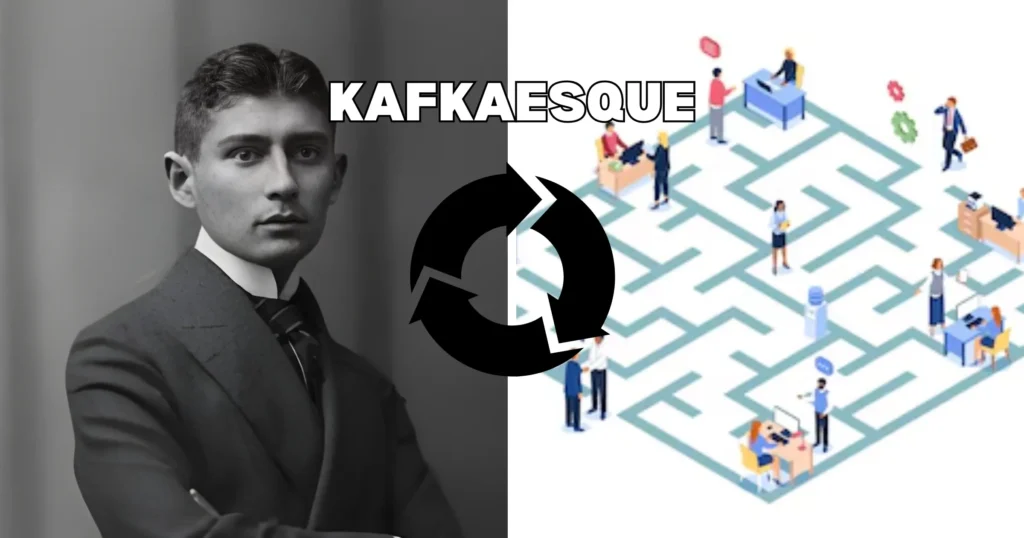
You’re trapped in an endless loop with customer service—transferred seven times, each rep asking the same questions, no one able to help. You describe it as “Kafkaesque” and your friend nods knowingly.
But here’s the thing: you both might be using the word wrong.
Most people think Kafkaesque means “bureaucratic nightmare.” It means something far more specific—and far more disturbing. Understanding the difference reveals why Franz Kafka’s century-old fiction still captures exactly what’s broken about modern systems.
Basic Definition (What Everyone Gets Wrong)
Here’s what dictionaries tell you: Kafkaesque describes situations with “nightmarishly complex, bizarre, or illogical” qualities. Merriam-Webster adds “senseless, disorienting, often menacing.”
Accurate? Yes. Complete? Not even close.
The problem with these definitions: they describe the feeling without explaining the mechanism. They tell you what Kafkaesque looks like from the outside. They don’t tell you what makes something genuinely Kafkaesque versus just frustrating, weird, or bureaucratic.
That distinction matters. And it starts with understanding the man whose name became the term—and why his life shaped the very meaning of the word.
Who Was Franz Kafka?
Franz Kafka lived from 1883 to 1924 in Prague. He worked as an insurance clerk by day, writing fiction by night. He published little during his lifetime. He died at 40 from tuberculosis, instructing his friend Max Brod to burn all his unpublished work.
Brod didn’t listen. He published everything.
Good thing. Those manuscripts became some of the most influential literature of the 20th century: The Metamorphosis, The Trial, The Castle. By 1946—just 16 years after Kafka’s death—his name had become an adjective in English.
Here’s why that happened so fast.
Kafka didn’t just imagine bureaucratic nightmares. He lived them. Every day at the Workers’ Accident Insurance Institute, he processed claims, enforced rules he found absurd, navigated Byzantine procedures that helped no one. He saw how systems designed to help people actually trapped them.
Every night at home, he dealt with his domineering father’s arbitrary authority—rules that changed without warning, expectations impossible to meet, criticism that left him paralyzed.
He knew what it felt like to be caught in systems that made no sense but demanded total compliance anyway.
His fiction wasn’t fantasy. It was documentary. He transformed his daily experience of institutional absurdity into literature that defined a new kind of nightmare—one where the horror comes not from monsters or violence, but from systems that trap you through their own illogic.
That’s why his name stuck. Because he captured something we didn’t have words for before.
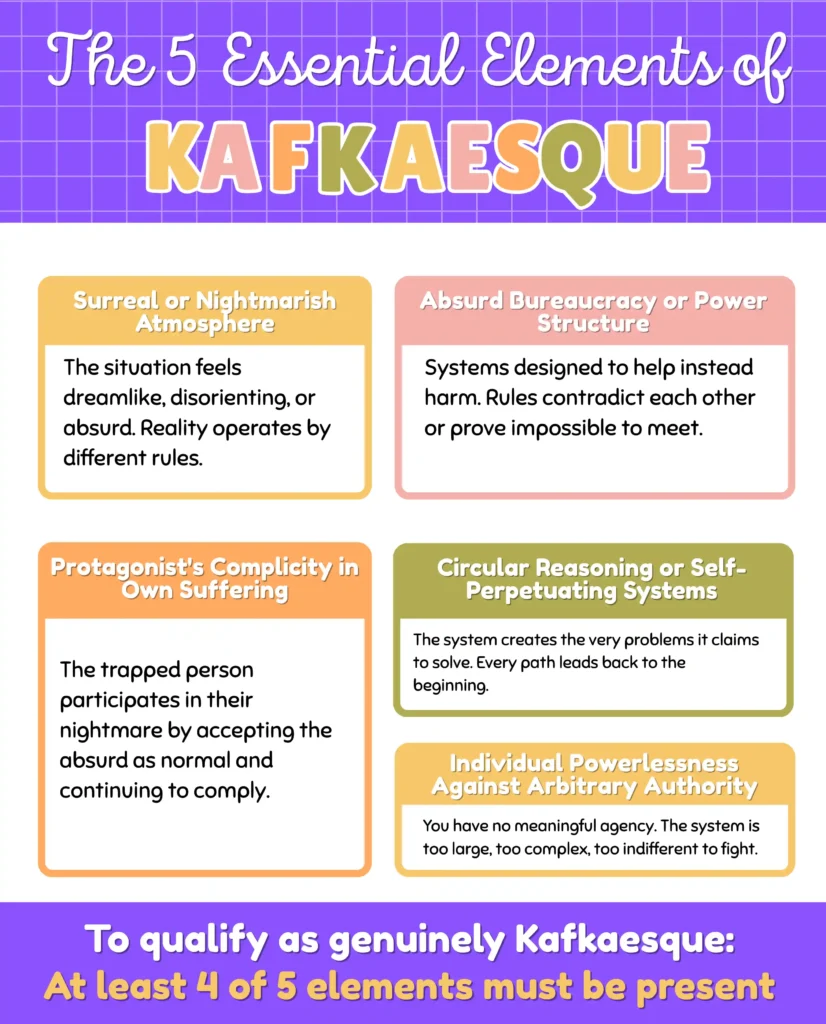
The 5 Essential Elements of “Kafkaesque”
Most people slap “Kafkaesque” on any frustrating bureaucratic situation. Here’s what actually makes something Kafkaesque—and what separates genuine nightmares from ordinary annoyances.
I’ve created a framework from analyzing Kafka’s work, studying literary criticism, and examining how the term is used correctly. Five essential elements. You need at least four of these five for something to truly qualify as Kafkaesque.
Element #1: Surreal or Nightmarish Atmosphere
The situation feels dreamlike, disorienting, or absurd. Reality operates by different rules. Logic breaks down. You can’t quite believe this is happening, yet it is.
Not just weird—impossibly weird. Like waking up as a giant insect and your main concern is being late for work.
Element #2: Absurd Bureaucracy or Power Structure
Systems designed to help you instead harm you. Rules contradict each other. Requirements prove impossible to meet. Authority figures can’t or won’t explain the logic.
The bureaucracy isn’t just inefficient. It’s fundamentally irrational. The harder you try to navigate it, the more trapped you become.
Element #3: Circular Reasoning or Self-Perpetuating Systems
Here’s where it gets darker.
The system creates the very problems it claims to solve. You need Document A to get Document B, but you need Document B to qualify for Document A. The solution causes the problem. The cure is the disease.
And you can’t escape because there’s no exit built into the system. Every path leads back to the beginning.
These first three elements appear in plenty of frustrating situations. But the next two—especially #5—are what separate true Kafkaesque nightmares from mere bureaucratic annoyance.
Element #4: Individual Powerlessness Against Arbitrary Authority
You have no meaningful agency. Authority is arbitrary, capricious, or unknowable. You can’t appeal to reason or justice because neither governs the system.
You might be told rules exist, but no one can produce them. Or the rules change mid-process. Or different officials give contradicting instructions. And you? You can’t fight back. The system is simply too large, too complex, too indifferent.
Element #5: The Protagonist’s Complicity in Their Own Suffering
This is the kicker. This is what most people miss.
In genuinely Kafkaesque situations, the protagonist isn’t just a victim. They participate in their own nightmare. They accept the absurd as normal. They comply with impossible demands. They keep trying to navigate the system even when it’s clearly designed to trap them.
It’s not stupidity. It’s something more disturbing: the internalization of systemic absurdity. They’ve accepted that this is just how things work.
Kafka scholar Noah Tavlin nailed this in the TED-Ed video that’s become the definitive Kafkaesque explainer: “It’s not just the absurdity of bureaucracy—it’s the irony of the characters’ circular reasoning in reaction to it.”
That’s the nightmare. You’re not just trapped. You’re helping maintain the trap.
The Five-Element Test:
When you encounter something potentially Kafkaesque, check it against these five elements. If at least four are present, you’re probably using the term correctly. If fewer than four? Find a different word.
Why Circular Reasoning Matters Most
This fifth element—protagonist complicity—deserves extra attention because it’s what makes Kafkaesque situations truly horrifying. And it’s what most people miss when they use the term.
Take Kafka’s short story “Poseidon.” The god of the sea is overwhelmed by paperwork—endless forms about ocean currents, marine life, shipping routes. He’s so busy administering the sea that he never actually sees it. He could delegate. He won’t. Why? Because only he can do it properly.
Poseidon creates his own prison. The system trapping him is his own creation, sustained by his own choices, perpetuated by his own rigid thinking. That’s the circular reasoning at work.
You see this in The Trial. Josef K is arrested but never told his crime. Instead of demanding answers, he accepts the premise. He hires lawyers. He attends hearings. He navigates a legal system that refuses to explain itself—and by participating, he validates it.
Or The Metamorphosis. Gregor Samsa wakes up as a giant bug. His first thought? “How am I going to get to work on time?” He accepts his transformation as just another logistical problem to solve.
The horror isn’t just that these systems are absurd. It’s that the people trapped in them accept the absurdity and keep playing along.
Kafkaesque in Kafka’s Works
Kafka’s major works demonstrate all five elements in action.
The Trial embodies them perfectly. Josef K is arrested one morning in his boarding house without explanation. “Someone must have been telling lies about Josef K., for without having done anything wrong he was arrested one fine morning.”
He’s never told his crime. He’s never formally charged. Yet an entire legal apparatus springs into existence around him—courtrooms in tenement attics, lawyers who can’t help, judges who never appear. Every attempt to defend himself entangles him deeper.
Picture the cathedral scene late in the novel. K meets a prison chaplain who tells him a parable about a man waiting his whole life to gain entry through a door. At the end, the guard reveals the door was meant only for him—but now it’s closing because he’s dying.
K tries to analyze the parable logically. Is the man deceived? Is the guard lying? The chaplain cuts him off: “You don’t need to accept everything as true, you only have to accept it as necessary.”
That’s Kafkaesque in one sentence. A system where truth doesn’t matter—only compliance.
The Metamorphosis takes the absurd as its premise: man becomes insect overnight. But the Kafkaesque part isn’t the transformation. It’s that Gregor’s family treats it primarily as an inconvenience. They’re annoyed he can’t work anymore. The surreal becomes mundane.
The Castle presents a simpler version of the same nightmare: a land surveyor arrives at a village to do a job he was hired for, but no one can confirm his employment and he can never reach the officials who might verify it. Catch-22 as architectural metaphor.
In all three: surreal atmosphere, absurd bureaucracy, circular logic, powerlessness, and protagonist compliance. That’s the pattern.
Modern Kafkaesque Situations (With Analysis)
These patterns aren’t trapped in Kafka’s fiction. They’re playing out right now, in 2026, in ways that would make Kafka grimace with recognition.
Health Insurance Pre-Authorization Loops
You need surgery your doctor ordered. Insurance requires pre-authorization. To get authorization, you need medical records proving you need the surgery. But to get those records, you need… the surgery results. Meanwhile, you fund the insurance system denying you care.
Framework check:
- ✓ Surreal: Doctor says yes, insurance says prove you need it
- ✓ Absurd bureaucracy: Contradictory requirements
- ✓ Circular reasoning: Need results to get approval for procedure that produces results
- ✓ Powerlessness: Can’t override, can’t appeal to higher logic
- ✓ Complicity: You keep trying to satisfy impossible demands
Verdict: Genuinely Kafkaesque (all 5 elements present)
AI Account Suspensions
Your account is suspended for violating community guidelines. Which guideline? They can’t say—it would help future violators. You can appeal. To whom? An algorithm. The algorithm that flagged you judges your appeal. The system creates the problem, investigates itself, and rules on its own decisions.
Framework check:
- ✓ Surreal: Punished for unnamed violations
- ✓ Absurd bureaucracy: No human review possible
- ✓ Circular reasoning: The accuser judges the appeal
- ✓ Powerlessness: No human authority to reach
- ✓ Complicity: You wrote the appeal, accepting this process as legitimate
Verdict: Genuinely Kafkaesque (all 5 elements present)
Immigration Visa Catch-22s
You need a work visa to get a job. You need a job offer to get a work visa. The job offer expires while you wait for visa processing. Each requirement blocks the others. You can’t start anywhere because you need to have already started somewhere else.
Framework check:
- ✓ Surreal: Impossible prerequisites
- ✓ Absurd bureaucracy: Each office requires other office’s approval first
- ✓ Circular reasoning: A → B → A → B forever
- ✓ Powerlessness: Can’t override the requirement structure
- ✓ Complicity: You keep applying, accepting the contradiction
Verdict: Genuinely Kafkaesque (all 5 elements present)
What ISN’T Kafkaesque (Common Mistakes)
Now let’s establish boundaries. Not every frustrating situation qualifies—and misusing the term waters down its power.
✗ Bad day? Not Kafkaesque.
“My alarm didn’t go off, I spilled coffee on my shirt, and I missed the bus. So Kafkaesque!”
No. That’s just a bad morning. There’s no surreal element, no bureaucracy, no circular reasoning, no system trapping you. Bad luck isn’t Kafkaesque.
✗ DMV wait? Usually not Kafkaesque.
“I waited three hours at the DMV. Total Kafkaesque nightmare!”
Waiting in line is frustrating, not Kafkaesque. Unless: the DMV tells you that you need Form A, which you can only get by showing Form B, which requires Form A to obtain. That crosses into Kafkaesque territory. Slow isn’t the same as absurd.
✗ Confusing instructions? Not Kafkaesque.
“This IKEA manual is so Kafkaesque!”
Confusing isn’t Kafkaesque. Difficult to understand isn’t Kafkaesque. Unless the instructions require tools you can only obtain by following the instructions, it’s just poor technical writing.
The threshold matters: You need at least four of the five essential elements. Frustrating alone doesn’t cut it. Weird alone doesn’t cut it. Even bureaucratic alone isn’t enough.
Save “Kafkaesque” for genuine nightmares where systems trap people through their own absurd logic—and the trapped person can’t help but participate in maintaining the trap.
You’ve Just Transformed Your Understanding
Stop for a second and notice what just happened.
You started this article thinking “Kafkaesque” meant “bureaucratic nightmare” or “really frustrating situation.” Now you have a five-element framework. You can distinguish between ordinary annoyance and genuine Kafkaesque horror. You understand circular reasoning. You recognize protagonist complicity.
That customer service loop from the opening? You now understand why it qualifies—not just that it’s annoying, but that the system creates the problem it claims to solve (you need a supervisor, but supervisors only talk to customers who’ve already talked to five reps who couldn’t help), and you participate by staying on the line, accepting that “this is just how it works.”
That’s the shift. You’ve moved from vague usage to precise identification.
You have a filter now. You can test situations against the framework. You can spot when someone misuses the term. You won’t be that person anymore.
Let’s keep going.
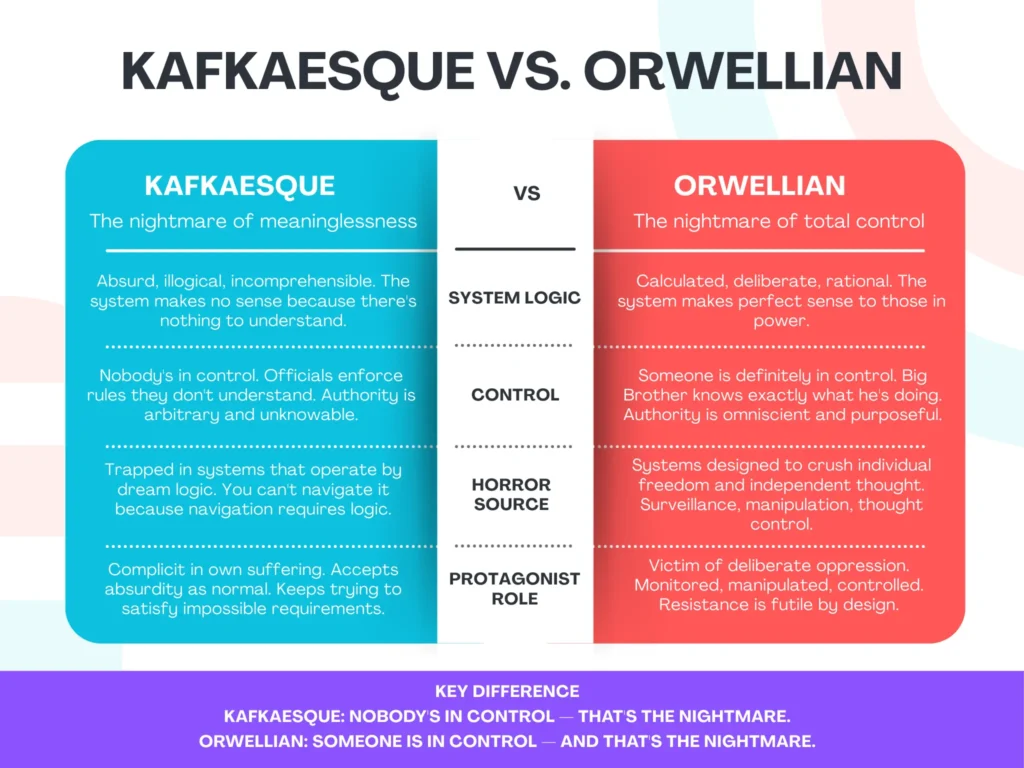
Kafkaesque vs. Orwellian
People often confuse these terms. Both describe oppressive systems, but they describe different kinds of oppression.
Kafkaesque: The system doesn’t make sense. It’s absurd, illogical, impersonal. You can’t understand it because there’s nothing to understand. The horror comes from meaninglessness. Officials don’t know why they’re enforcing rules—they just enforce them. You’re trapped in a nightmare that has no internal logic.
Orwellian: The system makes perfect sense—to those in power. It’s calculated, deliberate, controlled. Surveillance. Thought control. Language manipulation. Rewriting history. The horror comes from systems designed specifically to crush individual freedom and independent thought. Big Brother knows exactly what he’s doing.
Key difference: In Kafkaesque situations, nobody’s in control—that’s the nightmare. In Orwellian situations, someone is definitely in control—and that’s the nightmare.
Kafka gives you incomprehensible absurdity. Orwell gives you brutal clarity.
You can have elements of both. A surveillance state with such complex bureaucracy that even the watchers don’t understand it would be Orwellian in intent and Kafkaesque in execution. But the terms aren’t interchangeable.
Kafkaesque in Pop Culture
Writers and filmmakers have been exploring Kafkaesque themes for decades. Here’s where to see the five elements in action:
Brazil (1985) — Terry Gilliam’s film is the gold standard. A bug falls into a printer, changing “Tuttle” to “Buttle.” The wrong man is arrested, tortured, killed. Sam Lowry tries to fix the mistake, becoming entangled in the very bureaucracy he’s trying to navigate. All five elements present. This is what Kafkaesque looks like on screen.
Severance (Apple TV+) — Workers surgically split their consciousness. Their “work selves” have no memory of the outside world. Their “outside selves” don’t know what they do at work. Both versions exist in systems they never chose but can’t escape. The complicity is literal: they consented to this, once.
Breaking Bad – “Kafkaesque” scene — Jesse goes to therapy after trauma. His therapist asks what he’s feeling. “Kafkaesque,” Jesse says. The therapist asks what that means. Jesse can’t explain—he just knows it fits. It’s meta-commentary on how people use the term without understanding it, which itself becomes Kafkaesque.
Other notable examples: The Lobster (people transformed into animals if they don’t find romantic partners), After Hours (1985 Scorsese film—one man’s endless night of complications), Black Mirror (various episodes, especially “White Bear”), and surprisingly, the trial scene in Alice in Wonderland (arbitrary rules, circular reasoning, no way to win).
How to Use “Kafkaesque” Correctly
You’ve got the framework. Now here’s how to actually use the word.
Grammar Rules:
- Always capitalize it: “Kafkaesque” (proper adjective from a name)
- No hyphen unless using as compound modifier before noun: “the Kafkaesque situation” but “a Kafka-esque quality” is wrong, just use “Kafkaesque quality”
- Can appear before nouns (“a Kafkaesque nightmare”) or after linking verbs (“the situation was Kafkaesque”)
- Can modify with adverbs: “almost Kafkaesque,” “completely Kafkaesque,” “increasingly Kafkaesque”
Good Usage Examples:
✓ “The adoption process became Kafkaesque—we needed proof of income to qualify, but we couldn’t get that proof without already having a child to claim as a dependent.”
✓ “Tech support was Kafkaesque: I couldn’t cancel my subscription without logging in, but my account was locked for having an expired credit card on file.”
✓ “The appeals process took on a Kafkaesque quality—the committee reviewing my case could only be contacted by mail, but they returned mail marked ‘undeliverable’ because I didn’t include my case number, which I couldn’t get without… contacting them.”
Bad Usage Examples:
✗ “Traffic was Kafkaesque this morning.” — No, traffic was just slow. No bureaucracy, no circular reasoning, no complicity.
✗ “This movie is so weird and Kafkaesque.” — Being weird doesn’t make something Kafkaesque. Is there absurd bureaucracy? Circular reasoning? Or just surrealism?
✗ “My boss is Kafkaesque.” — A person can’t be Kafkaesque; situations or systems can be. (Though you could say “My boss created a Kafkaesque work environment.”)
When in doubt, check your situation against the five-element framework. If at least four elements are present, you’re probably using it correctly. If fewer than four, find another word—frustrating, absurd, surreal, bureaucratic. English has plenty of options.
Why This Word Matters
The term “Kafkaesque” emerged around 1946, just 16 years after Kafka’s death. That’s remarkably fast for a literary term to enter common usage.
It survived because it captures something specific about modern life that we didn’t have precise language for before. There’s frustration, there’s confusion, there’s bureaucracy—but Kafkaesque describes the particular nightmare where systems trap you through illogic, and you can’t help but participate in your own entrapment.
Here’s what you’ve gained:
You opened this article thinking “Kafkaesque” was just a fancy word for frustrating bureaucracy. Now you see it differently. You can identify the five elements in real situations. You understand why Poseidon creates his own nightmare. You know why your friend’s insurance claim story isn’t just annoying—it’s genuinely Kafkaesque because the system creates problems it claims to solve.
You have a framework to spot when systems trap people through circular logic and absurdity. That’s not just vocabulary. That’s a lens for understanding modern life.
And you can use the term precisely—which means you preserve its power.
Because here’s what happens when we misuse powerful terms: they lose meaning. Merriam-Webster already notes that “Kafkaesque” has been “watered down and given a lack of specificity due to overuse.” When everything frustrating becomes Kafkaesque, nothing is.
Use it precisely. Use it when those five elements align—when surreal bureaucracy creates circular traps and people can’t help but comply. Use it when you recognize that particular modern horror Kafka documented: systems so absurd they shouldn’t exist, yet we navigate them daily, accepting their logic as normal.
That’s when the word has power. That’s when it cuts through vague complaints and identifies something genuinely nightmarish about how we’ve organized society.
And now you can wield it correctly.