
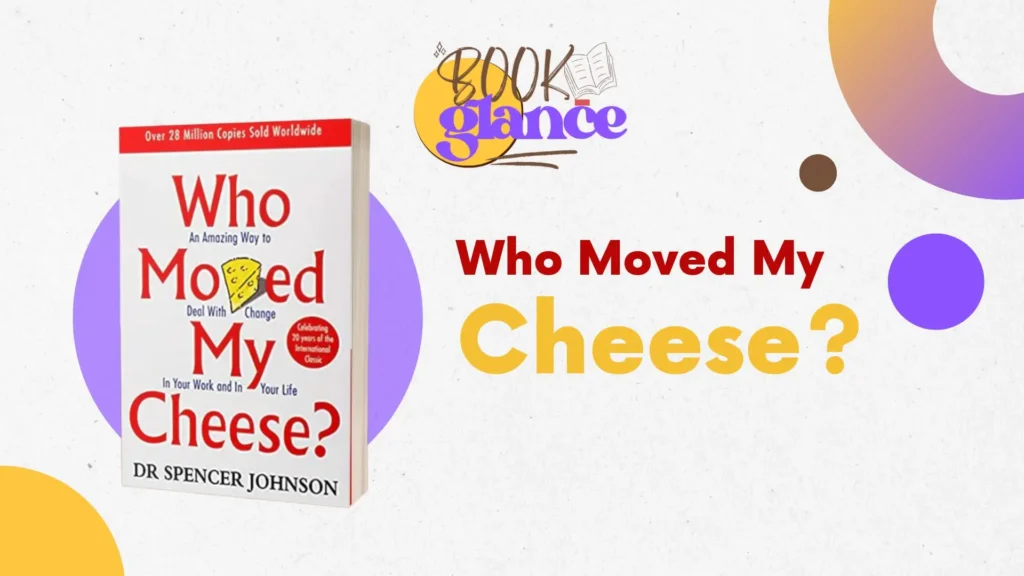
What if your biggest obstacle to success isn’t your circumstances—but which character you become when those circumstances shift? Who Moved My Cheese? presents four characters searching for cheese in a maze: two mice who adapt instantly, and two “little people” whose complex brains become their greatest liability. The question isn’t whether your cheese will disappear. It’s whether you’ll be ready when it does.
One-Sentence Takeaway
Who Moved My Cheese? by Spencer Johnson uses four characters navigating a maze to reveal why some people adapt to change instantly while others resist until it’s too late—and how to recognize which pattern you’re trapped in so you can choose a better response.
Who This Helps & What You’ll Learn
This summary is for you if:
- You’re facing a major transition (job loss, career shift, relationship change, health crisis) and don’t know how to move forward
- You recognize you’re resisting change but can’t figure out why or how to stop
- You’re leading a team through organizational change and need a framework everyone can understand
- You keep getting blindsided by change instead of seeing it coming
You’ll learn:
- The four personality types people become during change (and which one you default to)
- Why smart people often struggle more with change than simple-minded responders
- How to spot early warning signs that your “cheese” is disappearing
- The specific question that breaks through fear-based paralysis
- A step-by-step model for adapting faster when circumstances shift
- How to help others move through resistance without forcing them
- Why the journey through uncertainty matters as much as finding the solution
Why It Matters
Change doesn’t announce itself politely. Your company restructures. Your industry gets disrupted. Your relationship ends. Your health shifts. The job you thought was secure disappears overnight. That’s the external problem—change happens constantly, whether you’re ready or not.
But here’s the internal problem that actually derails you: when change hits, you freeze. Or you rage. Or you deny it’s happening. Or you blame someone else. You know intellectually that resisting won’t bring back what’s gone, but you can’t seem to move forward. You’re stuck at the empty cheese station, returning every day to a place that no longer serves you, because at least it’s familiar. The fear of the unknown feels worse than the reality of having nothing.
This creates a philosophical problem that should make you angry: we live in the most change-saturated era in human history, yet most of us have zero framework for navigating it well. We’re expected to adapt constantly—to technology, markets, relationships, our own bodies—without any mental model for why we resist or how to move through that resistance with dignity. That’s not fair, and it doesn’t have to be this way.
Here’s what’s at stake: stay stuck in your pattern, and you’ll keep suffering through every transition. You’ll be the person who sees opportunity too late, who gets left behind while others adapt, who spends years mourning what’s gone instead of building what’s next. Or you can learn the framework that’s helped millions of people transform their relationship with change. You can become someone who anticipates shifts before they happen, adapts quickly when they do, and actually grows stronger through uncertainty instead of being broken by it.
After understanding this book’s framework, you won’t just handle the current change better. You’ll have a diagnostic tool for life—a way to catch yourself mid-resistance, identify which character you’re being, and consciously choose the response that leads to growth instead of stagnation.
Core Concepts Overview
The genius of this book lies in its allegorical simplicity. Four characters live in a maze and search for cheese every day. The maze represents wherever you spend time looking for what you want—your workplace, your community, your relationships. The cheese represents whatever makes you happy: a fulfilling career, financial security, a loving relationship, good health, freedom, creative expression.
Two characters are mice named Sniff and Scurry. They keep things simple. Sniff sniffs out change early by paying attention to his environment. Scurry scurries into action the moment things shift. They don’t overthink or overanalyze—they notice, they act, they adapt.
The other two characters are “little people” (the same size as mice) named Hem and Haw. They represent the complex parts of us—the sophisticated brains that can envision better futures but also create elaborate justifications for staying stuck. Hem denies and resists change because he fears it will make things worse. Haw initially resists too, but he’s capable of learning and adapting when he sees that change can lead to something better.
Here’s what makes this framework powerful: you’re not just one character. Depending on the situation, you might be Sniff in your career (sensing industry shifts early) but Hem in your relationships (refusing to accept when something’s ending). The goal isn’t to always be the mice—it’s to recognize which character you’re being in any given moment and consciously choose your response.
These four characters represent the spectrum of human responses to change. The mice use instinct and simplicity. The little people use complex reasoning that can either help them (Haw) or trap them (Hem). Understanding this spectrum gives you the diagnostic tool you’ve been missing.
Main Framework/Model
The story follows a predictable arc that mirrors every change experience you’ll face. Initially, all four characters find an enormous supply of cheese at Cheese Station C. Life is good. They return every morning, eat their fill, and go home satisfied. This is your comfort zone—when everything’s working and you’ve forgotten that circumstances can shift.
But here’s where the mice and little people diverge. Sniff and Scurry stay alert. They wake up early every morning, put on their running shoes, scurry to the cheese station, and sniff around to see if anything’s changed. They notice the supply decreasing day by day. Hem and Haw, meanwhile, grow complacent. They start sleeping in, arrive later, expect the cheese to be there. They’ve built their entire identity around Cheese Station C and can’t imagine life without it.
One day, the cheese is gone. Completely. The mice aren’t surprised—they saw it coming. They immediately put their running shoes back on and head into the maze looking for new cheese. No drama, no analysis, just simple logic: no more cheese here, go find new cheese there. Within days, they’ve discovered Cheese Station N, loaded with fresh cheese.
Hem and Haw arrive later that morning and are shocked. Hem’s immediate response: “Who moved my cheese? This isn’t fair! We’re entitled to this cheese!” He rants, blames, demands answers. Haw stands frozen in disbelief, unable to process that his whole world just changed. They return to the empty station every day, hoping the cheese will magically reappear, because facing the maze means facing uncertainty.
This is where the real story begins. Haw starts questioning his fears. He realizes that staying at the empty station is slowly killing him. He writes on the wall: “What would you do if you weren’t afraid?” He builds courage by imagining himself finding new cheese, by envisioning success before experiencing it. Finally, he ventures into the dark maze alone.
The journey is hard at first. He gets lost, feels foolish, doubts himself. But something shifts—the adventure itself begins to energize him. He realizes that what he feared (the unknown) was never as bad as what he imagined (his mental catastrophizing). Each small step forward teaches him something new, and he starts writing lessons on the maze walls for Hem to find.
Eventually, Haw reaches Cheese Station N, where Sniff and Scurry are thriving. But he doesn’t get comfortable. He’s learned that cheese doesn’t last forever. He keeps his running shoes nearby and regularly ventures into the maze, sniffing for signs of change, ready to adapt the moment his new cheese starts getting old.
Key Principles Explained
As Haw journeys through the maze, he writes core lessons on the walls. These aren’t just platitudes—they’re the precise mental shifts that break through resistance:
“Smell the cheese often so you know when it’s getting old.” Stop assuming permanence. Pay attention to early warning signs. Is your industry shifting? Is your relationship showing strain? Is your health declining? Noticing small changes early lets you adapt before crisis hits.
“The quicker you let go of old cheese, the sooner you find new cheese.” Clinging to what’s gone delays your recovery. Every day you spend mourning the past is a day you’re not building the future. This doesn’t mean suppressing grief—it means not letting attachment paralyze you.
“Movement in a new direction helps you find new cheese.” Action breaks the spell of fear. You don’t need the perfect plan. You need to start moving, gather information, adjust course. Clarity comes from doing, not from thinking.
“What you are afraid of is never as bad as what you imagine.” This might be the most important insight. Fear lives in your mind and multiplies in darkness. The actual experience of change—even difficult change—is almost always more manageable than the terror you build up beforehand.
“Old beliefs do not lead to new cheese.” If you keep thinking the way you’ve always thought, you’ll keep getting what you’ve always gotten. Adaptation requires updating your mental models, not just your actions.
Practical Examples
The book’s power comes from how these principles play out in Haw’s transformation. Early in his journey, he’s plagued by fear—what if he fails? What if he gets more lost? What if there’s no new cheese anywhere? These fears nearly send him back to the empty station.
But then he asks himself: “What would I do if I weren’t afraid?” The answer is immediate and clear: he’d venture deeper into the maze, trust the process, believe in possibility. That single question becomes his compass. Every time fear grips him, he asks it again and acts on the fearless answer.
He also discovers that imagining success precedes achieving it. Before he finds Cheese Station N, he visualizes himself enjoying new cheese. He sees himself happy, satisfied, thriving. This mental rehearsal doesn’t just motivate him—it rewires his brain to expect good outcomes instead of catastrophe.
Perhaps most importantly, he learns to laugh at himself. When he realizes how long he stayed at the empty station, how much time he wasted in denial, he doesn’t beat himself up. He laughs at his own folly. That laughter creates space for growth. As the book states: “The fastest way to change is to laugh at your own folly—then you can let go and quickly move on.”
He tries to share these insights with Hem, returning to show him the lessons on the wall. But Hem isn’t ready. He’s still angry, still blaming, still insisting his old cheese should come back. Haw realizes that no one can change for someone else. Hem will have to find his own way, in his own time, or stay stuck forever. The book leaves this ambiguous—we never see if Hem eventually adapts.
Real-World Application
The moment change hits, follow Haw’s roadmap. First, identify which character you’re being right now. Are you denying the change happened (Hem)? Blaming others? Waiting for things to go back to normal? That’s your signal to shift.
Ask yourself: “What would I do if I weren’t afraid?” Write down the honest answer. Don’t judge it, don’t dismiss it—just acknowledge what you’d do if fear weren’t a factor. That answer is your action plan.
Start moving, even if you don’t have the full picture. Update your resume. Have the difficult conversation. Research new industries. Take the course. Small actions break the paralysis. You don’t need to know where you’ll end up—you just need to know your next step.
While you’re moving, practice smelling the cheese. In your current situation, what are the early warning signs you ignored? Create a habit of noticing: check industry trends monthly, have quarterly relationship check-ins, monitor your health metrics, track job satisfaction. Build an early-warning system so you’re never blindsided again.
Finally, help others without forcing them. Share what you’re learning, but don’t drag people out of their empty cheese stations. Hem types need to find their own motivation. You can point to the lessons on the wall, but they have to take the first step into the maze themselves.
Common Mistakes
The biggest mistake is assuming your cheese is permanent. Success breeds complacency. You get comfortable, stop paying attention, and wake up one day to find everything’s changed while you weren’t looking.
Second is letting fear create paralysis. You tell yourself you’re “being careful” or “thinking it through,” but really you’re frozen. The maze will always feel scary until you start moving through it.
Third is waiting too long to act. Yes, better late than never—Haw eventually adapts. But the mice found new cheese days earlier because they moved immediately. Every day of delay is a day of unnecessary suffering.
Fourth is blaming others for moving your cheese. The universe doesn’t owe you stability. Markets shift. People change. Bodies age. Raging about unfairness keeps you stuck at the empty station.
Finally, don’t make the mistake of thinking one successful adaptation means you’re done. Haw learned this—even at Cheese Station N, he keeps his running shoes ready. Change never stops coming.
Final Verdict & Next Steps
Who Moved My Cheese? deserves its status as a classic. Read it if you’re facing any significant change or if you lead others through transitions. The parable format makes complex psychology accessible—you can read it in 90 minutes and remember it for life. The character framework gives you a vocabulary for discussing change without blame or judgment.
The book’s limitation is its simplicity. Some readers find it too basic, almost condescending. It doesn’t explore the deeper psychology of why we resist, the neuroscience of fear, or the systemic factors that make change harder for some people than others. It’s not a replacement for therapy or serious change management literature.
But that simplicity is also its strength. You can share it with your teenager, your team, your aging parents. Everyone gets it. And in the moment when change is happening and you’re overwhelmed, you don’t need academic theory—you need a simple question: “Which character am I being right now?”
Next steps: Read the full book—it’s genuinely short and the story delivers more impact than any summary can. Share it with people navigating change. And the next time your cheese disappears, remember Haw’s question: “What would you do if you weren’t afraid?” Then do that thing.
After applying this framework, you’ll stop seeing yourself as a victim of circumstances. You’ll recognize resistance patterns the moment they start, catch yourself returning to empty cheese stations, and consciously choose to venture into the maze instead. That’s the transformation—from someone change happens TO, into someone who happens WITH change.