

In 1993, Al Ries and Jack Trout made a claim that most authors don’t have the nerve to make. Not “here are some useful ideas about marketing” — but laws. Immutable ones. The kind that, if you violate them, your marketing program is doomed regardless of how much money or talent you throw at it. Thirty years later, it’s worth asking the only question that matters about a book this confident: were they right?
The answer is: more than you’d think, less than they claimed, and the gap between those two things is where the book’s real value lives.
The 22 Immutable Laws of Marketing is a short book — you can read it in an afternoon — and it reads with the brisk certainty of two men who have been in the room when famous companies made catastrophically avoidable mistakes. Ries and Trout were marketing consultants in the business of telling clients things their internal teams were too invested to say. That professional positioning — the outsider who charges money to tell uncomfortable truths — shapes the book’s tone entirely. They are not here to make you feel good about your marketing. They are here to explain why it probably isn’t working, and why the reason is almost certainly not what you think.
The 22 laws are their attempt to codify a consulting career into principles. And the first thing worth knowing about those principles is that they don’t behave equally. Some of them describe how human minds work. Others describe how markets behave. These two categories sound similar, but they are not — and the difference between them is the difference between a law that holds thirty years later and one that cracked the moment someone invented social media.
The Two Men Who Decided Marketing Had Rules
They had been saying this for years before anyone wrote it down. Ries and Trout coined the concept of brand positioning in a series of articles in Advertising Age in 1972 — the idea that marketing is not a battle of products but a battle fought entirely inside the prospect’s mind. That single reframing of what marketing actually is became one of the most influential ideas in the field’s history.
By 1993, they had the corporate war stories to back it up. The book’s examples read like a damage report from a decade of watching companies repeat the same expensive mistakes: IBM trying to be everything to everyone, General Motors spreading its brands until none of them stood for anything, Miller Lite being launched as a line extension that diluted the parent brand rather than extending its strength. The pattern Ries and Trout kept seeing was not insufficient creativity or inadequate budgets. It was companies breaking principles they had never been told existed.
That’s the pitch of this book, and it’s a compelling one.
Whether the 22 principles they identified are actually laws is a harder question — and one the book doesn’t really invite, because it’s written with an authority that treats the question as already settled. The Ehrenberg-Bass Institute, a respected marketing research organisation, reviewed the book and found the laws are never quantified, never tested against systematic evidence, and rely entirely on anecdote. What Ries and Trout call laws, a scientist would call hypotheses. Plausible ones — but hypotheses.
That criticism is fair. It is also, to some extent, beside the point.
The Idea That Makes the Whole Book Work
The book’s spine is a single claim that sounds obvious until you think about it for thirty seconds and realise it isn’t. Law 4 — the Law of Perception — states that marketing is not a battle of products. It is a battle of perceptions. There is no objective reality in marketing, no best product, no definitive truth about quality. There are only perceptions in the minds of customers, and those perceptions are the only reality that marketing ever touches.
That’s not a metaphor. Ries and Trout mean it as a structural description of how buying decisions happen. No one evaluates products through clean comparison and rational analysis. People compare their perceptions of products, which were formed long before they ever walked into a store or opened an app. The product you think is better is the one that got to your mind first, or the one whose story your mind accepted, or the one whose category was defined in a way that quietly excluded the competition. The product itself is almost beside the point.
Once you accept this, the entire architecture of the book follows. If marketing is a battle of perceptions, then the strategic questions shift completely — away from “how do we make a better product?” and toward “how do we get into the mind first?” and “what word do we want to own?” and “what does our competitor already own that we will never dislodge?”
This is also why The 22 Immutable Laws of Marketing is more interesting than a typical strategy guide. It is less a manual than a theory of human cognition. The laws that derive directly from this perception insight are the ones that have aged best. The laws that don’t — the ones that describe market mechanics, competitive structures, distribution, and resources — are where the book shows its 1993 timestamp most clearly.
The Laws That Thirty Years Couldn’t Break
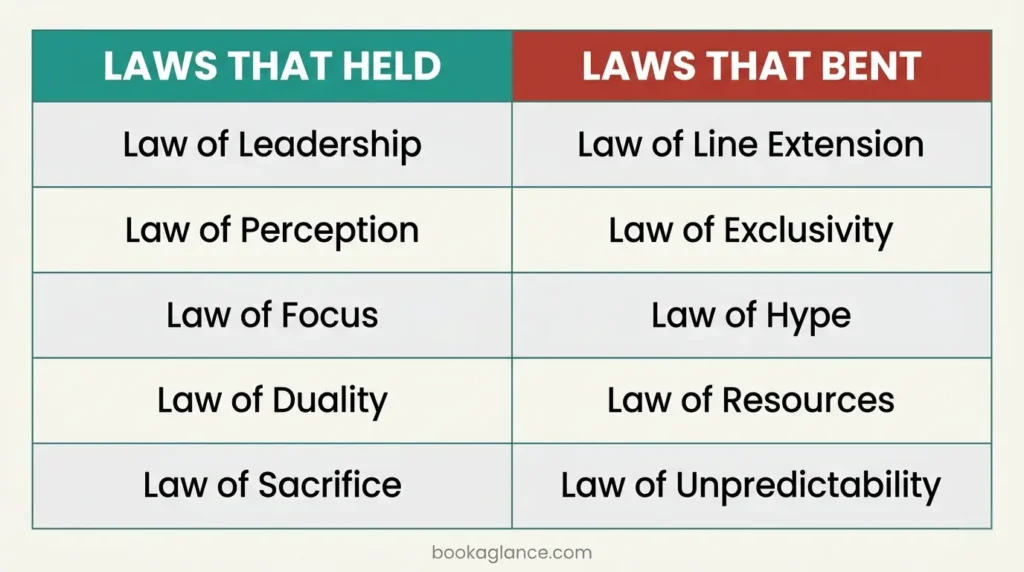
The laws that have survived are not a random collection. They cluster around a single insight: human perception is sticky, categorical, and resistant to correction by evidence. The laws that describe this are as true now as in 1993, because the human brain has not changed. A reader who wants a shorthand for which laws to trust: if the law describes how minds work, trust it. If it describes how markets are structured, test it against your context first.
The Law of Leadership states that it’s better to be first than to be better. This sounds like a cynic’s observation about market unfairness. It’s actually a precise description of how memory works. The first brand to occupy a category becomes the mental shorthand for that category — not a competitor to be evaluated against other options, but the default assumption that forecloses the question. You don’t think “what is the best search engine?” You think “Google.” The question never forms. The slot is already filled. Ries and Trout’s examples were Heineken and Hertz and Harvard. The current list writes itself: iPhone, Uber, Zoom — not because these are objectively the best products in their categories, but because they got there first and named the category in the process.
The Law of the Mind extends this: being first in the marketplace only matters insofar as it lets you be first in the mind. This distinction looked theoretical in 1993. The browser wars, the search engine wars, the social network wars — each involved a technically earlier entrant losing to a later one that won the mind more decisively. MySpace was in the marketplace before Facebook. AltaVista was before Google. First in the market, second in the mind: gone.
The Law of Focus — that the most powerful thing in marketing is owning a single word in the prospect’s mind — has held without qualification. Volvo owns “safety.” FedEx owned “overnight.” Red Bull owns “energy.” The moment a brand tries to own more than one word, the first word starts to blur. When Volvo began promoting performance alongside safety, it didn’t become a performance brand. It became a less certain version of itself. This same narrowing principle runs through Essentialism and Deep Work — the idea that focus requires genuine sacrifice, and that expanding outward is almost always easier in the short term and more expensive in the long one.
The Law of Sacrifice is its logical partner: you have to give something up to get something. The most successful brands of the last thirty years have been aggressively narrow — by channel, by product, or by message. The brands that struggled were almost always the ones that expanded into adjacent categories while attempting to hold the original promise. Harley-Davidson’s 1990s push into perfume and wine coolers is the textbook example — the brand didn’t lose its core customers because the products were bad. It lost them because the products made the brand’s core promise feel less serious.
The Law of Duality — that in the long run, every market settles into a contest between two major players — has held with uncomfortable regularity. iOS and Android. Coke and Pepsi. Visa and Mastercard. Boeing and Airbus. The law predicts not that third players become distant third — but that they become afterthoughts, perceived as compromises rather than choices. This law looks like a description of competitive dynamics. It’s actually a description of how humans cognitively simplify decisions under pressure. We don’t maintain a ranked list of seven viable options. We simplify to two and pick one.
That’s the thing about human nature: it doesn’t disrupt.
Where the Book Cracked
The Law of Line Extension is where Ries and Trout planted their flag most aggressively — and where the flag took the most damage. The law states that there is an irresistible pressure to extend a successful brand name into new products, and that every time a company gives in to that pressure, it weakens the original brand. Heinz extending into baby food. Levi’s extending into shoes. IBM extending into everything until its name stood for nothing in particular.
The underlying logic is sound, and the examples they chose held up. But the companies that defined the next thirty years of business broke this law comprehensively and thrived. Amazon began as an online bookstore and became a logistics empire, a cloud computing platform, a hardware manufacturer, and a streaming service. Apple moved from computers to music players to phones to watches to payment systems. Google became Alphabet and spread across maps, autonomous vehicles, health research, and the operating system running two billion phones. By the Law of Line Extension, these companies should have scattered their identity beyond recovery. Instead they became the most valuable brands in history.
The honest reading is that Ries and Trout got the direction of the law right but the scope wrong. Line extension within a category is still demonstrably damaging — when a luxury car brand releases an entry-level model to chase volume, the aspirational buyers who defined its value start quietly drifting. But extending across categories, particularly when the extension creates a new category rather than competing in an existing one, doesn’t follow the same pattern. Amazon Web Services didn’t dilute the Amazon brand. It became its own category, running on Amazon’s credibility while developing credibility of its own.
The Law of Exclusivity suffers from a related problem. The claim is that once a competitor owns a word in the mind, the word cannot be taken from them. That held for thirty years as a description of stable markets. What it didn’t account for is what happens when the word itself becomes worthless. Blockbuster owned home entertainment so completely in the 1990s that no competitor could challenge it on its own terms. Netflix didn’t challenge it on its own terms. Netflix reframed what home entertainment meant, making Blockbuster’s word not the target to beat but the category to escape. The word wasn’t dislodged — the category it anchored was quietly replaced.
The Law of Hype deserves credit for its boldest specific prediction, which came true: the authors looked at the extraordinary press coverage surrounding Steve Jobs’ NeXT computer and wrote, explicitly, that it would fail. It did. But Ries and Trout drew the wrong general conclusion. Their law implies that hype and genuine success are inversely correlated. The iPhone launch in 2007 was among the most hyped product releases in consumer electronics history. The hype was entirely correct. What the law was actually capturing wasn’t that hype is always wrong. It was that manufactured PR hype, in the absence of substance, is always wrong. That’s a more limited claim — and a more accurate one.
The Law of Resources — that without adequate funding, a good idea will not survive — has aged the worst of all. In 1993, marketing meant broadcast television, print advertising, and physical distribution, all of which required capital at a scale that genuinely filtered out underfunded competitors. The internet made marketing free, then made viral marketing an asset available to anyone with a smartphone and an audience. The law wasn’t wrong about its era. It just described conditions that no longer exist, and Ries and Trout had no way of knowing the conditions were temporary.
Two Types of Law, Only One Still Standing
The pattern that emerges from looking honestly at which laws held is not random and not about quality of thinking. The laws that have lasted are laws about human psychology. The laws that have frayed or broken are laws about market conditions.
This is a more important distinction than it sounds.
Human psychology changes very slowly, if at all. The tendency to stick with the first option that occupied a mental category — the resistance to revising a formed perception even in the face of contradicting evidence — the cognitive simplification that collapses complex competitive fields into a binary choice: these are not cultural habits. They are documented features of how human minds process information under conditions of uncertainty and overload. Ries and Trout stumbled onto them through decades of consulting work rather than through neuroscience, and they named them imprecisely, but they identified them correctly.
Market conditions, on the other hand, are contingent. They depend on distribution infrastructure, communication technology, capital costs, regulatory environment, and competitive structure — all of which the internet spent twenty-five years comprehensively rearranging. Laws built on 1993’s market conditions have a shelf life. Some are now period pieces.
Nobody in the summary literature on this book names this distinction. The universal response is “the concepts are sound but the examples are outdated” — which is true and misses the point in the same sentence. The examples aren’t what’s outdated. Some of the laws are outdated, and some aren’t, and the difference between them tells you something real about which marketing principles are operating on durable ground and which ones are renting it.
Frequently Asked Questions
What is the main idea of The 22 Immutable Laws of Marketing?
Ries and Trout argue that marketing is not a battle of products — it is a battle of perceptions. The brand that gets into the customer’s mind first and owns a clear, simple category wins. Their 22 laws describe how to achieve this and the predictable ways companies fail when they ignore it.
Is The 22 Immutable Laws of Marketing still relevant?
Partly. The laws that describe human psychology — Leadership, Perception, Focus, Duality, Sacrifice — remain as accurate as ever because human cognition has not changed. The laws that describe market conditions — Line Extension, Resources, Exclusivity — have fared worse. The internet, social media, and platform economics changed the competitive dynamics the book assumed were fixed.
What is the Law of Perception?
The Law of Perception states that marketing is a battle of perceptions, not products. There is no objective reality, no best product — only what customers believe. Ries and Trout argue that the brand winning in the mind wins in the market, regardless of what product testing says. It is the most durable law in the book.
What is the Law of Leadership?
The Law of Leadership states that it is better to be first than to be better. The first brand to occupy a category in the customer’s mind becomes the default — it is not evaluated against competitors but assumed. Ries and Trout illustrate this with Charles Lindbergh (first solo Atlantic flight, universally remembered) versus Bert Hinkler (second, almost unknown).
Who wrote The 22 Immutable Laws of Marketing?
Al Ries and Jack Trout, two American marketing consultants who spent decades advising major companies on positioning strategy. They had previously co-authored Positioning: The Battle for Your Mind (1981). The 22 Immutable Laws of Marketing was published in 1993. Ries died in 2022 at age 95. Trout died in 2017.
The Honest Case for Reading It
Thirty years of evidence makes a decent judge. The laws that describe human perception — Leadership, Mind, Focus, Perception, Sacrifice, Duality — have held because they were never really about marketing. They were about cognitive architecture. A reader who finishes this book with those six laws clear in their mind has learned something that will not expire.
The laws that describe market mechanics have fared less well, and the honest use of this book requires knowing which type you are reading at any given moment. The Law of Line Extension has boundary conditions the authors didn’t acknowledge. The Law of Resources has been partially obsoleted by cost curves they couldn’t foresee. The Law of Exclusivity assumes stable categories in a world that spent thirty years proving categories are provisional.
None of this makes the book less worth reading. It makes it more worth reading carefully.
The argument that the laws are immutable was always slightly overstated — good consulting rhetoric more than scientific claim. What Ries and Trout were actually selling, underneath the confident framing, was a habit of thought: the habit of asking whose mind are we trying to occupy, and how is it already occupied, before spending any money at all. That question is not a law. It doesn’t hold or violate. It is simply one of the more productive questions a person responsible for marketing anything can ask, and it was underused before this book and remains underused now.
Read it for those reasons. If you want to apply the same critical lens to a different kind of strategic rulebook, The 48 Laws of Power rewards the same question: which of these principles are operating on psychology and which on context?
The title promised immutability. What the book delivers is something more useful: a set of starting hypotheses about human behaviour in markets, some of which have earned their confidence and some of which deserve more scepticism than the authors were ever inclined to apply.
That’s enough to make it worth your afternoon.