

The most discussed plot twist in recent thriller fiction works because of a single assumption it makes about you as a reader. You assume the two storylines are happening at the same time. They are not. Everything else follows from that. Whether the book earned that assumption — whether it played fair with you or played you — is the only question worth answering in a review of The Silent Patient.
The short answer is: it played fair. Just barely, deliberately, and with considerable skill.
Alex Michaelides published The Silent Patient in February 2019. It became the biggest-selling debut novel in the world that year, won the Goodreads Choice Award for Mystery and Thriller, spent more than a year on the New York Times bestseller list, and sold in forty-nine countries. The blurb comparisons to Gone Girl and The Girl on the Train are not inaccurate. They are also not quite the right frame. What Michaelides built is something structurally closer to a stage magician’s act than a traditional thriller — a sustained, technically demanding piece of misdirection that depends not on hiding information but on controlling which information you think to ask for.
This review contains complete plot spoilers including the twist ending. If you haven’t read the novel and want to experience it unspoiled, stop here.
The Setup: Alicia and the Silence
Alicia Berenson is thirty-three years old when she shoots her husband Gabriel and stops speaking.
She does not speak to the police. She does not speak at her trial. She does not speak at The Grove, the North London psychiatric facility where she is committed. Her silence is so total and so sustained that it becomes its own kind of statement — louder, ultimately, than anything she could have said.
This is the novel’s first and most elegant premise: that silence is not the absence of communication but a form of it. Alicia’s refusal to explain herself forces everyone around her to explain for her — her lawyers, her psychiatrists, the press, the reading public. She becomes a projection screen for everyone else’s theories about guilt, trauma, madness, and motive. The only thing she produces after the murder is a painting she titles Alcestis, a reference to the Greek mythological figure who gave her life to save her husband, then was returned from the dead. Michaelides uses the Alcestis myth as the novel’s emotional watermark — the idea that love sometimes looks like sacrifice and sometimes looks like destruction, and that the line between them is not always visible from the outside.

Michaelides is genuinely skilled at the atmospheric setup. The Grove feels like a real place — its institutional rhythms, the specific texture of life inside a psychiatric facility, the way patients and staff develop their own economies of trust and manipulation. His background working at a secure psychiatric facility for teenagers gives the setting a credibility that purely imagined versions of this world rarely achieve. Alicia herself is rendered with restraint. We know her through her diary entries, presented as documents from before the murder — a record of the weeks leading up to Gabriel’s death. She is intelligent, watchful, perceptive. She records things in the precise, slightly detached register of someone trying to impose order on something that frightens her.
The diary structure does two things simultaneously. It gives the reader direct access to Alicia’s interiority, which would otherwise be sealed off by her silence. And it creates the first of the novel’s several sustained deceptions — because the diary is presented as past-tense material, backstory, context, while Theo’s investigation feels like the present. The reader files them in the correct temporal sequence without being told to. When that sequence turns out to be wrong, the reread reveals how precisely Michaelides managed the filing.
She loved Gabriel — not simply, not without friction. He had become distracted in ways she couldn’t fully account for. She was watching him in the weeks before his death with the specific alertness of someone who suspects something but cannot yet name it. The reader, filing all of this as backstory, watches Alicia’s mounting unease as historical inevitability — we already know how it ends. What we are watching, we believe, is the road to a moment already passed. This is the machinery that makes the twist possible. And first: Theo Faber.
Theo Faber: The Therapist the Reader Was Supposed to Trust
Theo Faber applies for a position at The Grove specifically because of Alicia Berenson. He has been following her case for years. He is obsessed with it in ways he does not fully examine. When he gets the job and begins treating her, he investigates her personal life outside their sessions — tracking down her family members, visiting people connected to the murder, forming a private theory about what happened that runs parallel to and consistently ahead of what his clinical work should produce. He develops an intense emotional investment in her. His wife notices. His supervisor notices. He does not notice, or will not.
This is not a portrait of dedicated eccentricity. It is a portrait of a therapist in serious trouble — someone whose personal investment in a case has compromised every boundary the profession exists to maintain. The therapeutic frame requires that the therapist’s needs be bracketed out of the room. Theo’s needs are the room.
Most readers find him sympathetic throughout. This is not a failure of the reader. It is the precise effect Michaelides is engineering.
Theo is given everything the genre uses to build sympathy: self-awareness, wit, a difficult childhood that explains his interest in trauma and healing, a marriage under strain from his wife Kathy’s apparent emotional withdrawal. He narrates his own obsession with Alicia in the register of a man puzzling through a professional challenge, not a man acting out a private crisis. He is honest about his uncertainty and his mistakes, in the way that first-person narrators who are hiding something tend to be honest about everything except the thing they are hiding.
The twist reveals that Theo was the masked man who broke into the Berenson house in the weeks before Gabriel’s death. He had discovered — through surveillance he presents as concern for his marriage — that Gabriel was having an affair with Kathy. He broke in, restrained Gabriel, and held him at gunpoint. His intent: to expose Gabriel’s selfishness to Alicia by forcing Gabriel to choose between saving himself and protecting his wife. Gabriel chose himself. Theo left him alive. Alicia, having seen what her husband was, then shot Gabriel herself. The character construction here has a clear parallel in First Lie Wins — the protagonist whose self-presentation is itself the performance, and whose credibility depends entirely on the reader’s willingness to accept the narrative frame they’re offering.
The twist retroactively transforms every scene between them. The sessions the reader experienced as clinical engagement were something else entirely. The care Theo appeared to take was self-protective. Every moment of apparent dedication is surveillance.
Here is where the novel is doing something more interesting than most of its reviews acknowledge: Theo is not a sympathetic man who turns out to have a dark secret. He is a predator who was always a predator, whose self-presentation as a dedicated healer was always a performance, and whose narrative voice was always the voice of someone managing their story rather than telling it. The reader’s sympathy was never misplaced in the sense of being tricked by accident. It was manufactured, deliberately, by a man expert at manufacturing it. The novel’s argument, if it has one beyond the mechanics of the plot, is that this is exactly how dangerous people operate — not as obvious monsters, but as the most sympathetic person in the room.
The novel is most interesting when it commits to this reading. It does not always commit.
The Construction: Does the Twist Hold Up?
The technical question is whether Michaelides played fair.
The novel alternates between two narrative strands.
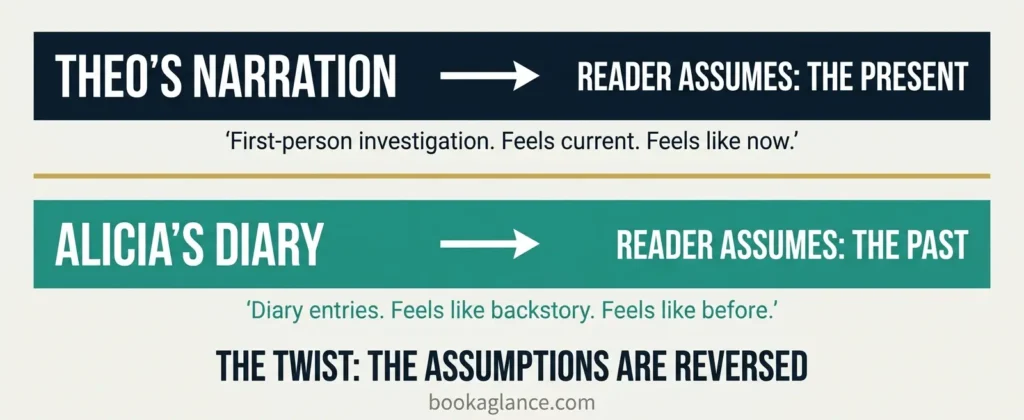
The first is Theo’s first-person present-tense account of his work at The Grove — his sessions with Alicia, his investigation into her past, his deteriorating marriage. The second is Alicia’s diary, presented as entries from the weeks before Gabriel’s murder. The reader processes these as temporal counterparts: Theo’s present, Alicia’s past. The assumption feels natural because it is the assumption the thriller genre trains you to make when a novel alternates between a present investigation and a past event.
The twist turns this assumption inside out. Theo’s narration is not the present. It is set before the murder — in the period when Theo was moving toward the confrontation in the Berenson house. Alicia’s diary was not written before the murder. It was written after it, at The Grove, in silence — her silent communication, the thing she was producing while Theo sat across from her pretending to help. The timeline the reader assembled was exactly reversed.
Did Michaelides earn this? He did, for two reasons and with one important caveat.
The first reason is that he never explicitly stated the two timelines were contemporaneous. The reader assumed it. This is a distinction that matters. A fair twist exploits the reader’s assumptions without actively lying to them. The Silent Patient withholds the temporal relationship between its two strands and allows the reader’s genre training to fill the gap with an assumption that happens to be wrong. This is a legitimate move. It requires the reader to accept that they were not deceived so much as they deceived themselves — which is uncomfortable, and is the correct response to have.
The second reason is that the evidence for the real timeline is present throughout. It is not buried in a footnote or produced from nowhere in the final chapter. Small details — particular word choices in Alicia’s diary, specific things Theo’s investigation reveals that he could not have known if the timelines were running parallel — clock the actual sequence for a reader who goes back and looks. The reread of The Silent Patient is a genuinely different experience from the first read, not because the novel becomes a different book, but because the same sentences mean different things. That is the mark of a twist constructed with care rather than conjured after the fact.
The caveat: the construction only works once, completely, at pace, in a single reading. The novel is designed to be consumed quickly — short chapters, propulsive prose, a plot that pulls. Read slowly, the temporal ambiguity occasionally strains. Michaelides manages this largely through the momentum of the narrative — the reader is moving fast enough that the questions don’t quite form. This is craft, not flaw. But it means the novel is essentially a single-use mechanism. It is built for the experience of the first read, and the first read is very good.
The closest structural comparison in the site’s Thriller cluster is Verity — a novel that similarly requires a complete revision of everything that came before once the ending arrives, and that similarly turns on a question of which narrative voice to trust. The Silent Patient is more mechanically precise than Verity. Its twist is cleaner, its misdirection more carefully controlled. Verity is emotionally richer and more willing to leave its central question genuinely open. They are different kinds of achievement, and readers who love one will likely want the other.
What the twist does not do is make the investigation sections feel, in retrospect, like they were secretly about something deeper. This is the limitation the next section addresses. The mechanics are impressive. The meaning that should sit underneath them is thinner than the novel’s ambitions suggest.
The Psychological Framework: What the Novel Claims and What It Delivers
The novel promises psychological depth and delivers psychological atmosphere — and the difference matters more here than it would in a thriller making no such claims.
The Silent Patient positions itself as a serious examination of trauma, silence, and the therapeutic relationship. Michaelides drew on his experience working at a secure psychiatric facility for teenagers and his deep engagement with psychotherapy in theory and practice. The vocabulary is correct throughout. The Grove feels clinically credible. The language of the sessions sounds right.
The gap between sounding right and being right is where the novel quietly fails the ambitions it announced for itself.
Take Alicia’s silence. The novel offers it as its central psychological mystery — what does the silence mean, what is it protecting, what will it take to break it? The answer the novel provides is: Alicia is silent because she knows who was in the room the night she killed Gabriel, and naming it would destroy the one person she has come to trust. She is protecting Theo. The silence is strategic rather than symptomatic — a rational act of concealment rather than a traumatic response to unbearable experience.
This is the right answer for the thriller the novel chose to be. It is also a deflation of the psychological promise the novel made. Trauma-induced mutism is a real phenomenon with its own complex phenomenology. The novel gestures at this throughout, building a picture of Alicia as someone whose entire history has involved silence as a response to unbearable events: a mother who died in a car accident when Alicia was a child, a father who responded to that loss with emotional withdrawal and worse, a lifetime of using art as the medium through which she could express what she couldn’t say. The silence after Gabriel’s death could have been the culmination of that history.
Instead it is a decision. The psychological depth the novel assembled turns out to be backstory rather than mechanism. Compare this to The Midnight Library, which takes a similarly extreme response to an unbearable life — near-death withdrawal from the world — and uses it to do genuine psychological and philosophical work about what we choose and what we inherit. Both novels use extreme female silence as their central premise. One does something real with it. The Silent Patient uses it to produce a twist.
The therapy itself is similarly decorative. Real therapeutic work is slow, recursive, and organised around the gradual construction of a relationship secure enough for the most defended material to approach. The sessions Michaelides depicts are atmospherically convincing but clinically skeletal — they serve the plot more than they illuminate what therapy actually is or does. In a thriller making no such claims, this would be unremarkable. The Silent Patient makes the claims, which is why the gap is visible.
What Michaelides is genuinely good at is the psychology of obsession. Theo’s fixation on Alicia — its self-justifying logic, its capacity to reshape everything he perceives in service of what he needs to be true — is rendered with considerable accuracy. The way he constructs himself as her rescuer, her advocate, the one person uniquely positioned to understand her, is recognisable as a portrait of someone whose needs have fully colonised their professional identity. This is psychologically true and well observed. It is the novel working at the level of its actual strengths rather than its stated ambitions.
The secondary characters do not share this precision. Jean-Felix, Alicia’s gallerist and one of the investigation’s red herrings, is characterised only by his relationship to the mystery — once his relevance to the plot is exhausted, so is he. Max Berenson, Gabriel’s brother, exists almost entirely as misdirection, his conflict with Gabriel sketched but not inhabited. Paul Rose, Alicia’s childhood friend whose connection to her backstory should matter more than it does, is given history without interiority. In a novel where the twist depends on the reader being sufficiently invested in the wrong theories, the thinness of these characters is a structural weakness — the reader abandons them easily not because the misdirection is clever but because there wasn’t much to hold on to.
Frequently Asked Questions — Full Spoilers
What is the twist in The Silent Patient?
Theo Faber — the therapist narrating the novel — is revealed to be the masked intruder who broke into Alicia and Gabriel’s home in the weeks before the murder. He had discovered Gabriel was having an affair with Kathy, his wife. He broke in, restrained Gabriel, and forced him to choose — effectively testing whether Gabriel would sacrifice himself to protect Alicia. Gabriel chose himself. Theo left without shooting either of them. Alicia, having witnessed what her husband was, then shot Gabriel herself. The novel’s two timelines are also inverted: Theo’s narration is the past, Alicia’s diary the present.
Does the twist in The Silent Patient hold up?
Yes — it was constructed fairly. Michaelides never explicitly stated the two timelines were running simultaneously. The reader assumed it, based on the thriller genre’s standard conventions. A fair twist exploits assumptions without inventing false information, and this one qualifies. The evidence for the correct timeline is present throughout the novel and becomes visible on a reread. The construction is technically sound, though it works best at reading pace.
Who is the real villain in The Silent Patient?
Theo Faber. His investigation of Alicia is not therapeutic dedication — it is surveillance designed to manage his own exposure as the man who was in the room the night Gabriel died. Every session, every apparent breakthrough, every moment of professional care is a performance by a man protecting himself. The novel’s most uncomfortable implication is that he was always this person, and the reader found him sympathetic throughout.
What does the painting Alcestis mean in The Silent Patient?
Alicia names her post-murder painting after the Greek mythological figure who gave her life to save her husband, then was brought back from the dead. The reference is ironic rather than literal — Alicia did the opposite of Alcestis, killing the husband she had sacrificed for. The painting is her first and only communication after the murder: a title that encodes the answer for anyone paying close attention.
Is The Silent Patient worth reading?
Yes, with calibrated expectations. It delivers one of the most technically precise twists in contemporary thriller fiction and the experience of finishing it is genuinely satisfying. What it does not deliver is the psychological depth its framework promises. Read it for the mechanism. Accept that the mechanism is doing all the work. That is enough.
The Verdict
The Silent Patient is the kind of thriller that justifies its own existence through a single extraordinary achievement — and has the self-awareness to build everything around that achievement rather than pretending the rest of the novel is doing comparable work.
The twist is genuinely good. Not good-for-a-debut or good-considering-the-premise but good in the absolute sense: technically precise, fairly constructed, and capable of retroactively reorganising three hundred pages of reading into a coherent new shape. The experience of finishing this novel — the specific quality of realisation as the pieces click into position in the final twenty pages — is something few thrillers deliver with this degree of satisfaction. Michaelides earned it.
What he gave up for it is real and should be accounted for. The psychological framework is atmosphere. The secondary characters are plot machinery. The middle third drags in ways that a tighter editorial pass might have addressed. The novel is longer than it needs to be for everything except the twist, and the twist needed the length to work — so this is a structural constraint rather than a failure, but it means the reading experience before the final act is uneven in ways the final act largely redeems.
The question of whether the trade is worth it depends entirely on what you read psychological thrillers for. If you read for plot architecture and the experience of genuine surprise, The Silent Patient delivers one of the best examples of both that contemporary thriller fiction has produced. If you read for the kind of psychological depth that makes a thriller feel like it is also saying something true about how people work, the novel will leave you with a sense of promise unfulfilled.
For the reader who wants to follow this with something that makes the psychological furniture load-bearing, All the Colors of the Dark is the suggestion this site would make most urgently. It is a different kind of thriller entirely — slower, more devastating, built on genuine emotional architecture rather than plot mechanics. The contrast serves both books honestly. They are doing different things. Whitaker’s is harder and more lasting. Michaelides’s is more fun.
For the structural parallel — the novel where the narrative framework requires complete reassembly once the ending arrives — Verity is the natural companion. Where The Silent Patient gives you a clean answer in its final pages, Verity refuses to, and the refusal is itself the argument. Readers who found The Silent Patient’s resolution too tidy will find Verity more unsettling. Readers who found the resolution satisfying will find Verity infuriating in the best possible way.
Read The Silent Patient in one or two sittings if you can manage it — the momentum is part of the mechanism, and the novel rewards the reading mode it was designed for. Accept that the psychological depth it promises is partly a misdirection, like the timeline. And then, when you finish and sit with the specific quality of having been played fairly, recognise that being played fairly by someone very skilled at it is a pleasure the genre doesn’t deliver often enough.