

In 2014, a blogger named Marc Winn merged a Spanish framework about purpose with a Japanese word he had recently encountered and published the result on his personal website. Within a few years, his diagram — four overlapping circles representing what you love, what you are good at, what the world needs, and what you can be paid for — had been shared millions of times under the label ikigai. It has since appeared in Forbes, the Harvard Business Review, and on the desks of corporate coaches in forty countries. Ken Mogi, a Japanese neuroscientist who has written his own book on ikigai, has described the diagram as wrong. Japan never made it.
The diagram is now so inseparable from the 2016 book by Héctor García and Francesc Miralles that most readers finish it believing they have learned a Japanese philosophy of purpose, when they have actually absorbed a Western framework for career planning that borrowed a Japanese word. The two things are related in the same way that a fortune cookie is related to Chinese culture: adjacent, well-intentioned, and not quite the thing it claims to be.
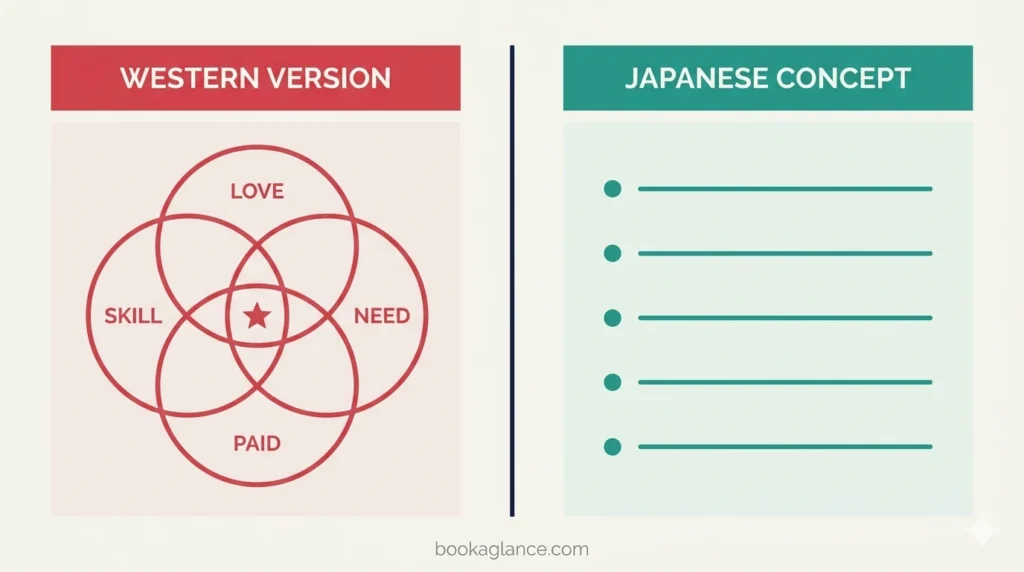
The actual concept is both simpler and more radical. And the book, once you get past the diagram that floats around the internet attached to its name, contains ideas worth understanding — about longevity, about attention, about what it means to stay alive in the fullest sense of the word.
Where the Venn Diagram Actually Came From
In 2014, blogger Marc Winn combined a Spanish purpose framework by Andrés Zuzunaga with the Japanese word ikigai and published the result online. It spread globally. Ken Mogi, a Japanese neuroscientist who studies ikigai, has called the diagram wrong. Japan never produced it.
What Ikigai Actually Means Before the West Got Hold of It
The word is a compound. Iki — to live, to be alive. Gai — worth, value, the fruit of something. Together: a reason for being. The meaning of ikigai is not “purpose” in the career-planning sense. It is closer to “what makes getting up worth it.”
The distinction matters enormously. In Japan, ikigai does not require a Venn diagram. It does not require you to identify your unique talent, locate the intersection of your passion and the market, and build a business at the centre. A 90-year-old woman in Okinawa tends her garden every morning and considers it her ikigai. A retired schoolteacher tutors neighbourhood children on Saturday afternoons. A man who has worked at the same small restaurant for forty years takes pride in knowing which regular customer likes their tea slightly cooler than everyone else. These are not grand purposes. They are not scalable. They are not monetisable. And they are, in the Japanese understanding, precisely the point.
Ken Mogi, whose own book on ikigai is grounded in Japanese research rather than Western packaging, describes the concept through five pillars: starting small, releasing yourself, finding harmony with others, seeking the joy of small things, and being in the here and now. None of these pillars mention career. None of them mention profit. Ikigai, in its original sense, is not a destination you locate by filling in four circles. It is a quality of attention you bring to whatever is already in front of you.
This is a genuinely strange idea for a Western audience raised on the premise that purpose is a thing you find — something hidden inside you that the right book will help you excavate. The Japanese conception runs almost the reverse: ikigai is not hidden. It is created, continuously, through practice and presence. You do not discover your ikigai. You build it, small thing by small thing, in the texture of an ordinary day.
The morning coffee you drink without looking at your phone. The route to work where you notice the same tree each season. The conversation with a colleague that has no agenda. These are not consolation prizes for people who have not yet found their purpose. In the Japanese understanding, they may be the purpose itself.
Both Paulo Coelho in The Alchemist and the ikigai tradition circle the same tension — whether purpose is something you find at the end of a journey or something that accrues in the small daily acts of the journey itself. Coelho’s answer and Mogi’s answer are not the same. But the question is identical.
What García and Miralles Actually Found — and What the Centenarians Said
García and Miralles did not invent the Venn diagram, and it is worth being clear about that. What they did was travel to Ogimi, a village on the northern tip of Okinawa recognised by the World Health Organization as having the highest concentration of centenarians on the planet, and ask the people there why they were still alive.
The answers were not what a Western self-help reader might expect. Nobody in Ogimi mentioned their career. Nobody mentioned achieving their goals or optimising their morning routine. What they described, again and again, was something quieter: the pleasure of being useful, the comfort of community, the sense of having somewhere to be and someone waiting for them. One centenarian woman said she got up every morning because her plants needed watering. Another because her friends would notice if she did not show up to their regular gathering. The purposiveness was real — but it was anchored in the small, the local, the immediate.
The Ogimi research points toward something that Western culture finds genuinely difficult to absorb: that longevity may have less to do with optimising your life than with not trying to escape it. The centenarians García and Miralles interviewed were not chasing anything. They were not becoming. They were present, occupied, connected — and they had been so, at the same modest scale, for a hundred years.
Moai — Okinawa’s tradition of informal social groups that form in childhood and persist across a lifetime — sits at the centre of this. A moai meets regularly, supports its members financially and emotionally through every difficulty, and continues, without particular drama, for decades. In a community where moai is normal, you cannot disappear without being noticed. You cannot stop showing up without someone coming to find you. The social accountability is not imposed — it is simply what happens when you belong to something that has existed for sixty years. Your continued presence is expected. Your absence is felt. And that expectation, García and Miralles argue, is one of the most powerful forces keeping the Ogimi centenarians alive.
The contemporary parallel is not a peer accountability app. It is the friend group that has met every Thursday for twenty years. The amateur choir where people notice when you are gone. The neighbourhood where your name is known and your habits are unremarkable and your presence is part of the texture of other people’s days. Most people do not have this. Most people have moved at least once in their adult lives, changed jobs, changed cities, changed social circles. The kind of continuity the Ogimi moai represents — decades of the same people, the same rhythms, the same small obligations — is the thing that modern life most efficiently destroys in the name of opportunity and growth.
García and Miralles do not develop this criticism explicitly. But it sits in the book, implied, behind every centenarian interview: the secret to a long life may not be something you add. It may be something you stop subtracting.
Flow — and Why You Don’t Have to Be a Concert Pianist to Enter It
The best chapter in Ikigai is not about ikigai. It is about flow — the state of complete absorption in a task that psychologist Mihalyi Csikszentmihalyi (pronounced roughly “Mee-high Cheeks-sent-me-high”) spent decades studying and that García and Miralles argue is the closest daily experience to what the Ogimi centenarians describe as their reason for being.
Csikszentmihalyi’s research found that the moments people report as most satisfying in their lives are almost never the moments of rest or leisure they anticipated would make them happy. They are the moments of complete engagement — when the difficulty of a task is precisely matched to the capability of the person doing it, and the doing itself becomes so consuming that time stops registering in the normal way. A surgeon mid-operation. A jazz musician mid-improvisation. A programmer chasing a bug through code at two in the morning, not noticing the time. The content varies wildly. The quality of attention is identical.
What García and Miralles add is the observation that flow is not the exclusive property of virtuosos operating at the edge of their abilities. An elderly woman in Ogimi enters flow while arranging flowers. A retired fisherman enters it while maintaining his nets, a task he has performed for sixty years and could probably do blind. The Csikszentmihalyi version of flow requires challenge. The Ogimi version requires something closer to devotion — a quality of care brought to a task that does not need to be difficult to be absorbing.
This dissolves a common misreading of the flow concept that has made it less useful than it should be. People hear “flow requires challenge matched to skill” and conclude they need to be doing something harder — that the reason their work does not feel meaningful is that it is not ambitious enough, not impressive enough, not difficult enough to deserve that quality of attention. The Ogimi evidence suggests the opposite. The flower arrangement is absorbing not because it is challenging but because the person doing it actually cares about the flower.
You know this feeling. The task at work that everyone else finds tedious and that you, inexplicably, do not mind — because something in how your brain is organised finds it satisfying in a way you would struggle to explain. The cooking that nobody calls a passion but that you do carefully anyway, with more attention than the meal requires. The walk you take by the same route not out of laziness but because familiarity has made the route legible — you notice everything precisely because you know what everything normally looks like. These are the ground from which flow grows. And the Ogimi centenarians suggest that a life composed largely of them is not a lesser life. It may be the longest one.
The conditions García and Miralles draw from Csikszentmihalyi are worth keeping: know what you are doing and why. Remove distractions before they occur rather than fighting them mid-task. Engage fully, or not at all. Taken together with the Okinawan material, they make a different argument than a standard productivity book makes. The goal is not to enter flow in order to produce more. The goal is to enter flow because being fully present in something — anything — is what being alive actually feels like, as opposed to what it feels like to be somewhere while thinking about somewhere else.
What the centenarians in Ogimi had was a quality of presence in their daily occupations that the book does not quite manage to name but that every interview in it points toward.
Morita Therapy and the Philosophy of Action
The most underread section of Ikigai — the one that gets three paragraphs in most summaries and deserves three times as many — is the chapter on morita therapy.
Shoma Morita (1874–1938) was a Japanese psychiatrist and professor at Jikei University School of Medicine in Tokyo who developed his therapeutic approach in the early twentieth century, partly as a response to what he saw as the limitations of Western psychoanalysis. The Freudian method, broadly, asks the patient to understand the origin of their suffering — to excavate the past, identify the wound, and resolve it through insight. Morita’s method begins from a different premise: that the attempt to understand and eliminate negative feelings before acting is itself the problem.
Morita therapy does not ask you to fix how you feel before you do the thing. It asks you to do the thing while feeling however you feel, because the feeling changes through action rather than through analysis. A person with anxiety who waits until they feel less anxious before engaging with life will wait indefinitely. A person with Morita’s approach notices the anxiety, accepts it as the current weather of their inner life, and goes to tend the garden anyway. The anxiety does not disappear. But it stops being the main event.
The application to ikigai is direct and García and Miralles make it clearly: purpose is not something you locate through sufficient introspection. You do not find your ikigai by sitting with the four-circle diagram long enough. You find it — or rather, you build it — by engaging with life at whatever scale is available to you and paying attention to what engagement feels like. The feeling follows the action. The meaning follows the showing up.
The ikigai is in the going. Not in the finding. — bookaglance.com
This is the sharpest idea in the book, and it arrives quietly, in a chapter most readers skim.
It is also exactly what the Venn diagram misses. The diagram assumes that your ikigai is a fixed destination — that if you map your loves, skills, values, and marketable talents precisely enough, you will find the spot where they converge, and that spot is your purpose. Morita’s framework suggests the opposite: that purpose is not pre-existing, waiting to be discovered at the intersection of four circles. It is created in the act of caring about something consistently over time. The retired teacher who tutors neighbourhood children on Saturday afternoons did not discover that tutoring was her ikigai. She made it her ikigai by showing up enough times that it became the thing she could not imagine not doing.
The diagram is, quietly, an anxiety machine. It presents purpose as a puzzle to be solved rather than a practice to be sustained, which means that anyone who cannot fill it in concludes they have not found their purpose yet — that they are somehow behind, that the meaning others seem to have is unavailable to them until the circles align. Morita’s method — and the Ogimi evidence — suggests that meaning is behind them, in the small actions they have already taken, and ahead of them only in the sense that they need to keep taking similar ones.
What to Take From This Book and What to Leave
Ikigai is a short book — under 200 pages — that covers a lot of ground. Okinawan longevity research, centenarian interviews, flow theory, morita therapy, Japanese diet, gentle movement practices, the ten rules of ikigai condensed into a final chapter. The breadth is part of its appeal and part of its limitation. Nothing gets the depth it deserves. Everything gets enough to point you somewhere.
What to leave: the four-circle Venn diagram. Not because it is useless — it is actually a reasonable tool for thinking about career direction — but because it has nothing to do with ikigai in the Japanese sense and calling it ikigai smuggles in a set of assumptions that undermine the book’s actual argument. The diagram assumes that purpose requires the intersection of passion, skill, social value, and income. The book’s own Ogimi research demonstrates that the longest-lived, most purposeful people on earth have purposes that meet none of these criteria in the Western sense. A woman who tends her garden does not need to be paid for it. She needs to care about it, and to keep caring about it, and to have somewhere to be tomorrow morning.
What to take: the Okinawan material, understood properly. The moai — the lifelong social group that makes disappearance impossible and belonging unconditional. The observation that the centenarians in Ogimi do not retire in the Western sense: they do not draw a line between the working self and the self that follows, because the concept of stopping the thing that gives your days structure is alien to how they understand a life. One centenarian in the book is asked when she plans to stop. The question seems to genuinely puzzle her. Stop what? The work is not the point. The engagement is the point. Stopping engagement is what she associates with dying, not with the reward that comes after a productive life.
The flow chapter is worth keeping — specifically the revision of the concept away from elite performance and toward quality of attention in ordinary tasks. And Morita’s framework is worth keeping most of all, because it dissolves the waiting problem: the specific modern paralysis of people who are postponing full engagement with their lives until they have figured out what their lives are for. The action comes first. The meaning follows.
Greg McKeown makes a parallel argument in Essentialism: that the Essentialist’s primary skill is not deciding what to add but what to remove — editing rather than acquiring. The ikigai tradition takes this further. The question is not which of your many purposes to prioritise. It is whether you are present enough in the small ones you already have to recognise them as purposes at all.
What the book does not do is engage honestly with the gap between the Okinawan conditions it describes and the conditions most of its readers actually live in. Ogimi is a small, stable, multigenerational village where most people have never left, where the social fabric is intact, where the pace of life is genuinely slow. The moai works because people stay. The ikigai works because the life around it is continuous. For a person who has moved three times in the last decade, whose social circle is distributed across four cities, whose work changes every two years — the Ogimi model is instructive but not portable as-is. The book offers it as an inspiration without sitting with how much structural change adopting any part of it would actually require.
This is not a reason not to read it. It is a reason to read it critically — to take the ideas that translate and leave the ones that only make sense in a village on a Japanese island where the same people have been gathering every Tuesday for sixty years.
What Ikigai Looks Like Without the Diagram
A reason for being that does not have to be large. That does not have to be monetisable, or impressive, or legible to anyone outside the life it belongs to. That is built through repeated, attentive action rather than located through sufficient self-examination. That is sustained by community — by people who notice your presence and would notice your absence. That is expressed most clearly not in the grand commitments but in the small ones: the garden you tend, the meal you cook carefully, the person you show up for when showing up is inconvenient.
The centenarians in Ogimi were not remarkable people. That is what makes them remarkable.
They had not done extraordinary things or achieved notable successes or solved the four-circle puzzle of their passions and gifts and market value. They had done ordinary things, for a long time, with genuine care. They had stayed. They had kept their moai. They had not retired from engagement with the world because they had never understood engagement as something you stop.
Viktor Frankl — who arrived at similar conclusions from incomparably grimmer circumstances — argued in Man’s Search for Meaning that meaning is not found but made, and that the capacity to make it persists under conditions that should, logically, make it impossible. The Ogimi evidence suggests something adjacent: that meaning made from small things, sustained over decades, in the company of people who have known you long enough to stop being impressed by you, is not a lesser form of purpose. It may be the most durable form there is.
The diagram will keep circulating. It is too shareable to disappear, too clean to resist, too useful as a career-planning tool to be fully replaced by something as unglamorous as “tend your garden and stay close to your people.” But the concept it borrowed its name from is older, quieter, and considerably more honest about what a good life actually requires.
Your ikigai probably already exists. It is in the thing you keep returning to without asking whether it is worth returning to. The question is whether you are paying enough attention to notice it.
Frequently Asked Questions
What is the meaning of ikigai?
Ikigai is a Japanese compound word — iki meaning “to live” and gai meaning “worth” or “value” — that translates loosely as “a reason for being.” In Japan, ikigai refers to the small daily things that make life feel worth living: a morning ritual, a craft practised over decades, the company of people who have known you for years. It is not primarily about career or purpose in the Western sense.
What is the ikigai Venn diagram and is it really Japanese?
The four-circle Venn diagram — showing the intersection of what you love, what you are good at, what the world needs, and what you can be paid for — was created by Western blogger Marc Winn in 2014. It is not Japanese in origin and does not accurately represent the original concept. Japanese researchers who study ikigai, including neuroscientist Ken Mogi, have described it as a misleading misrepresentation of the actual philosophy.
What is the book Ikigai about?
Ikigai by Héctor García and Francesc Miralles explores the longevity and purpose of residents in Ogimi, a village in Okinawa recognised as having the highest concentration of centenarians in the world. The book covers the concept of ikigai, the role of social bonds (moai), flow states, morita therapy, diet, and movement. Its central argument is that a reason for being — found in small, daily, meaningful acts — is a key ingredient of a long and engaged life.
Is Ikigai worth reading?
The book is worth reading for its Okinawan research, its chapters on flow and morita therapy, and its centenarian interviews. Its main limitation is that it has become so associated with the Western Venn diagram that most readers miss what the book actually argues. Read it for the Ogimi material and the philosophy of action — not for career-planning advice.