

In 1965, six Tongan schoolboys were shipwrecked on a remote Pacific island. They stayed for fifteen months. Nobody died. Nobody was hunted. They built a garden, set a fractured leg, and kept a fire going so they could be found. When the boat that rescued them pulled up, the boys were singing.
Lord of the Flies had been on school reading lists for a decade by then. Its central claim — that boys stripped of civilisation will destroy each other — had already been disproved by actual boys. We kept teaching the novel anyway. That tells you something. The question is what.
This is not an argument that Lord of the Flies is a bad novel. It is an extraordinary one — tightly constructed, psychologically precise about certain things, and capable of landing a reader in genuine dread within its first fifty pages. William Golding was a serious writer working from serious experience. He fought in the Second World War. He was at the D-Day landings at Normandy. He watched the Bismarck engagement from HMS Galatea. He had seen what human beings do to each other when the structures that normally constrain them are removed. He believed in the darkness he was describing.
The problem is not that Golding lied. The problem is that his novel presents a specific story — about specific boys, shaped by a specific writer’s specific trauma — as a universal statement about human nature. And somewhere between 1954 and now, millions of readers accepted that claim without asking whether it was actually true.
This summary covers the novel completely — the plot, the characters, the symbols, the argument Golding is making, and the argument the evidence makes in response. It also asks the question that no school syllabus does: if the Tongan boys cooperated, why did Golding’s boys descend? And if the answer to that question isn’t “because that’s what humans do” — then what is it?
The Island: What Golding Built
The setup is deceptively simple.
A group of British schoolboys — evacuated from England during a fictional future war — are the sole survivors of a plane crash on an uninhabited tropical island. There are no adults. There are no rules. There is abundant food, fresh water, and the kind of paradise that children’s adventure stories had been promising since R.M. Ballantyne published The Coral Island in 1857.
Golding knew The Coral Island intimately. Ballantyne’s book is the one Lord of the Flies is written against — a story in which three shipwrecked English boys face every danger the Pacific can throw at them and emerge triumphant through pluck, good sense, and the civilising influence of Christian moral values. The boys in The Coral Island are, essentially, proof that British character is robust enough to prevail over any environment. Golding read it and disagreed, radically, with everything it assumed. His novel is a point-by-point refutation dressed as a story.
He named his characters to echo Ballantyne’s deliberately — Ralph and Jack both appear in The Coral Island, and anyone who recognised the reference understood immediately what Golding was doing. The message was clear: here is what actually happens when you remove the comforting assumptions of Victorian optimism and look honestly at what boys are.
Lord of the Flies belongs to the same postwar tradition of British allegory that produced Animal Farm and Brave New World — books that use contained fictional worlds to make arguments about political power and human nature that realism would diffuse. The island is Golding’s laboratory. The boys are his specimens.

What Golding builds on the island is a social experiment with no exit. Ralph — physically impressive, instinctively democratic — is elected leader and sets about the business of rescue: a signal fire on the mountain, shelters on the beach, a system of order. The conch shell he and Piggy find becomes the instrument of that order — whoever holds it has the right to speak, which means the conch is not just an object but an idea, a portable parliament carried around an island.
Piggy is the intellectual of the group — asthmatic, fat, wearing thick spectacles, constantly aware of what the adult world would say about their situation. He is also the most rational person on the island. His contribution to almost every crisis is the correct one. His recommendations are almost always ignored.
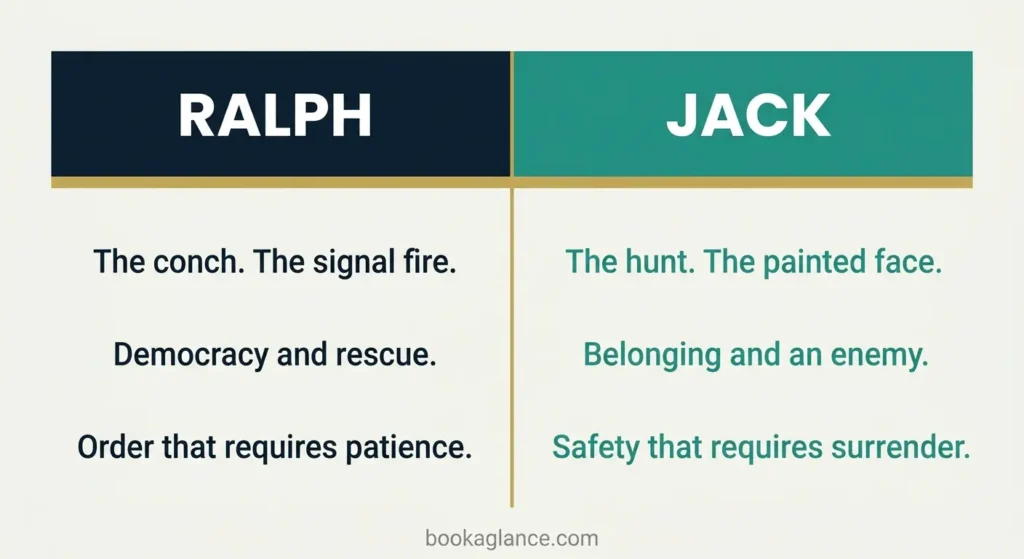
Jack Merridew arrives leading a choir in black cloaks, already accustomed to authority, already forming his identity around the performance of toughness. He wants leadership and doesn’t get it. He gets the hunters instead — a compromise that seems workable at first, and is the novel’s first structural irony, because what Jack’s hunters need in order to function is the willingness to kill, and once you have built that willingness into a group of boys, it does not stay pointed only at pigs.
Simon is the novel’s outlier, and the most theologically loaded character. He is gentle, visionary, prone to solitary retreats in the forest. He is the one who intuits — before anyone else names it — that the beast the boys fear is not a creature on the mountain. It is something already present on the island. It arrived with them. The title itself — Lord of the Flies — is a translation of Beelzebub, the Hebrew name for a demon, and it announces Golding’s theological frame from the cover.
The setting Golding creates does something crucial: it removes every excuse. The boys are not starving. They are not under attack from outside forces. The island provides. What they bring with them — their fear, their need for hierarchy, their appetite for exclusion — is theirs, not the island’s. The paradise is real. The destruction is imported.
This is what makes Lord of the Flies structurally powerful as a novel, regardless of whether its thesis holds. Golding has designed a controlled experiment: strip away every mitigating factor, provide everything needed for survival and cooperation, and see what happens. The question that the novel does not ask is whether Golding designed the experiment to confirm its hypothesis — and whether an experiment designed to confirm its hypothesis proves anything beyond the designer’s convictions.
The boys are all English. All male. All from a culture that has spent centuries telling boys that sensitivity is weakness, that leadership requires dominance, and that the strong do not need protecting. They have also just survived a wartime evacuation. They are children of a society at war. They carry the logic of that world with them onto the island. A different group of boys — different culture, different gender composition, different relationship to authority and violence — might produce a different result. Six Tongan teenagers did.
The Descent: How the Boys Break
The collapse does not happen all at once. It happens the way most social collapses happen — gradually, then suddenly, each small concession making the next one easier.
The first crack appears before the reader might notice it. The boys fail to maintain the signal fire. A ship passes. They miss it because Jack’s hunters chose pig over rescue, and when Ralph confronts him, Jack punches Piggy and breaks one of the lenses of his glasses. It is a minor violence, measured against what comes later. But it establishes the logic that will govern everything that follows: that Jack’s appetite for dominance will be indulged, that the consequences fall on Piggy, and that the group will rationalise it.
Fear accelerates what dominance begins. A dead parachutist lands on the mountain in the night — a casualty from the war being fought above them, invisible and lethal in the adult world — and the boys mistake his rotting, wind-moved body for the beast they have been dreading. Once the beast has a location, Jack can offer protection from it. Ralph can offer rescue; Jack can offer safety. In a community governed by fear, safety is a more immediately compelling product than rescue. Jack moves from rival to necessary.
The tribe Jack builds is a masterclass in what social psychologists call deindividuation — the process by which individual moral identity dissolves into group behaviour, releasing actions that the individual would not perform alone. Jack gives the boys paint. Painted faces are not their faces. A boy who would not throw a stone at Piggy becomes capable of throwing it when the stone is thrown by the tribe. The rituals Jack introduces — the chant, the dance, the frenzied re-enactment of the hunt — are not mere entertainment. They are the mechanism by which boys who arrived on the island with functioning consciences are systematically relieved of them.
Simon understands this before anyone else. His conversation with the Lord of the Flies — the pig’s head impaled on a stake, swarming with the insects its name translates from — is the novel’s theological centre. The beast, the head tells him, is not something external. It is inside the boys themselves. Simon already knew this; the hallucination confirms it. He climbs the mountain, discovers the parachutist, understands that the beast is a dead man, and runs down to tell the others. He arrives at the edge of the firelit circle during the tribal dance.
The boys kill him.
They kill him in a frenzy, in the dark, without individually deciding to do it. Later, in the morning, some of them know what they did. Ralph knows. Piggy almost admits it to himself before pulling back from the knowledge. The dance didn’t start with the intention of killing Simon. The dance started as a performance of shared identity, and Simon ran into it from the wrong direction, and the frenzy had its own logic by then, and he died.
This is Golding’s most precise observation: that the worst things groups do are rarely planned. They are the emergent products of structures that were allowed to develop — the permission to dehumanise, the cultivation of fear, the dissolution of individual accountability into collective action. Roger, who begins the novel by throwing stones that deliberately miss a younger boy, operates on a continuum. By the end he is levering a boulder off a cliff onto Piggy’s head without ceremony or apparent feeling. The distance between those two acts is not a leap. It is a series of small steps, each one enabled by the step before.
When the boulder falls and Piggy dies and the conch shatters into pieces that are not worth picking up, something in the novel’s architecture breaks too. The conch was always a story the boys agreed to tell themselves — an object that meant what they decided it meant, carrying authority only while enough of them consented to that authority. The moment a boy chooses to throw the boulder, the story is over. What remains is Ralph running, and Jack hunting him, and the whole island on fire.
The naval officer who arrives to find Ralph sobbing on the beach is one of the sharpest ironies in postwar British fiction. He looks at the ragged, painted, armed children around him and is embarrassed — not for them, but for the British schoolboy tradition they represent. He has arrived from a warship. He is fighting in a war. The savagery he is mildly scandalised by is a pale domestic version of the savagery that produced him. The boys will be rescued into a world that has been doing, at industrial scale, precisely what Jack did on a small island.
The Real Boys: What Actually Happens
The story might have been lost — as it nearly was — except that Dutch historian Rutger Bregman came across it while researching his book Humankind: A Hopeful History, published in 2020. He tracked down Peter Warner, the Australian sea captain who found the boys, and heard the full account.
Six boys from a boarding school in Tonga, ranging in age from their mid-teens, took a boat without permission for a fishing trip in 1965. A storm blew them off course. After eight days at sea, they washed up on ‘Ata, a rocky uninhabited island south of Tonga that had been deserted for a century. They stayed for fifteen months.
What Warner described was the opposite of Lord of the Flies in almost every particular. The boys had divided into shifts to maintain a fire — not for rescue primarily, but because fire meant warmth and cooked food and a hearth around which a community organises itself. They had built shelters. They had a small garden. They had fashioned a rudimentary gym from pieces of salvage. When one of them broke his leg in a fall, the others splinted it. When arguments grew serious — as they did, because six teenagers on a rock for fifteen months will argue — they had developed a practice of separating until the anger passed and then returning to resolve the disagreement. Nobody was hunted. Nobody was killed. Nobody painted their face.
Bregman found one of the six men the boys had become and asked him what he thought of Lord of the Flies. The man had read it. He thought it was an interesting story. He didn’t recognise it as a description of what boys do.
The question this raises is not simply “was Golding wrong?” He was, by the evidence of ‘Ata, wrong. The more interesting question is: why did the Tongan boys cooperate when Golding’s English boys descended into savagery? And the answer is not that Tongan boys are better than English boys. It is that the conditions were different in ways that mattered.
The Tongan boys were from a culture that did not build male identity around dominance and the suppression of vulnerability. They were close friends before the shipwreck. They had existing relationships of genuine trust and affection — not the contingent alliances of strangers thrown together by a plane crash and an election. They did not have a Jack: a boy whose entire social project was the performance of authority through the control of others. Most importantly, they did not have fear weaponised against them by a figure who needed the fear to maintain his position.
Golding’s island produces savagery because Golding put Jack on it. Jack is not a universal type. He is a specific type — the authoritarian personality, the boy who needs hierarchy like oxygen and builds it wherever he is placed. The Tongan boys did not have one. Or if they had tendencies in that direction, the culture they came from did not reward those tendencies the way British public school culture rewarded Jack’s.
This requires accepting that Lord of the Flies is less a novel about human nature and more a novel about a very particular kind of English masculinity, in a very particular kind of English institution, produced by a very particular kind of English war. Golding thought he was writing about all boys. He was writing about his boys — which is a different, and ultimately more honest, thing.
Golding got the mechanism right. He got the inevitability wrong. Those are different claims — and only one of them is supported by the evidence.
The darkness in Lord of the Flies is real. Golding did not invent the capacity for mob violence or the political utility of fear. He mapped these things with precision. What he got wrong was the inevitability — the claim, built into the novel’s architecture, that this is what humans do when the rules fall away. Sometimes they do. Sometimes six boys in the Pacific sing to each other and tend a fire and wait to go home.
He knew it, somewhere. In a 1995 interview, Golding said: “I am not satisfied with my books. People find them pessimistic. And I am not a pessimist, I am an optimist. And if their optimism — which is obvious to me as the background of my books — is not obvious to everyone, then perhaps I have failed as a writer.” This is not the statement of a man who believed the darkness was inevitable. It is the statement of a man whose books were read as saying things he was not certain he meant.
Lord of the Flies is, in the end, a novel about education. Just not the one the curriculum wants it to be.
Why We Believed It
The Tongan boys’ story was not secret. It was reported at the time, in local newspapers, in the records of the shipping company whose captain found them. The pessimistic story was more useful than the hopeful one, and usefulness has always shaped what gets remembered.
The pessimistic view of human nature is not just a literary thesis. It is a political technology. If humans are fundamentally savage, and civilisation is the only thing standing between order and chaos, then the argument for strong institutions, concentrated authority, and the suppression of individual freedom becomes self-evident. Hobbes made this argument in 1651 — that without a sovereign to enforce order, life would be solitary, poor, nasty, brutish, and short. Lord of the Flies is Hobbes rendered in the language of fiction — absorbed by several generations of students as observed fact rather than philosophical position, and assigned as school reading because the adults who set curricula already believed what it was arguing.
The timing of the novel’s publication matters. 1954 is nine years after Hiroshima. Four years after Korea. The year before the Warsaw Pact. The Cold War is fully assembled and running. A novel that demonstrates, elegantly and devastatingly, that boys left without institutional structures will destroy each other is not merely a literary achievement in that context. It is a confirmation of everything the postwar order needs its citizens to believe.
Golding himself was shaped by this moment in ways he could not entirely separate from his fiction. He watched men do things to each other that the prewar world would have considered impossible. The darkness he described was not invented. It was witnessed. Viktor Frankl, writing about conditions incomparably more extreme than any fictional island, found evidence for the opposite — prisoners who gave away their last bread, guards who smuggled food. His argument was not that the darkness was absent, but that the darkness never had the final word. Golding’s novel, in its architecture, gives the darkness the final word every time.
The pessimistic view also does something psychologically useful: it is pre-emptively self-protective. If you believe people are fundamentally self-interested, you are never surprised when they behave badly. The confirmations are everywhere. The cooperations are invisible because they do not fit the thesis. 1984 works the same mechanism in a different register: once you have seen the Thought Police, you see surveillance everywhere. Once you have read Lord of the Flies and accepted its premise, you see Jack in every political landscape — and Jack is not hard to find.
The Netflix adaptation released in 2026 has reopened a debate the school curriculum has been quietly avoiding since 1954: whether the novel’s vision is a warning or a self-fulfilling prophecy, whether showing children the darkness of human nature teaches them to resist it or to expect it. That debate does not have a settled answer. But the fact that the question has not been asked more urgently, for seventy years, is itself a kind of answer about what the culture preferred to believe.
There is also the question of what the novel does to the boys it describes. Golding’s characters are shaped by the specific culture of the British public school — a system designed to produce leaders by teaching boys that vulnerability was weakness, that hierarchy was natural, and that the strong deserved their position. Lord of the Flies is not merely a critique of these boys. It is, in a way, their logical extension. Jack is what the public school system was producing, dressed in a choir robe and given an island.
Golding did not want to write a pessimistic novel. He said so. He wanted to show the darkness so that the reader, confronted with it clearly, might choose differently. The problem is that “choose differently” requires believing the choice is possible — and the novel, in its execution, makes it very hard to believe that. Ralph tries. Piggy tries. Simon understands. All three are defeated or destroyed.
The six Tongan boys had something Golding’s boys did not: prior knowledge of each other. They were friends. They arrived on the island with a relational history, with obligations to each other that preceded the crisis. Cooperation is not the absence of individual self-interest. It is a practice that requires cultivation — relationships built before the crisis, norms maintained through the crisis, trust accrued over time. Golding’s boys don’t cooperate because they were never taught to. The island reveals what their formation had already produced.
Frequently Asked Questions
What is the main theme of Lord of the Flies?
The novel’s central theme is the conflict between civilisation and what Golding sees as innate human savagery — specifically, his argument that without institutional structures, humans will default to violence and tribalism. The post examines this thesis honestly, including the real-life counter-evidence of six Tongan boys who were shipwrecked in 1965 and cooperated successfully for fifteen months, suggesting Golding’s thesis is not universal but contingent on specific conditions.
What does the conch shell symbolize in Lord of the Flies?
The conch shell represents democratic authority and the rule of law — whoever holds it has the right to speak, making it a portable parliament. Crucially, it only functions while enough boys agree to respect it, which makes it a symbol of consensus-based order rather than power enforced by strength. When it shatters, democratic procedure ends. What replaces it — Jack’s tribe, organised around fear and shared performance — needs no such agreement, only compliance.
What does the Lord of the Flies pig’s head symbolize?
The pig’s head impaled on a stake — swarming with flies, speaking to Simon in his hallucination — represents the beast the boys have been fearing, now given a location and a voice. The title Lord of the Flies is a translation of Beelzebub, signalling Golding’s theological frame. The head tells Simon that the beast is not external but internal — something the boys brought with them. Simon already understood this. His attempt to share that understanding with the others ends in his death.
Is Lord of the Flies based on a true story?
No — but there is a real story with striking parallels. In 1965, six Tongan schoolboys were shipwrecked on an uninhabited Pacific island for fifteen months. Unlike Golding’s boys, they cooperated throughout, built shelters and a garden, set a broken leg, and maintained a fire. They were rescued alive. Rutger Bregman documented this in Humankind (2020). The real story does not make Golding’s novel pointless — but it does challenge the novel’s claim that the descent into savagery was inevitable.
Why is Lord of the Flies still taught in schools?
Partly tradition, partly genuine literary merit — the novel maps the mechanics of mob formation, authoritarian capture, and the dissolution of individual conscience into group action with real precision. What it teaches depends on how it is taught. Read as a warning about specific conditions that enable atrocity, it is valuable. Read as a universal verdict on human nature, it installs a pessimism about our species that the evidence does not support — and that has been politically useful to those who benefit from pessimism.
What the Novel Gets Right
It would be convenient to dismiss Lord of the Flies entirely. The Tongan boys cooperated, the thesis is wrong, close the book. But that is not what the evidence supports, and it would be a less honest reckoning than the one Golding himself attempted.
The novel gets several things exactly right. It gets them right with a precision that no amount of counter-evidence about the Tongan boys can dislodge — because what it maps correctly is not human nature in the universal sense but something more specific and more portable: the conditions under which decent people become capable of atrocity.
Roger’s arc is the clearest illustration. He does not arrive on the island willing to kill. He arrives with a conditioning so deep it is unconscious — his arm held back from throwing the stones that would strike Henry by the entire accumulated weight of social norms. The taboo holds. Then, gradually, it doesn’t. Each small release enables the next. By the time the boulder rolls, Roger has not made a single dramatic decision to become a killer. He has made a hundred small decisions to let the old taboo erode a little further, and then one day there is nothing left.
This is not a fiction. The Milgram obedience studies, Philip Zimbardo’s influential — if now contested — research into situational evil, and subsequent decades of social psychology document the same dynamic Golding describes: that the distance between ordinary person and perpetrator is shorter than the ordinary person believes, and that the journey between them is made up of incremental steps rather than a single crossing of a clear moral line. Golding got here through imagination and war-witnessed horror. The researchers got here through methodical study. They arrived at the same place.
What he also gets right is the mechanism of authoritarian capture — the specific sequence by which Jack converts a democratic assembly into a tribe. It is not violence that does it first. It is the offer of belonging. Jack’s hunters have a function, a shared identity, a ritual, a uniform of painted faces, an enemy. Ralph’s democracy has a conch and a set of rules that require the patience to sit in meetings. In conditions of fear, Jack is winning before he throws a punch. He is winning the moment he gives the boys something to be together rather than something to do separately. The conch is an abstraction. The hunt is an experience. Most people, under pressure, will choose the experience.
This pattern — the authoritarian who builds identity through shared performance and shared enemy, the democrat who asks for procedural patience — has not become less recognisable since 1954. Jack’s tactics require no island. They function on any platform where fear can be amplified, identity can be weaponised, and the hunt can be directed. The conch shatters in different ways now, but it shatters.
Where Golding went wrong was in the ending he chose for each of these dynamics. He wrote them as inevitable. The honest version of the novel would acknowledge that what happens to the boys is not inevitable but contingent — produced by specific people in specific conditions, demonstrating specific dangers that are real and worth mapping, without claiming those dangers are the whole of what humans are. To Kill a Mockingbird makes the same argument about a different kind of darkness: that ordinary people are capable of atrocity, that the conditions enabling it are precise, and that naming those conditions is more useful than declaring the darkness inevitable.
Read Lord of the Flies. Read it with the Tongan boys in mind — not as a refutation that makes the novel pointless, but as a context that makes it honest. The novel is correct about Roger and his stones. It is correct about Jack and his paint and his manufactured fear. It is correct that the conch can break, that democratic procedures can be dismantled by the simple offer of belonging and an enemy. These things happen. They are happening, in various forms, in most of the political landscapes a reader in 2026 is living inside.
What it is not correct about is the word “inevitably.” That word does all the work of making Golding’s specific diagnosis feel like a universal law. Remove it, and what remains is a precise and important map of how a particular kind of social collapse unfolds under particular conditions. That map is still worth having. It is still worth teaching.
Just not as the final word on what happens when the adults leave the room.
The Tongan boys kept the fire going for fifteen months. When the rescue boat appeared, they did not fight over who got on first. They sang. This is also data. It is also what humans do.