

Farming was the worst decision our species ever made. Harari doesn’t soften this. The Agricultural Revolution — the moment we figured out how to grow our own food — gave us civilisation, yes. It also gave us back pain, malnutrition, eighteen-hour days, and a social hierarchy that wouldn’t exist for another few thousand years. By the time you finish Sapiens, you will understand exactly how we got here, and you will not be entirely sure whether “here” is somewhere worth having arrived.
Yuval Noah Harari published Sapiens in Hebrew in 2011. The English translation came out in 2014, and within a few years it had become the rare history book that people pressed into strangers’ hands and said: you need to read this.
The reason is not that Harari is the most rigorous historian writing today. He is not, and we will get to that. The reason is that he found a way to hold 70,000 years of human behaviour in one hand and ask a question simple enough to stop you mid-sentence: what kind of animal are we, actually?
His answer is both flattering and deeply unsettling. We are, above all, the animal that believes in things that do not exist. Stories. Nations. Money. Human rights. Gods. And that capacity — that strange evolutionary quirk that allowed a group of hairless primates to cooperate in the millions — is the entire engine of everything we call civilisation.
Sapiens is a book about where that engine came from, what it has built, and what it might do next. It also tells you where Harari’s confidence outruns his evidence — which he does, and regularly. The book earns both kinds of attention.
Before We Were Anything: The Cognitive Revolution
For most of human history, we were not particularly impressive.
Homo sapiens appeared in East Africa roughly 300,000 years ago. For the next couple of hundred thousand years, we were middling — a medium-sized predator, foraging in small bands, occasionally being eaten by larger things. At least six human species, by Harari’s account, shared the planet simultaneously: Neanderthals in Europe, Homo erectus in Asia, Homo floresiensis — who barely reached a metre in height — on the Indonesian island of Flores. We were not even the strongest or the most widespread. By most ecological measures, we were not the obvious candidate for planetary dominance.
Then, around 70,000 years ago, something shifted.
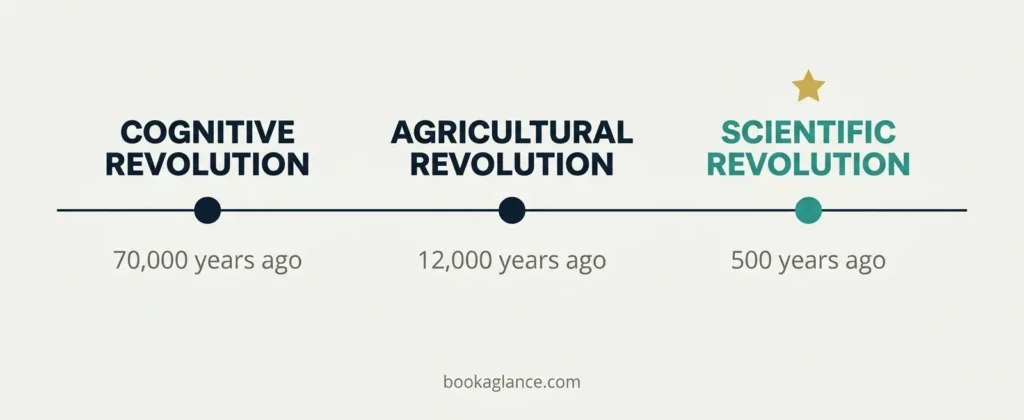
Harari calls it the Cognitive Revolution. His argument is that Homo sapiens developed a new kind of language — not just a system for communicating physical facts (“there is a lion by the river”) but a system for communicating fictions (“the river spirit demands that we hunt only on Tuesdays”). This distinction sounds almost trivial. It is not. The ability to talk about things that don’t exist — to share a belief in something invisible and agree to organise behaviour around it — is, Harari argues, the single most important fact about our species.
Here is why. Every social animal has a coordination limit. Chimpanzees live in troops of up to about 50. Beyond that, the group can’t maintain social cohesion — there are too many relationships to manage, too many grievances to track, too many hierarchies to hold together through individual relationships. The limit is biology.
Homo sapiens blew past this limit. We built cities of millions, empires of hundreds of millions, global institutions of billions. We did it not through biology but through shared belief. A hundred strangers who have never met can cooperate instantly if they share a common story — a nation, a corporation, a religion, a currency. Chimpanzees cannot do this. A chimpanzee cannot be persuaded to hand over a banana today in exchange for a promise of two bananas next week. The concept of “promise” doesn’t exist for it. For us, it is the foundation of every economy that has ever existed.
The shared fictions thesis
Large-scale human cooperation runs not on logic or individual self-interest but on shared stories — imagined realities that exist nowhere except in the minds of the people who believe them. Money. Nations. Human rights. Corporations. None of these exist in physical reality. All of them are more powerful than anything that does.
This is the thesis that makes Sapiens worth reading even if you disagree with everything else in it. The argument that large-scale human cooperation runs not on logic or individual self-interest but on shared stories — imagined realities that exist nowhere except in the minds of the people who believe them — is not a cynical argument. It is actually an astonishing one. Money is not valuable because it is gold. It is valuable because enough people agree it is valuable, and that agreement is a story with no physical grounding whatsoever. The same is true of a limited liability company, a human right, a national border, and a credit score.
You’ve been navigating an architecture of shared fictions your entire life. Harari just turned the lights on.
This also explains something that standard history struggles with: how Homo sapiens managed to out-compete every other human species on the planet. The Neanderthals were not weaker than us — their bones show more muscle mass, and their brains were roughly the same size. What they apparently lacked was the capacity for Harari’s kind of flexible, fictional communication. A band of Sapiens who shared a belief in a common ancestor, a tribal god, or even a trade agreement could coordinate in ways a band of Neanderthals couldn’t match. Whether we outcompeted them or interbred with them (the evidence suggests some of both, varying by geography) matters less than what the pattern reveals: the species that could tell the best stories won.
If that sounds slightly uncomfortable — as though our deepest advantage over every other intelligent species on earth was an enhanced capacity for collective self-deception — then you are reading Harari correctly. The question then becomes: what did we do with that advantage?
The Trap We Built: The Agricultural Revolution
The way the Agricultural Revolution is usually taught, it sounds like a promotion. Humans graduate from foraging to farming, from wandering to settlement, from subsistence to surplus. This is the trajectory of progress. It is also, by most of the measures that actually affect a human life, precisely backwards.
Around 12,000 years ago, somewhere in the fertile crescent of what is now the Middle East, humans began to stay in one place and grow food rather than follow it. The Agricultural Revolution is usually taught as a triumph. And measured in certain ways — population size, caloric output, the eventual creation of cities and writing and medicine — it was. In the 10,000 years since farming began, the human population grew from roughly a few million to nearly 8 billion. Agriculture fed that expansion. Without it, none of what we call civilisation exists.
Harari’s argument is that this framing gets things precisely backwards.
He is not the first person to notice that early farmers had worse diets than the foragers who preceded them. Archaeological evidence from skeletal remains is fairly clear on this: the transition to agriculture brought shorter stature, more tooth decay, more nutritional deficiencies, and a pronounced increase in infectious disease — the inevitable consequence of living in close proximity to livestock and to each other’s waste. The forager who spent four hours a day gathering a wide variety of food was, by most biological measures, healthier than the peasant farmer who spent twelve hours bent over a single crop that might fail.
But Harari goes further than noting the health statistics. His argument is structural.
Evolution, he reminds us, does not care about the wellbeing of individuals. It cares only about the propagation of DNA. Wheat — which was one of the first and most successful cultivated crops — spread from a small patch of wild grass in the Middle East to cover vast stretches of the globe. From wheat’s perspective (Harari is aware this is a provocative framing), the Agricultural Revolution was an extraordinary success. The plant reproduced at a scale utterly impossible in the wild. It achieved this by making itself useful enough to humans that humans did its propagation for it — clearing forests, irrigating fields, defending crops from pests and rival communities. Wheat didn’t domesticate us. But it did restructure our entire way of life in its service.
The deeper trap is not physical. It is social.
Farming requires staying in one place. Staying in one place allows you to accumulate property. Accumulated property requires protection. Protection requires armies. Armies require hierarchy. Hierarchy produces elites. Elites produce ideologies that justify the hierarchy. Within a few thousand years of the first planted field, the world had stratified into rulers and subjects, owners and workers, the taxed and the taxers — a structure that most farming civilisations, across every continent, reproduced with striking consistency.
The peasant farmer working land he would never own, producing surplus he would never eat, paying tithes to a lord who had never farmed a day in his life — this is not an aberration of the agricultural system. It is, Harari argues, a near-inevitable product of it. The trap was baked into the decision to stay. And by the time anyone noticed the trap, there were too many mouths dependent on the system to dismantle it. There was no going back.

The bite of this argument lands hardest when you hold it against contemporary life. The knowledge worker who works longer hours every year, produces more measurable output than any generation before them, and nonetheless feels further from financial security than their parents did is living a version of this structural dynamic. The surplus moves upward. The individual rationalises it because the alternative — leaving the system entirely — is not really an alternative at all. The wheat fields are gone. The mortgage, the career track, and the cost of a city apartment have replaced them. The structure is identical. If you want to change your relationship to the system at the individual level, Atomic Habits offers the tools — but Harari is explaining the system those habits exist inside.
Harari does not offer a solution to this. That is not the book he is writing. But he does offer something arguably more useful: a name for a trap that most people are experiencing without a framework to understand it.
The Stories That Run the World
A village of 150 people can run on gossip, reputation, and personal relationship. A city of 50,000 cannot.
Everyone in the village knows who owes what to whom. Social trust operates face to face. But a city of 50,000 — let alone an empire of 10 million — cannot function on personal acquaintance. Most of the people in it have never met each other and never will. For them to cooperate, to trade, to pay taxes, to follow laws, to serve in armies, they need something more than individual trust. They need a shared belief system large enough to encompass strangers.
Harari calls these systems imagined orders. His term for these is intersubjective realities — things that exist because enough minds agree they do. He identifies three that have proven powerful enough to unify millions of people who have nothing else in common: money, empires, and universal religions. His point is not that these things are fraudulent or bad. His point is that they are all, at their foundation, stories — and that this is precisely what makes them so powerful.
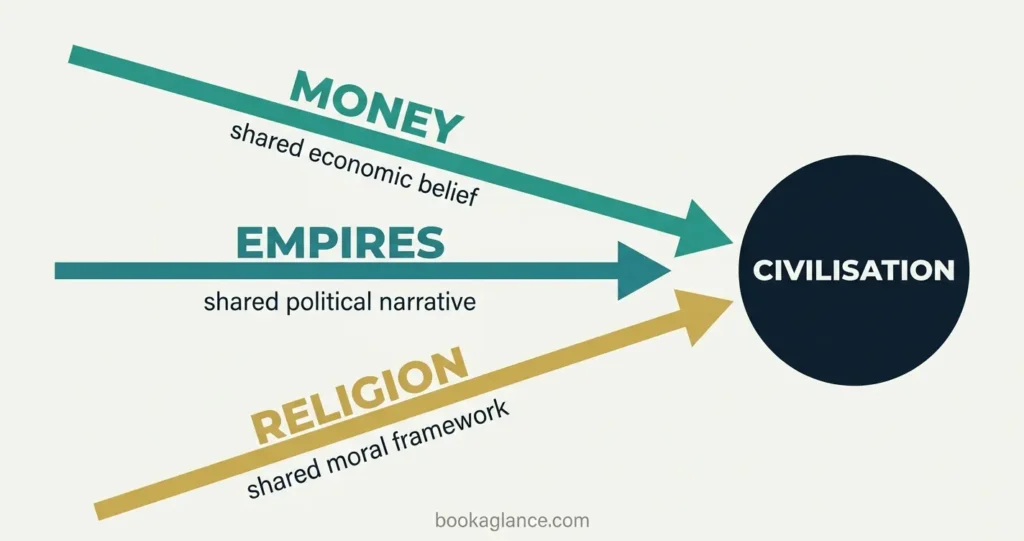
Money is the most universal of the three. Every functioning economy in human history has depended on a medium of exchange — shells, gold, coins, paper, digital entries in a ledger — that has no intrinsic value beyond what its users collectively agree it has. A Roman gold coin did not feed you because gold was nutritious. It fed you because everyone in the Roman world agreed to treat gold as a store of value, which meant a farmer would accept it for his grain, which meant a soldier would accept it as wages, which meant the empire could fund armies without physically transporting grain across thousands of miles. The coin was useful because the story held.
This still works. The number in your bank account is not a physical object. It is an entry in a database that multiple institutions agree to treat as real. The moment enough people stop believing in that agreement — as happens, briefly and catastrophically, during bank runs — the number becomes meaningless. Money is always and only a collective fiction that functions as long as the collective maintains it.
Empires operated on a similar principle, though the story was different. The specific content of the justification varied. Rome claimed it was spreading civilisation. Imperial China operated under the Mandate of Heaven. Britain built an entire pseudo-science to make racial hierarchy feel like natural law. Different stories. The same function: a narrative that made subjugation feel either natural or beneficial to enough of the people being subjugated that the empire could maintain itself without constantly suppressing revolt. The violence was always there if needed. The story meant it usually wasn’t.
Universal religions — Harari focuses on Buddhism, Christianity, and Islam as the most globally successful — solved the same coordination problem from a different angle. Where money unified people through shared economic interest and empires through shared political narrative, religion offered a shared moral framework that transcended both ethnicity and geography. Any human, anywhere, who accepted the faith was part of the community. That universality was genuinely revolutionary: it meant a Christian merchant from Lyon and a Christian merchant from Constantinople could do business on the basis of shared ethical commitments that neither could verify except through the story they both believed.
The word “fiction” here does not mean unimportant. Imagined orders are the most consequential things in human history precisely because they are imagined — because they can be redesigned, expanded, or replaced in ways that physical reality cannot. You cannot renegotiate gravity. You can renegotiate what money means, which is what every currency reform in history has done. The flexibility of the story is its power.
He is also honest about the asymmetry. Imagined orders, once established, protect themselves. The social hierarchy produced by the Agricultural Revolution was not maintained by constant brute force — it was maintained by ensuring that people born into the lower tiers of the hierarchy believed in the same story as the people born into the upper tiers. The peasant who prayed to the same God as the king, who believed that the social order was divinely ordained, who understood his suffering as spiritually meaningful — that peasant was participating in the maintenance of his own subjugation. Not out of stupidity. Because the story was all he had.
If you want to understand why deeply unfair systems persist for centuries without revolution, Harari has your answer. It is not because the people inside them lack the intelligence to notice the unfairness. It is because the imagined order provides them with a framework — a religion, a nationalism, an economic ideology — that makes the unfairness interpretable, bearable, or simply invisible. This is not a historical observation. It is a live description of how power maintains itself right now.
The Scientific Revolution and the Deal We Made
Five hundred years ago, European sailors set out into open ocean without knowing what was on the other side. This was not courage in the heroic sense. It was something stranger: a collective decision by an entire civilisation to admit it didn’t know things — and to treat that ignorance as a problem worth solving at enormous expense and risk.
Harari marks the Scientific Revolution as beginning around 1500, not because science suddenly appeared (humans had been making careful observations about the natural world for millennia) but because something specific changed in how European societies related to knowledge. Earlier civilisations — including highly sophisticated ones — largely assumed that the important truths were already known, preserved in sacred texts or ancient authorities. The task of the scholar was not discovery but transmission: to understand what had been passed down, to interpret it correctly, to apply it faithfully. Progress meant recovering lost wisdom. It did not mean generating new wisdom that superseded the old.
The shift that produced the Scientific Revolution was a shift in epistemic humility. The admission, institutional rather than merely personal, that we do not know — and that systematic investigation of the unknown is therefore the highest intellectual project. That sounds obvious from where we stand. It was genuinely radical. Admitting ignorance is an act that requires overthrowing the authority of everyone who claimed to know.
What happened next is the part the textbooks underemphasise. The Scientific Revolution did not proceed through pure curiosity. It proceeded through an alliance — between knowledge, capital, and imperial power — that is the real engine of the modern world.
The logic ran like this: invest in discovery, and discovery produces technology, and technology produces military and economic advantage, and advantage produces wealth, and wealth funds more discovery. Columbus’s voyage to the Americas was not financed by a philosopher. It was financed by the Spanish Crown, which understood, correctly, that geographical knowledge was a form of power. The British Empire funded astronomical research and cartographic expeditions not out of abstract interest in science but because navigational accuracy was strategically essential. The pharmaceutical industry funds medical research not because corporations love human health but because cures are commercially valuable. The chain between curiosity and capital has never been broken. Harari’s point is that this was true from the beginning.
The third member of the alliance is capitalism — specifically, the concept of credit. The modern economy runs on the belief that the future will be worth more than the present. A bank lends money that doesn’t yet exist, trusting that the investment will generate returns that make repayment possible. A company issues shares against projected future profits. A government borrows against future tax revenue. This entire architecture depends on a shared story about growth — that tomorrow, there will be more. For most of human history, this was not a safe assumption. Economies were largely static: what existed this year was roughly what would exist next year. The Scientific Revolution broke that assumption, because suddenly there were genuinely new things to invest in — new trade routes, new crops, new technologies — and the returns on those investments were real enough to make the credit story plausible.
Empire did the rest. The wealth extracted from colonies — in raw materials, in enslaved labour, in captive markets — didn’t just make European powers rich. It funded the research institutions, the universities, and the industrial infrastructure that produced the next wave of technological advantage. The Industrial Revolution was not a spontaneous eruption of British ingenuity. It was, in significant part, the return on two centuries of colonial extraction. Harari names this without flinching, which is one of the places where his instinct for honest reckoning serves the book well.
The deal the Scientific Revolution struck was this: we will give you knowledge that transforms the material conditions of human life. In exchange, you will let capital, empire, and the logic of growth direct where that knowledge goes and what it builds. We are still living inside this deal. The AI systems currently reshaping labour markets were not built in university philosophy departments contemplating the good life. They were built in corporate research labs, funded by venture capital, and deployed according to growth projections. The logic has not changed. Only the technology has. For the fictional version of where this trajectory leads, Brave New World remains the most unsettling extrapolation anyone has written.
What Sapiens Gets Wrong (and Why It Still Matters)
Harari is a better storyteller than he is a scholar, and anyone who reads Sapiens as a work of rigorous academic history is going to run into trouble.
The criticisms from professional historians are real and worth naming. Harari writes with a confidence that the evidence frequently doesn’t support. His account of forager life — the idea that pre-agricultural humans worked fewer hours, enjoyed more varied nutrition, and lived more psychologically satisfying lives than their farming descendants — is plausible and has some archaeological support, but it is far more contested than he presents it. The skeletal evidence tells us something about nutrition and disease patterns. It tells us very little about subjective wellbeing, social conflict, or the psychological texture of lives lived 40,000 years ago. Harari extrapolates from limited evidence into sweeping conclusions with a fluency that reads as authority but functions as speculation.
His treatment of religion draws the sharpest criticism, and not only from believers. The secular framework he applies throughout the book consistently positions religion as a coordination mechanism — useful, sometimes coercive, ultimately a story in service of social control. This is a legitimate analytical lens. It is not the only legitimate analytical lens, and the book doesn’t always acknowledge that. The experience of genuine faith — the phenomenology of prayer, the structure of moral communities, the way religious practice shapes perception and motivation over a lifetime — doesn’t fit neatly into Harari’s functional account. He is aware of this, occasionally, but not consistently enough to satisfy anyone who thinks the reduction is too aggressive.
The happiness argument is perhaps the most intellectually vulnerable section of the book. Harari raises the question of whether all this progress has actually made humans happier — and concludes, somewhat dramatically, that we probably aren’t happier than our forager ancestors, possibly less so. The evidence he marshals for this is thin, and the concept of happiness he uses is undertheorised. He is asking an important question. His answer is more impressionistic than he lets on.
What he is genuinely, undeniably good at is synthesis. The ability to stand above 70,000 years of human behaviour and trace the structural patterns — to see that the same dynamic that produced Sumerian grain surpluses also produced the subprime mortgage crisis, that the mechanism behind Roman imperial expansion is still running in the foreign policy of contemporary great powers — is a rare intellectual gift. Not many people can hold that much material in view simultaneously and draw connections that are both surprising and persuasive.
He is also good on the emotional register of history. The chapter on the Agricultural Revolution manages to make you feel the weight of the trap in a way that statistics alone never could. The section on the slave trade is precise and unsparing without being moralistic. The account of the modern economy’s dependence on an endlessly deferred future is one of the clearest short explanations of capitalism’s psychological logic that exists in popular non-fiction.
The right relationship to Sapiens is not uncritical acceptance and not dismissive scepticism. It is the relationship you might have with a brilliant friend who reads everything, synthesises fearlessly, occasionally overreaches, and nonetheless leaves you thinking about the conversation for weeks. You don’t believe everything they say. You’re glad they said it. You go and check the things that seemed too confident, and sometimes you find they were right, and sometimes you find the reality is more complicated — but either way, you now know something you didn’t before.
That’s a different standard than academic rigour. Not a lower one. Harari is writing the kind of book that changes what questions you ask — and that is a different, and arguably harder, thing than writing the kind that settles them.
Frequently Asked Questions
What is the main argument of Sapiens?
Harari’s central argument is that Homo sapiens became the dominant species not through physical strength but through a unique ability to believe in shared fictions — money, nations, religions, and laws that exist only because enough people agree they do. These imagined orders allow millions of strangers to cooperate, which no other species can do at scale.
What are the three revolutions Harari describes in Sapiens?
Harari identifies three turning points: the Cognitive Revolution (around 70,000 years ago), when humans developed the capacity for abstract language and shared beliefs; the Agricultural Revolution (around 12,000 years ago), when humans began farming and formed permanent settlements; and the Scientific Revolution (around 500 years ago), which unleashed the alliance of knowledge, capital, and empire that built the modern world.
What does Harari mean by imagined orders?
Imagined orders are systems of belief that exist only because enough people collectively agree they do — money, human rights, national borders, corporations. They have no physical reality but enormous practical power. Harari’s point is not that they are fake or worthless, but that their power depends entirely on continued collective belief.
What does Sapiens say about the Agricultural Revolution?
Harari calls the Agricultural Revolution a trap. While it increased total caloric output and allowed populations to grow, it made individual lives harder — more labour, worse nutrition, more disease, and the creation of social hierarchies that concentrated surplus at the top. His provocative claim: we didn’t domesticate wheat, wheat domesticated us.
Is Sapiens worth reading?
Yes — with appropriate scepticism. Harari’s synthesis of 70,000 years of human history is genuinely illuminating, and his shared-fictions thesis reframes how you see modern institutions. He overreaches in places, writes with more confidence than the evidence supports, and his treatment of religion is reductive. Read it as a brilliant, occasionally overconfident big-picture argument — not as settled history.
The Most Dangerous Idea in the Book
Most readers finish Sapiens thinking the shared-fictions thesis is Harari’s most unsettling argument. It isn’t.
The thesis that money, nations, and human rights are imagined orders is provocative the first time you hear it — but it settles quickly into something almost comfortable. You can absorb it, file it under “interesting perspective,” and continue using your credit card. Knowing that money is a collective fiction doesn’t dissolve it. The story is stable enough that the revelation doesn’t destabilise it. Billions of people know, in some abstract sense, that currency has no intrinsic value — and the economy continues regardless, because belief doesn’t require innocence to function.
What Harari saves for the end of the book is harder to accommodate.
Having traced the entire arc from the Cognitive Revolution to the present, he arrives at a question that the preceding 400 pages have been building toward without quite naming: what do we actually want? Not what evolution selected for. Not what capitalism incentivises. Not what any religion commands or any nation requires. What does Homo sapiens — the animal that can imagine things that don’t exist, that can redesign its own societies and now its own biology — actually want for itself?
His answer is that we don’t know. And more troublingly, he suggests we have never seriously tried to find out. The entire history of our species, as he has just described it, is a history of systems — biological, agricultural, economic, imperial — that pursued their own logics with very little reference to human flourishing as a conscious goal. Evolution optimised for reproduction, not happiness. Agriculture optimised for caloric surplus, not individual wellbeing. Capitalism optimises for growth, not meaning. Each system produced real gains in certain dimensions while remaining indifferent to dimensions that most people would say matter more.
And now, Harari notes, we are approaching a moment where the question can no longer be deferred. Biotechnology and artificial intelligence are placing in human hands the ability to redesign not just our societies but our bodies, our minds, and potentially our successors as a species. For the first time in 70,000 years, the constraints are loosening. We could, within a century, become something genuinely different from what we are. The question of what we want to become — which civilisations have always been able to ignore because the answer seemed predetermined by biology and circumstance — is about to become unavoidable.
Harari is not optimistic that we are prepared for it. A species that spent its entire history running on shared fictions, that has never achieved consensus on what a good human life looks like, that cannot currently agree on how to distribute the surplus it already generates — this species is about to acquire godlike technological capabilities. He finds this alarming. So do most honest readers who follow the argument to its conclusion.
This is the idea that stays. Not the agricultural trap, not the monetary fiction, not the evolution of religion — but the final, quietly devastating observation that we have arrived at the most consequential decision point in the history of our species without anything resembling a serious conversation about what we actually value.
The Cognitive Revolution gave us the ability to imagine things that don’t exist. The question Sapiens ends on is whether we can imagine, and then build, a version of human life that we would genuinely choose — rather than one we simply inherited. Viktor Frankl spent three years in concentration camps thinking about this question from the bottom up, and Man’s Search for Meaning is where that answer lives at the individual level. Japanese philosophy has a quieter version of the same question — Ikigai names it as the reason to get up in the morning. And Matt Haig’s The Midnight Library is the fictional version of it: a whole novel about what it would mean to choose your life rather than inherit it.
Most readers, Harari observes, are more comfortable knowing the history than confronting the question. The history is already over. The question is not.
Read the book. Argue with it where it overreaches. Check the claims that feel too confident. But follow it all the way to the end, and take the last question seriously — because unlike the forager debate and the happiness statistics, that question does not have a contested answer in the academic literature. It is simply open. And it is addressed, with unusual directness, to you.